Author Archive

Persisting database objects: technical

In this decision, one board of appeal confirmed that concepts for persisting database objects are technical. Here are the practical takeaways of the decision T 0731/17 (Object persistence/MICROSOFT TECHNOLOGY LICENSING) of 15.1.2020 of Technical Board of Appeal 3.5.07:

Key takeaways

Decision T 1954/08 cannot be taken to mean that any effect resulting from the implementation of a non-technical feature or combination of features is non-technical.

The concept of accessing information contained in a database store via a database server is technical functionality.

The invention

This European patent application relates to persisting objects in a data store. The background section explains that Microsoft SQL SERVER, which integrates the Microsoft Windows .NET Framework Common Language Runtime (CLR), allows creating a “user defined type” (UDT) class, instances of which can then be persisted in the database store.

UDTs extend the scalar type system of the database and can be used in the same contexts as a system type, such as in column definitions, variables, parameters, function results, cursors, triggers, and replication. The class that defines a UDT can include methods that implement specific behaviours on objects of that type.

An object of a UDT class is persisted in the database store by a process known as “object serialisation”, which transfers the values of the variables of the class to the database store’s physical storage.

When a database query which references a behaviour of a persisted UDT object is executed, the object has to be deserialised, memory for the full object has to be allocated in the CLR to receive the object’s stored values, and the method implementing the behaviour has to be invoked on the full object.

The invention aims to reduce the processing overhead associated with allocating memory for storing the full object at runtime, deserialising and populating all parts of the object, essentially by providing metadata that allows “direct structural access” to the field values in the serialised representation of the persisted object.


Fig. 6 of EP 1 593 059

Here is how the invention is defined in claim 1:

  • Claim 1 (sole request)

Is it technical?

In the first instance decision, the examining division had argued that the only technical features of then claim 1 were “system”, “database store”, “server” and “persisted values” and that all other claim features, when taken in isolation, were non-technical because they were directed to a “non-technical rationale for providing ‘more efficient storage and retrieval of objects persisted in a database store'”.

The examining division then cited decision T 1954/08, arguiing that the non-technical features did not interact with the technical features to make a technical contribution because “effects stemming from the algorithmi[c] definition of a method do not define a technical character of the corresponding features”. Consequently, claim 1 was found to lack an inventive step over a “notoriously known distributed computing environment comprising general purpose computers and a network”.

The board, however, held that this reasoning is flawed:

According to decision T 1954/08 of 6 March 2013, reasons 6.2, “the sole processing speed” of a computer-implemented algorithm and “the sole amount of memory” it requires are not suitable criteria for determining whether a method step contributes to the solution of a technical problem.

However, these statements in decision T 1954/08 cannot be taken to mean that any effect resulting from the implementation of a non-technical feature or combination of features is non-technical. If non-technical features could never contribute to a technical effect just because they are non-technical, there would be no need to analyse whether non-technical features interact with the technical subject-matter of the claim to solve a technical problem or bring about a technical effect, which would be contrary to opinion G 1/04 (OJ EPO 2006, 334), reasons 5.3, and decision T 154/04 (OJ EPO 2008, 46), reasons 5, under (F), and 13 to 15.

The board also found that the inventive-step reasoning itself as provided by the examining division was not convincing:

In the present case, any attempt to properly formulate a problem that potentially would have led the skilled person from a network of general-purpose computers to the subject-matter claimed should have confronted the Examining Division with the fact that the claim, not analysed as a collection of disconnected terms but as a whole, contains various technical concepts.

For example, the claimed method involves the concept of accessing information contained in a database store via a database server. Such technical functionality is not disclosed by a network of general-purpose computers. The Board is aware that database management systems were well known at the priority date of the application (see document D1, column 1, lines 27 to 30), but that does not mean that an inventive-step reasoning can silently ignore the concept.

6.5 The separate section of the decision discussing documents D1 and D2 contains no detailed analysis. If the Examining Division was of the view that document D1, in column 3, lines 56 to 62, discloses direct access to object attributes “without de-serialization” because the cited passage does not positively state that serialisation takes place, the Board observes that no disclosure of serialisation is not a disclosure of no serialisation.

Since inventive step over documents D1 to D4 had not yet been assessed in detail, and since doing so by the board itself would have effectively replaced the examining division rather than reviewed the contested decision in a judicial manner, the board decided to remit the case back to the examining division for further prosecution.

More information

You can read the whole decision here: T 0731/17 (Object persistence/MICROSOFT TECHNOLOGY LICENSING) of 15.1.2020

Stay in the loop

Never miss a beat by subscribing to the email newsletter. Please see our Privacy Policy.

Privacy policy
* = Required field

Animating a graphics icon by superimposing an image sequence on a static background: non-technical

The European Patent Office refused to grant a patent on a GUI design of a household appliance such as a baking oven. Here are the practical takeaways of the decision T 1818/14 (User interface for appliance/ELECTROLUX) of 2.12.2019 of Technical Board of Appeal 3.5.03:

Key takeaways

The manner of presentation of information, i.e. how it is displayed, may relate to solving a technical problem and thus be able to contribute to inventive step if the way the information is displayed credibly assists the user in performing a technical task.

The invention

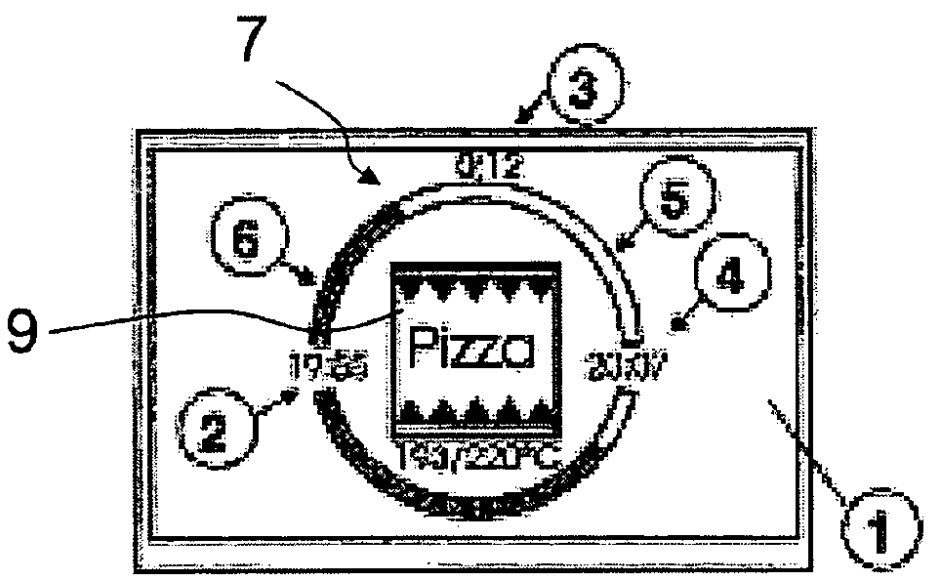
This European patent application concerns a user interface for an appliance such as a baking oven. Essentially, as defined in claim 1, the user interface has a controller for controlling a display panel which has first and second display panel sections. The first display panel section displays at least one of a time course and chart of linear, arrowed or curved geometry of at least one operation parameter, and the second display panel displays an operational mode of the appliance, the operational mode being represented by an animated graphics icon, the animated graphics icon being a superposition of at least one pictogram and an image sequence of several images.

Fig. 8 of EP 2 439 603

Here is how the invention is defined in claim 1:

  • Claim 1 (main request)

Is it technical?

The board based its inventive step reasoning on a prior art document which discloses a baking oven with a user interface. Implicitly, the user interface was controlled by a controller. There were also first and second display panel sections.

According to the board, claim 1 differed from this disclosure in that the animated graphics icon consists of a superposition of at least one pictogram and an image sequence of several images. Here is what the board said regarding the technical character of this difference:

In accordance with case law (cf. e.g. T 1185/13, point 4.1 of the reasons), the manner of presentation of information, i.e. how it is displayed, may relate to solving a technical problem and thus be able to contribute to inventive step if the way the information is displayed credibly assists the user in performing a technical task.

In the present case, the distinguishing features have no technical effect beyond the technical details of implementing an icon with a static part and an animated part. In particular, there is no improvement in the ability of the user to operate the oven by enabling further indications of the operational mode to be displayed, as argued by the appellant. In this respect, the animated graphics icon may be nothing more than a foreground representation of an oven with a background image sequence of burning wood, or a foreground picture symbolising the operational mode and an image sequence representing a fireplace with glowing coals (cf. paragraph [0056] of the description), which, when compared with D4, merely concerns a more aesthetically pleasing way of displaying the operational mode. Consequently, any improvement here lies within the field of a presentation of information (cf. Article 52(2)(d) EPC). Using the established COMVIK approach (cf. T 641/00), this aspect therefore does not contribute to inventive step.

The technical problem therefore reduces to that of how to implement technically an animated graphic icon consisting of a static part and a dynamic part. The claimed solution, i.e. the superposition of a pictogram and an image sequence, is deemed to be obvious to the skilled person based on common general knowledge, as it is well known that simple animation can be produced by a sequence of image frames (e.g. of a ball) superimposed on a background. A well-known example of this type of animation is the use of multiple image layers in the context of GIF (cf. EP 1 107 605 A2 (= D7), paragraph [0005], which refers to the prevailing state of the art). Further, in the case of D4, it is obvious that the “square box” part of the icon could be a static “pictogram”, and the changing grill bars could be represented by a sequence of images. Furthermore, the appellant has not claimed that creating simple animation in this manner was per se not known in the art.

Therefore, the board concluded that claim 1 lacks an inventive step and dismissed the appeal.

More information

You can read the whole decision here: T 1818/14 (User interface for appliance/ELECTROLUX) of 2.12.2019

Stay in the loop

Never miss a beat by subscribing to the email newsletter. Please see our Privacy Policy.

Privacy policy
* = Required field

Increased security when collecting and selling customer data: non-technical

The European Patent Office refused to grant a software patent on collecting and selling customer data. Here are the practical takeaways of the decision T 1039/13 (Updating information/EQUIFAX) of 11.12.2019 of Technical Board of Appeal 3.5.01:

Key takeaways

The Board is not persuaded by the appellant’s arguments that the alleged increased security is a technical effect that counts towards inventive step. It is rather a question of what and how much information to give away. That is something for the business person.

The invention

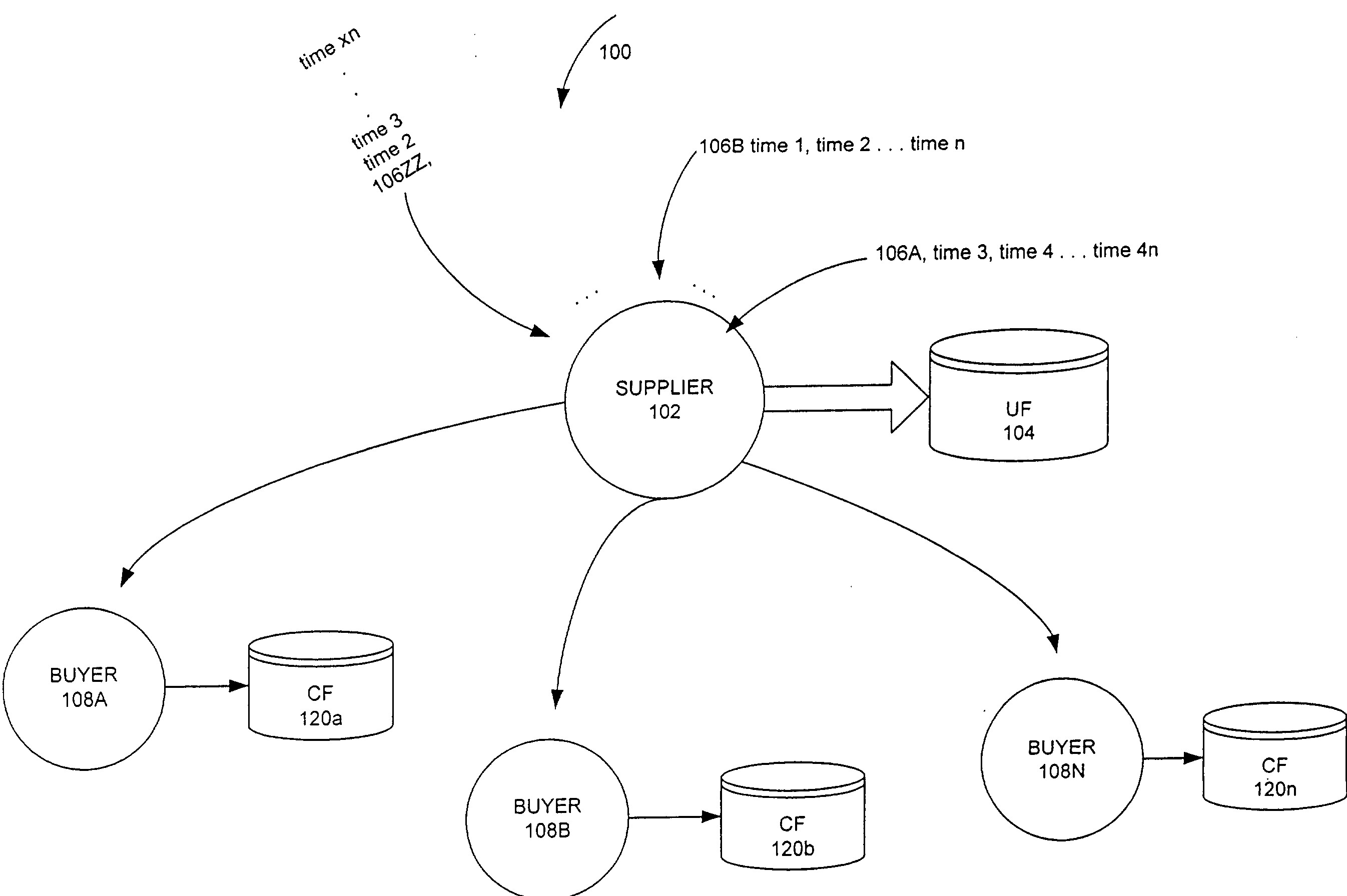
This European patent application concerns a method involving an information supplier that gathers information about consumers and sells it to a number of information buyers. The information buyers may use the processed information for marketing purposes.

Looking at Figure 1 of the published application, the information supplier (102) stores the consumer data in a “universe database file” (UF, 104). Each record in the UF has a “unique universe identifier” (UUID), which is stable over time. The information buyers (108A-N), on their end, store information about their existing or potential customers in “customer database files” (CF, 120a-n). The records in the CFs are indexed by a “unique customer identifier” (UCID):

Fig. 1 of EP 1 446 749

Here is how the invention is defined in claim 1:

  • Claim 1 (main request)

Is it technical?

Although the overall purpose of this application was to collect and sell customer data, claim 1 included a number of features concerning the database implementation. As summarized by the board:

Claim 1 of the main request covers the initial transfer of information from the information supplier to an information buyer as depicted in Figure 2 of the published application. At this stage, the information buyer’s CF is essentially a list of customers that it presumably already knows about, but whose records do not have UCIDs assigned to them (page 7, lines 18 to 19).

The information buyer sends the list of customers to the information supplier in a “transfer customer database file”. The information supplier assigns a UCID to each entry in the list, compares the list of customers with the information stored in the UF, and updates the customer database file (page 7, line 31 to page 8, line 8). The information supplier may, for example, add information about the customers’ income and debts. The information supplier also generates a conversion table (CT) that provides a mapping between the UCIDs and the UUIDs. The CT will be used for mapping the records in the CF to the records in the UF the next time the CF is to be updated (Figure 3; page 8, lines 18 to 28).

According to the board, claim 1 differed from the closest prior art in that the information buyer provides a database file to the information supplier, which, in turn, assigns unique identifiers (UCIDs) to the records in the file and updates them. The identifiers used for the customer database file are different from the UUIDs used in the central database. The information supplier also creates a conversion table between the UCIDs and the UUIDs.

The examining division had found that the provision of customer database files by the information buyer, as well as the updating of those files by the information supplier, were non-technical business requirements. The appellant argued that the invention increased the security of the information supplier’s database by limiting the extent to which it was accessed by outside systems, whilst also increasing the efficiency of information retrieval at the client end, because the CF could be hosted on the information buyer’s systems.

Thus, the key question and the point of dispute in this case was where to draw the line between the technical and non-technical features of the invention. Here is what the board said:

This is crucial, because the non-technical features are given to the skilled person as a set of requirements to implement. Since they are part of the problem rather than the solution, they cannot contribute to inventive step (see T 641/00 – Two identities/COMVIK).

Drawing the line between what is technical and not technical requires careful consideration of all the features of the invention and their associated effects.

In decision T 1463/11 (Universal merchant platform/CardinalCommerce), the “notional business person” was used as a tool for drawing the line between the non-technical requirements and the technical implementation of those requirements. The business person can require things such as “Move the money from the payer’s account to the payee’s account”, but the choice of technical means for carrying out the business requirements is normally left to the technical skilled person.

The Board is not persuaded by the appellant’s arguments that the alleged increased security is a technical effect that counts towards inventive step. It is rather a question of what and how much information to give away. That is something for the business person.

The Board agrees with the examining division that the invention is to a large extent a consequence of the relationship between the information supplier and the (plurality of) information buyers. The information supplier sells data to the information buyers. It wants to retain control over its data as much as possible. That is good for business. The information buyer keeps information about its customers or potential new customers. That is part of their business.

The business person might say: We (the information supplier) do not want to give away more information than necessary, and we want to control what information we give away. Give us a list of customers and we will update the records with information that we have about those customers. Thus, those are non technical requirements that are given to the skilled person.

It follows directly from the business requirements that the customer list be provided to the information supplier in some appropriate format, and that the information supplier update the file.

The Board also has doubts whether assigning a unique identifier (a key) to the customer records is technical. The business person could require: “We must be able to identify each customer.” In any case, the use of unique identifiers (primary keys) to identify records in a database was standard practice since long before the priority date.

The skilled person implementing the business requirements would assign keys to the customer records. Whether to use the same keys as in the central database or different keys is, from a technical point of view, a matter of convenient choice. In view of the non technical requirement “Don’t give away information”, using different keys would be the natural choice.

Furthermore, the keys used in the source systems in D6 are different from the keys in the central data warehouse. The skilled person would not see this as a teaching limited to data acquisition. On the contrary, he would recognise that the same arrangement could be used for the central database and the information buyer’s customer database.

Also, it is evident to the skilled person that, if different keys are used, a conversion between them is necessary. That is also known from D6.

Therefore, the board concluded that claim 1 lacks an inventive step and dismissed the appeal.

More information

You can read the whole decision here: T 1039/13 (Updating information/EQUIFAX) of 11.12.2019

Stay in the loop

Never miss a beat by subscribing to the email newsletter. Please see our Privacy Policy.

Privacy policy
* = Required field

Customizing a shared online environment: non-technical

The European Patent Office refused to grant a software patent on a system for providing customized experiences to client stations in a shared environment. Here are the practical takeaways of the decision T 1308/13 (Customised shared environment/DISNEY) of 17.12.2019 of Technical Board of Appeal 3.5.01:

Key takeaways

Customising a shared environment according to the users’ preferences, and adapting the interaction between different users within the shared environment so as to fit with each user’s customised environment, is a matter of presentation of information or playing a game.

The invention

This European patent application concerns an online shared environment, e.g. a virtual world or a computer game, in which users can interact in a chat.

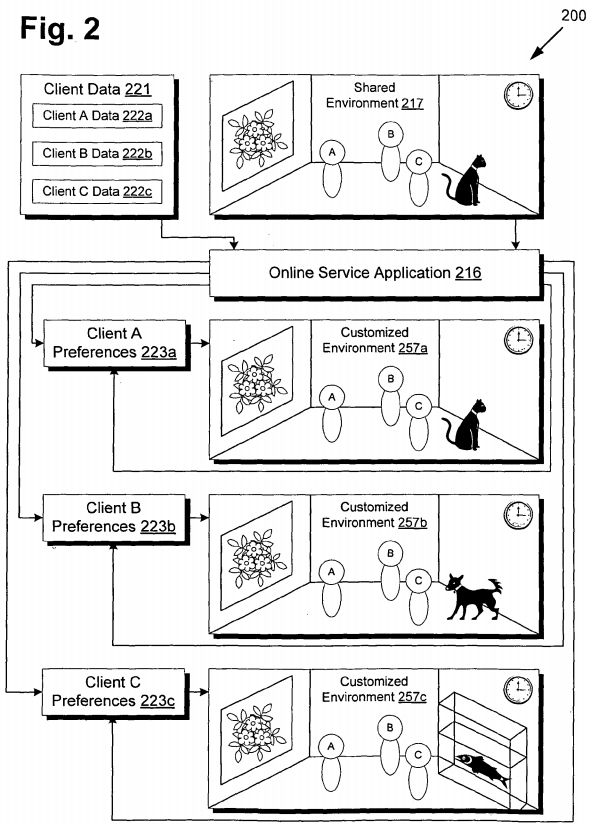
Figure 2 shows an example of a shared environment. There is a room with a flower painting, a clock, and an animal (a cat). Users A, B, and C, are present in the room and can chat with each other:

Fig. 2 of EP 2 211 299

The invention allows the users to customise the shared environment according to their individual preferences. User A likes cats and wants to see a cat. User B, on the other hand, prefers dogs, and user C wants to see a big fish in an aquarium. A problem arises when users A, B, and C interact with each other in relation to a customised element. For example, user B might write to user A “Isn’t that a cute dog?!”. However, user A who sees a cat will not know what user B is talking about.

The invention solves this problem by translating “interaction data” (the chat message in the example above) so that it fits with each user’s customised environment. In other words, the chat message “Isn’t that a cute dog?!” from user B to user A is translated into “Isn’t that a cute cat?!”, because user A’s customised environment comprises a cat. This is illustrated in Figure 3:

Fig. 3 of EP 2 211 299

Here is how the invention is defined in claim 1:

  • Claim 1

Is it technical?

The Board considered the background art described in the published application itself to be a good starting point for assessing inventive step. According to the published application, networked shared environments were known at the priority date. Those shared environments allowed users to interact with each other. However, it was not possible to customise the elements of the shared environment itself.

The invention in claim 1 thus differed from the known shared environment by the customisation of elements of the shared environment, and the translation of interaction data relating to a customised element of the shared environment.

The appellant argued that the invention solved the technical problem of reconciling customised individual personalisation with a shared social environment. However, without success:

The Board does not share the appellant’s view that this is a technical problem. Customising a shared environment according to the users’ preferences, and adapting the interaction between different users within the shared environment so as to fit with each user’s customised environment, is a matter of presentation of information or playing a game, i.e. it falls within the categories of excluded matter in Article 52(2) EPC.

Neither decision T 1177/97 nor T 769/92 helps the appellant’s case. According to T 1177/97, a piece of information that is used in a technical system may have technical character if it solves a technical problem in that system. However, the Board does not see that any technical problem is solved by the distinguishing features of the invention in claim 1. Furthermore, the Board does not see that the invention in claim 1 involves any technical considerations other than those relating to the computer implementation.

According to T 641/00 – Two identities/COMVIK, non-technical features, i.e. features that fall within the non-exhaustive categories of excluded matter in Article 52(2) EPC, do not contribute to inventive step. Such features are instead considered to be part of the framework of the technical problem to be solved, which is often a set of requirements to be implemented. The Board considers that the invention in claim 1 solves the problem of implementing the customisation and the translation of interaction data in the known shared environment. In the Board’s view, the implementation would have been obvious to the skilled person using routine programming.

Therefore, the board concluded that claim 1 lacks an inventive step and dismissed the appeal.

More information

You can read the whole decision here: T 1308/13 (Customised shared environment/DISNEY) of 17.12.2019

Stay in the loop

Never miss a beat by subscribing to the email newsletter. Please see our Privacy Policy.

Privacy policy
* = Required field

Cost-based optimisation of a query in a relational database system: technical

The European Patent Office considered cost-based optimisation of a query in a relational database system technical. Here are the practical takeaways from the decision T 1965/11 (Cost-based materialised view selection/MICROSOFT TECHNOLOGY LICENSING) of 24.3.2017 of Technical Board of Appeal 3.5.07:

Key takeaways

Retrieving data in a computer database is normally considered to have technical character.

More specifically, cost-based query optimisation that searches for low-cost query execution plans using a cost estimate for computer resources involves further technical considerations.

The invention

The application underlying the present decision relates to a database query optimizer that selects materialized views on a cost basis (cf. EP 1 193 618 A2, para. [0001]). A known concept regarding databases is to materialize (store) the result of queries and then use the computed result when similar queries are submitted to the database (cf. EP 1 193 618 A2, para. [0004]). For maximum flexibility, applications should not need to be aware that certain views exist, or are materialized. A query processor should identify matches between user queries and existing pre-computed results, and use such results when applicable (cf. EP 1 193 618 A2, para. [0005]). However, on some complex queries, view utilization will be possible only in sub-expressions of the complete query. These sub-queries may appear only after some reordering has taken place, which is a time-consuming task (cf. EP 1 193 618 A2, para. [0009]). Hence, the present application aims at providing a cost based query optimizer that determines the applicability of materialized views to a query. View utilization alternatives are generated in the exploration stage of optimization, so that interaction with other transformations in complex queries is taken into account. A final decision on whether to use a materialized view is based on estimated costs (cf. EP 1 193 618 A2, para. [0010]).

Fig. 2 of EP 1 193 618 A2

  • Claim 1 (auxiliary request IV)

Is it patentable?

The examining division rejected the present application at the end of the examining phase due to added subject-matter. This decision was appealed. In the statement of grounds of appeal, the appellant requested that the decision be set aside and also asked the Board to decide that the claims of at least the fourth auxiliary requests were allowable.

A plurality of prior art documents were discussed during the oral hearing. When it came to the assessment of inventive step, the Board in charge argued as follows:

5.1 According to decision T 1569/05 of 26 June 2008, reasons 3.6, retrieving data in a computer database is normally considered to have technical character. While the method of claim 1 does not include the actual data retrieval, the Board considers that the cost-based optimisation of a query in a relational database system has normally technical character (see T 1003/09 of 29 April 2015, reasons 13.3 and 13.5). Such cost-based query optimisation searches for low-cost query execution plans using a cost estimate for the computer resources (such as CPU, main memory or hard disk) needed to execute a query plan (see D8, section 2, for technical background). Hence, this cost-based approach involves further technical considerations (see opinion G 3/08, “Programs for computers”, OJ EPO 2011, 10, reasons 13.5) relating to the internal functioning of the computer system.

Furthermore, the Board was of the opinion that none of the cited prior art documents could render-obvious the subject-matter as defined by claim 1 of auxiliary request IV:

5.3 None of these prior-art documents addresses the problem of extending a table of alternatives generated by the query optimiser by adding further alternatives using materialised views. The invention makes it possible to find low-cost query execution plans that make use of the available materialised views in order to improve query performance (see page 2, third paragraph). Moreover, in order to explore the search space for such low-cost query execution plans, it proposes integrating the materialised views into the table of alternatives during the plan exploration stage. For this integration, it is necessary to match query plans with materialised views in order to identify useful plan alternatives for such views. The invention teaches using query graphs for the matching in order to substantially reduce the complexity of extracting operator trees which encode a specific join order. In the technical context of query optimisation in relational database systems, this teaching is based on further technical considerations and solves the problem of providing a technically feasible implementation, in particular one that achieves an acceptable time complexity for query optimisation in relational database systems.

As a result, the Board remitted the application back to the examining division with the order to grant a patent based on auxiliary request IV.

More information

You can read the whole decision here: T 1965/11 (Cost-based materialised view selection/MICROSOFT TECHNOLOGY LICENSING) of 24.3.2017.

Stay in the loop

Never miss a beat by subscribing to the email newsletter. Please see our Privacy Policy.

Privacy policy
* = Required field

Row-based selective auditing in an relational database system: technical

The European Patent Office considered row-based selective auditing in an relational database system technical. Here are the practical takeaways from the decision T 0963/09 (Selective auditing/ORACLE) of 5.6.2014 of Technical Board of Appeal 3.5.07:

Key takeaways

Database accesses in general and the specific implementation of row-based selective auditing in an relational database system, in particular, is considered technical.

The invention

The invention underlying the present decision relates to providing security in computerized databases. Databases oftentimes store highly sensitive data, such as salaries, corporate financial data, and even classified military secrets. For security reasons it is essential to be able to audit accesses to this sensitive data. Conventional database systems typically provide a general auditing facility that records an audit trail containing general information about the user and the query issued. However, conventional auditing facilities have a number of shortcomings. They do not record specific information about the application, the session environment or most importantly, the query results. Consequently, information gathered by a conventional auditing facility is frequently insufficient to reconstruct an event, or even to determine whether access rights have been violated (cf. WO 01/82118 A2, p. 1, l. 19-28). Hence, the application intends to provide an auditing mechanism that can specify a finer granularity of audit conditions during accesses to relational tables in order to minimize the number of false audit records that are generated (cf. WO 01/82118 A2, p. 2, l. 3-5).

Fig. 1 of WO 01/82118 A2

  • Claim 1 (main request)

Is it patentable?

The first instance examining division decided that the independent claims of the main request  lacked an inventive step in view of two cited prior art documents. Apart from the discussion of the prior art, the Board expressed some concerns in the summons whether the claimed subject-matter is technical at all:

7.6 In the communication accompanying the summons, the Board observed that auditing of database accesses, while in itself a technical operation, in the context of the present invention appeared not to serve any specific technical purpose going beyond the act of auditing. Similarly, the motivation for making auditing selective, i.e. limiting auditing of database accesses to accesses of rows satisfying a particular auditing condition, appeared to be non-technical.

During the oral hearing, the appellant argued against this (preliminary) view of the Board in charge:

7.8 At the oral proceedings, the appellant explained that the claimed invention allowed row-based selective auditing to be performed based on an auditing condition that referred to fields that were not included in the query result returned to the client.

Apparently, the Board followed this argument and considered the claimed subject-matter of the main request to involve an inventive step:

7.9 In view of this explanation the Board accepts that the claimed solution to the problem of implementing selective auditing cannot be regarded, without documentary evidence, as a mere obvious possibility.

Hence, at least implicitly, the Board in charge also considered the claimed subject-matter of the main request to be of technical nature and set the first instance decision aside.

More information

You can read the whole decision here: T 0963/09 (Selective auditing/ORACLE) of 5.6.2014.

Stay in the loop

Never miss a beat by subscribing to the email newsletter. Please see our Privacy Policy.

Privacy policy
* = Required field

Performing prediction of seat availability in a travel planning system: technical

The European Patent Office considered performing prediction of seat availability in a travel planning system technical. Here are the practical takeaways from the decision T 0279/05 (Predicting availability/ITA) of 5.10.2007 of Technical Board of Appeal 3.5.01:

Key takeaways

Using a server to implement a prediction of airplane seat availability rather than a travel agent client may be considered technical.

The invention

The application underlying the present decision relates to a method for providing availability of airline seats and more particular to determining airline seat availability information for use in travel planning and travel reservation systems (cf. WO/46715, p. 1, l. 7-9). In more detail, the method provides a technique to substitute predictions of availability for actual availability responses. Availability predictions are based upon several conceptual types of models which can be used separately or in various combinations. These models include a predictor based upon a cache or a database of stored availability queries and answers to the availability queries. The queries are used to identify when a stored query is the same as a received query request, and the answers are used as a substitute for direct access for future identical or substantially
related queries (cf. WO/46715, p. 4, l. 13-24).

Fig. 1 of WO/46715

  • Claim 1 (main request)

Is it patentable?

The application was rejected by the first instance examining division due to lack of inventive step since the use of caching servers is well-known common knowledge. However, no evidence was provided:

6. The examining division argued that the solution was obvious in view of the well-known use of local caching servers relieving main servers from processing load, but gave no detailed arguments provided, nor any evidence of this. (…)

While not expressly stated in the decision, it appears that the examining division considered the claimed subject-matter as a pure implementation of a business process and thus did not perform a search.

During appeal, the applicant argued that the claimed subject-matter solves a technical problem:

1. The application relates to determining airline seat availability. As explained by the appellant (see point VII, above), the invention solves the problem of relieving processing load on the availability system caused by the large number of low-fare flight searches. It achieves this by providing a travel planning system server that stores previous flight availability search results in a database and uses this data to predict results of subsequent searches.

According to the Board in charge, the subject-matter as claimed refers to a mixed-type invention and thus ruled that the COMVIK approach has to be applied for assessing inventive step:

2. The invention involves a mixture of technical aspects, e.g. servers and databases, and not technical aspects, e.g. airline seat availability and yield management. Decision T 641/00 – Two identities/COMVIK (OJ EPO 2003, 352) sets out the approach to judge inventive step in such cases:

“This approach requires identification of the technical field of the invention (which will also be the field of expertise of the person skilled in the art to be considered for the purpose of assessing inventive step), the identification of the closest prior art in this field, the identification of the technical problem which can be regarded as solved in relation to this closest prior art, and then an assessment of whether or not the technical feature(s) which alone or together form the solution claimed, could be derived as a whole by the skilled person in that field in an obvious manner from the state of the art.

(…)

The Board further outlined that using the result of a prediction being performed in a server distinguishes the claimed process from any manual activity and is thus not a mere implementation of a known business activity, but involves technical considerations. Hence, there was no reason to refuse searching the claimed subject-matter during the examination phase:

6. (…) Regardless of whether the presently claimed prediction is distinguished from the caching operation, the Board judges that the distinguishing features at least go beyond what is “notorious”, or essentially irrefutable, in this art. In the Board’s view this removes the basis for not performing a search under Rule 45 EPC, so that an additional search should be performed (cf. T 690/06, points 2 and 8) to establish the relevant prior art by which to judge the inventive step.

Finally, the board ruled that the examining division’s reasoning for lack of inventive step is not convincing and the present application is remitted back to the first instance examining division for further search and examination.

More information

You can read the whole decision here: T 0279/05 (Predicting availability/ITA) of 5.10.2007.

Stay in the loop

Never miss a beat by subscribing to the email newsletter. Please see our Privacy Policy.

Privacy policy
* = Required field

Improving image classification by training a semantic classifier: technical

The European Patent Office granted a software patent on a method for improving image classification by training a semantic classifier. Here are the practical takeaways of the decision T 1286/09 (Image classifier/INTELLECTUAL VENTURES) of 11.6.2015 of Technical Board of Appeal 3.5.07:

Key takeaways

Training a colour image classifier: technical (not questioned in the decision)

The invention

This European patent application relates to the field of digital image processing, and in particular to a method for improving image classification by training a semantic classifier with a set of exemplar colour images, which represent “recomposed versions” of an exemplar image, in order to increase the diversity of training exemplars.

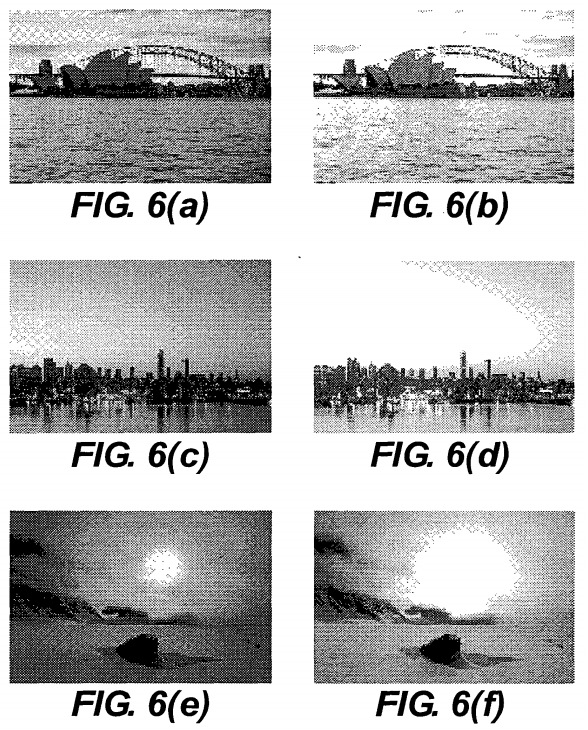
According to the application, known scene classification systems enjoy limited success on unconstrained image sets because of the incredible variety of images within most semantic classes. Exemplar-based systems should account for such variation in their training sets. However, even hundreds of exemplar images do not necessarily capture all the variability inherent in some classes. As an example of such variability, the application gives the class of sunset images which can be captured at various stages of the sunset and thus may have more or less brilliant colours and show the sun at different positions with respect to the horizon.

The gist of the invention was essentially to increase the diversity of exemplar images used to train a semantic classifier by systematically altering an exemplar colour image to generate an expanded set of images with the same salient characteristics as the initial exemplar image. More specifically, an exemplar image may be altered by means of “spatial recomposition”, i.e. by cropping its edges or by horizontally mirroring it. Another technique for expanding the set of exemplar images is to shift the colour distribution or to change the colour along the illuminant (i.e. red-blue) axis.

Fig. 6 of EP 1 418 509

Here is how the invention is defined in claim 1 (main request):

  • Claim 1 (main request)

Is it technical?

In this case, the board did not even put into question whether training a colour image classifier was technical. Accordingly, the board “just” compared the claimed feature combination of the invention with the available prior art to identify whether an inventive step was justified:

Document D3 does not deal with the problem of training a colour image classifier, but with the problem of improving the recognitions of an original character represented by a set of degraded bi-level images. Furthermore, it discloses the processing of many (degraded) images of a character to provide an approximation of the original character, whereas the present application teaches processing an exemplar image to generate a set of exemplar images, such that the original exemplar image and the corresponding set of exemplar images share some salient characteristics of a certain semantic class of images.

Furthermore, also the use of image degradation models for the automatic training of image classifiers referred to in D3 (see page 2, “Background of the invention”), is not comparable to the present invention. In fact, the prior art acknowledged in D3 starts from a single ideal prototype image and processes it to generate a large number of pseudorandomly degraded images which train the classifier to recognise defective images of the same symbol (D3, page 2, lines 35 to 37). The present invention, however, starts from a real-world exemplar image and alters it “spatially” or “temporally”, so as to produce a set of images which simulate other possible “real-world images” in the same image category.

Hence, in the Board’s opinion, the teaching of document D3 cannot be regarded as a suitable starting point for the present invention.

Also the other available prior art did not disclose anything more relevant for the claimed invention:

As to the prior art documents D1 and D2 cited in the course of the examination, document D1 is concerned with the use of learning machines to discover knowledge from data. It relates therefore to a different field of technology and is not relevant to the present invention. Document D2 was cited by the Examining Division only as evidence that it was generally known to provide a digital representation of an image.

Therefore, the board concluded that claim 1 involved an inventive step, and remitted the case back to the department of first instance with the order to grant a patent on the basis of claim 1 according to the appellant’s main request.

More information

You can read the whole decision here: T 1286/09 (Image classifier/INTELLECTUAL VENTURES) of 11.6.2015

Stay in the loop

Never miss a beat by subscribing to the email newsletter. Please see our Privacy Policy.

Privacy policy
* = Required field

Trusted third party to secure online transactions: non-technical

The European Patent Office refused to grant a patent on the concept of providing a trusted third party to secure online transactions. Here are the practical takeaways of the decision T 1761/14 of 27.11.2018 of Technical Board of Appeal 3.4.03:

Key takeaways

Providing a trusted third party (like a notary) in addition to the issuing entity/financial institution pertains to an administrative or business concept that does per se not contribute to the technical character of the invention.

The invention

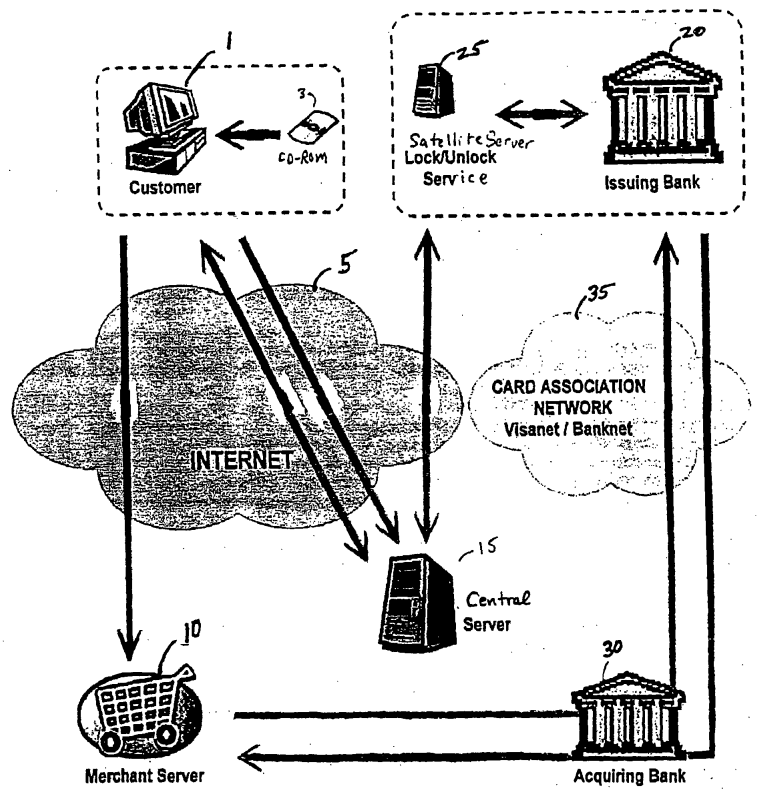
This European patent application is directed at increasing security in online business transactions. One goal of the application is to provide assurance to a merchant that the person attempting to make a purchase with a payment instrument is in fact authorized. Also, the likelihood of a cardholder’s issuing bank authorizing a fraudulent online transaction should be removed.

To this end, the application provides a process by which owners of payment instruments may have control over the usage of their payment instruments by giving them the ability to selectively block and unblock their payment instruments. Thus, one goal of the application is to allow the legitimate holder of a payment instrument to explicitly control the precise conditions under which a payment authorization request may be granted or rejected.

Fig. 1 of EP 1 388 135

Here is how the invention is defined in claim 1 (main request):

  • Claim 1 (main request)

Is it technical?

First of all, the board noted that in this case claim 1 was formulated in such an abstract manner that it does not necessarily require any technical feature at all. Therefore, claim 1 could thus even be seen as being excluded from patentability. However, since the main purpose of the application was to increase security in online transactions, the board interpreted claim 1 as if it was performed using the (generally known) technical means mentioned in the rest of the application.

Compared to the closest prior art, claim 1 was found to differ in that a trusted third party (“ttp”) is provided which acts as an intermediary between the authorised instrument holder and the issuing entity. However, this did not justify an inventive step according to the board:

Providing a trusted third party (like a notary) in addition to the issuing entity/financial institution pertains to an administrative or business concept that does per se not contribute to the technical character of the invention.

It must be concluded that claim 1 of the main request differs from D5 by a modified business concept.

The Board can accept the argument of the appellant that the skilled person would, starting from D5, have no motivation to introduce a ttp (and thus distinction (ii)) into the system of D5 (see section XII. above) only insofar as motivation by technical reasons is concerned.

However, in the present case and applying the principles as set out in T641/00, the person skilled in the art of computer technology is provided with the modified business concept including the provision of a ttp as a constraint to be met.

That is, the motivation to introduce a ttp/distinction (i) into the system of D5 is provided by the modified business concept instead of technical reasons.

Furthermore, another difference to the closest prior art was that the transaction is a non-face-to-face transaction:

In this respect, the Board notes that the application explicitly mentions that the distinction between card present/face-to-face and card not present/non-face-to-face transactions was instituted by banks and not by engineers or computer scientists (page 4, line 30 to page 5, line 1).

Consequently, the skilled person would only be faced, as objective technical problem to be solved, with the task of implementing the different, but given business concept underlying claim 1 using the generally known technical means mentioned in D5.

Such an implementation naturally involves adapting the generally known technical means, including registrations in data bases and communications using the networks, disclosed in D5 to the different business concept.

However, the application does not mention (and the Board is not aware of) any particular technical difficulty the skilled person would encounter when trying to do so. Instead, these adaptations have to be considered to be straightforward tasks for the skilled person.

Therefore, the board concluded that claim 1 did not involve an inventive step.

More information

You can read the whole decision here: T 1761/14 of 27.11.2018

Stay in the loop

Never miss a beat by subscribing to the email newsletter. Please see our Privacy Policy.

Privacy policy
* = Required field

Simulating the deployment of a 4G broadband service: non-technical

The European Patent Office refused to grant a patent on a method of simulating the deployment of a 4G broadband service. Here are the practical takeaways of the decision T 0988/12 (Network deployment simulator / ACCENTURE) of 17.7.2018 of Technical Board of Appeal 3.5.01:

Key takeaways

Working out different configurations of a broadband system, and calculating the cost of implementing and operating such a system, is an intellectual activity.

The invention

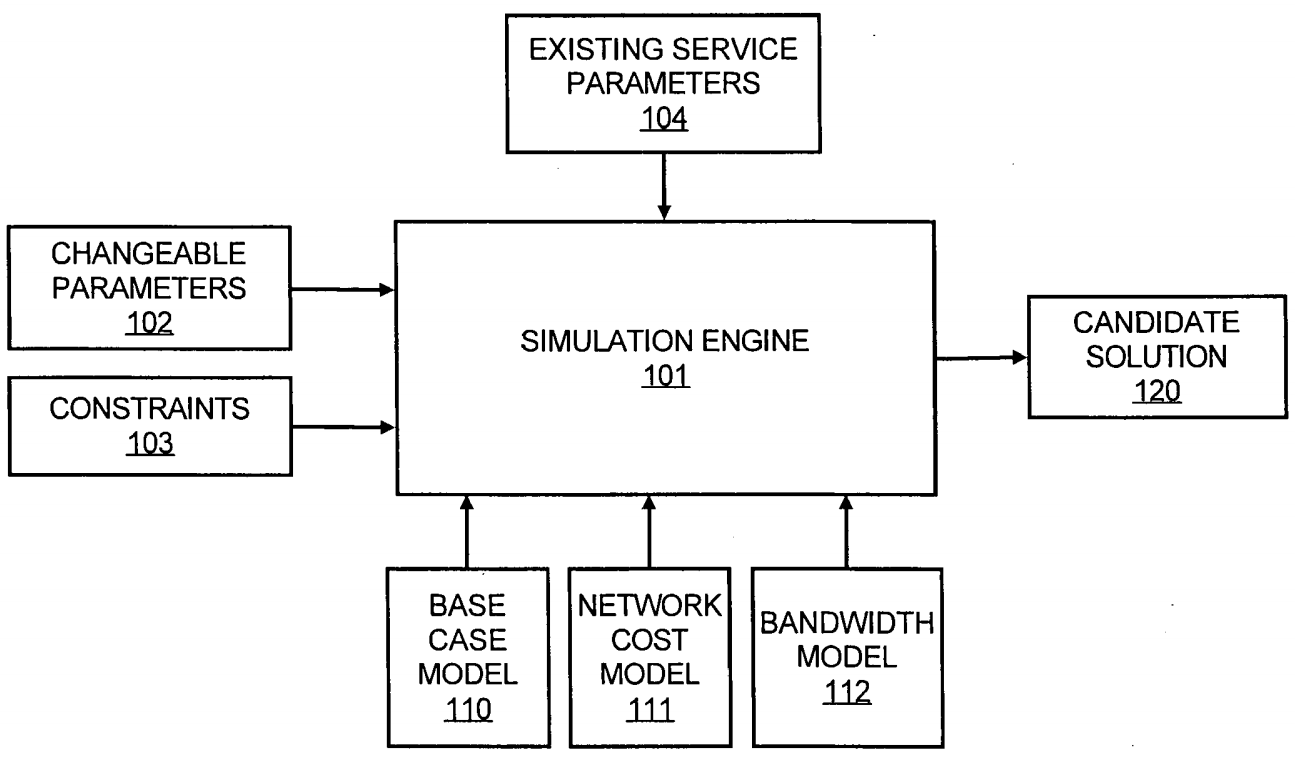
This European patent application relates to a computer simulation for the deployment of a 4G broadband service. The deployment of a 4G broadband service was said to give rise to many different scenarios. By means of computer simulation, the various scenarios could be analysed without first implementing the underlying broadband system.

As shown in Figure 1 of the published application, the simulation is based on a number of existing service parameters 104, changeable parameters 102, and constraints 103, and it involves the use of models that define the relationships between the various parameters. There is a “base case model” 110, a “network cost model” 111, and a “bandwidth model” 112. The output of the simulation is one or more candidate solutions 120 for the deployment of the 4G broadband service.

Fig. 1 of EP 2 113 872

Here is how the invention is defined in claim 1 (main request):

  • Claim 1 (main request)

Is it technical?

Following the established COMVIK approach, the board assessed whether the features of claim 1 that distinguish the invention over the closest prior art make a technical contribution, since only these features can establish an inventive step. The board took the view that claim 1 differs from a commonplace data processing system by the simulation carried out by that system. The question is whether this contribution is a technical one that counts towards inventive step:

A computer simulation is essentially the use of a model running on a computer to assess or predict the functioning of a system. It is difficult to see what technical effect such a process might have. The model is itself an abstract, mathematical concept. The simulation process using the model does not have any technical effect on the simulated system. Indeed, that system might not even exist in physical form. There is unarguably an effect on the computer running the simulation, but not one that goes beyond the normal effects of running software on a computer.

Nevertheless, the board also referred to decision T 1227/05, which is currently under critique in the pending referral G1/19. In that decision, it was held that specific technical applications of computer-implemented simulation methods were themselves to be regarded as modern technical methods:

The Board notes that decision T 1227/05 draws a distinction between an adequately defined technical system and a “metaspecification”, i.e. the description of something abstract, or non-technical, in words that make it seem technical. In the latter case, technicality cannot be derived from the simulated system.

It is helpful to consider what actually was judged to be an adequately defined technical system in T 1227/05. The invention in that case concerned the simulation of a circuit under the influence of 1/f noise. The circuit had input channels, noise input channels, and output channels, and its performance was described by differential equations. The Board considered the circuit to be an adequately defined class of technical items, and the simulation of the circuit to be a functional technical feature.

By contrast, the modelling of an undefined “physical system” in decision T 49/99 was considered to be a metaspecification of something abstract. That case concerned a method for analysing a physical system and providing an information model reflecting the essential properties of the physical system in terms of a hierarchy of abstract objects implemented using relational database technology. That type of information modelling was considered to be an intellectual activity that had all the traits typical of non-technical branches of knowledge.

In the present case, the board took the position that claim 1 does not define the simulated system in a way that clearly establishes it as technical, for the following reasons:

The deployment of a 4G broadband service is a broad concept, which covers both business scenarios and technical scenarios. In other words, it is not clear that the purpose of the simulation is technical. Indeed, looking at the example in Figure 4 of the published application, the purpose of the simulation is to determine cost (CAPEX, OPEX).

Claim 1 refers to a number of parameters that describe the broadband service. Some of them, for example “network” and “bandwidth”, may seem technical. However, as established in T 1227/05, the mere use of technical terms is not enough to adequately define a technical system. That is what is meant by metaspecification.

In the Board’s view, claim 1 does not establish any clear, technical relationship between the various parameters. The claim mentions a number of relationships, but only a few of them, for example the relationship between the number of cell sites and the spectrum, could count as technical; the others are about cost. However, claim 1 does not define the complete relationships between the parameters, for example by means of a formula, and, in any case, it is not clear how those relationships are used in the simulation. There is no complete simulation model that could be seen as technical.

The appellant had argued that in order to determine the cost, the technical configuration of the broadband system had to first be determined, and this was a technical step. The board did not agree:

The Board does not see that those configurations are adequately defined in the claim. In any case, working out different configurations of a broadband system, and calculating the cost of implementing and operating such a system, is an intellectual activity more like the information modelling in T 49/99 than the circuit simulation in T 1227/05.

For these reasons, the board concluded that the simulation in claim 1 is not technical and does not contribute to inventive step. The implementation of the simulation on the commonplace data processing system would have been obvious to the skilled person using routine methods. Consequently, the subject-matter of claim 1 of the main request was found not involve an inventive step.

More information

You can read the whole decision here: T 0988/12 (Network deployment simulator / ACCENTURE) of 17.7.2018

Stay in the loop

Never miss a beat by subscribing to the email newsletter. Please see our Privacy Policy.

Privacy policy
* = Required field