Author Archive

Sorting review information in priority order: non-technical

In this decision, the European Patent Office refused to grant a software patent on the concept of sorting review information in priority order to reduce the time and effort for a user to find desired review information. Here are the practical takeaways of the decision T 0886/17 (Displaying review information in priority order/Rakuten) of 6.3.2020 of Technical Board of Appeal 3.5.07:

Key takeaways

Sorting or grouping data in a particular manner on the display is a matter of the presentation of information, which as such is non-technical.

Not every physical change qualifies as a technical effect. A physical change caused by non-technical features is to be regarded as a technical effect for the purpose of assessing inventive step if the non-technical features are based on technical considerations aimed at controlling that physical change.

When assessing the presence of a credible technical effect in inventions involving presentations of information, a distinction has to be made between subjective psychological factors and objective physiological factors.

It is standard practice in user interface design to minimise the number of interactions.

The invention

This European patent application generally relates to providing review information about “transaction targets” such as products or accommodations. The system receives a search condition input by a user (e.g search words), searches transaction targets matching the search condition, and displays review information regarding the transaction targets in a predetermined display order. The purpose of the invention was to reduce time and effort necessary for a user to find desired review information.

Fig. 6A of EP 2 725 502

Here is how the invention is defined in claim 1:

  • Claim 1 (main request)

Is it technical?

The examining division had decided that claim 1 then on file constituted a straightforward technical implementation of a non-technical administrative and business-related scheme in a notorious electronic data processing system.

On appeal, the board started its patentability analysis from a notoriously known information retrieval system:

At the date of priority of the present application, web-based information retrieval systems which gave the users the possibility of reviewing or rating articles of interest and viewing such information as part of the search results were notoriously known. The application acknowledges in paragraph [0002] that such systems were known.

Such a notorious information retrieval system, which was the starting point for assessing inventive step in the Board’s preliminary opinion, includes searching means, acquiring means and controlling means similar to those defined in claim 1.

The board identified three differentiating features in the invention according to claim 1:

  • (a) the transaction targets are stored in a first computer database and the review information is stored in a second computer database distinct from the first;
  • (b) the apparatus includes determining means for determining a priority order of the pieces of review information of each transaction target which satisfies the search condition, the priority order being determined “according to a correspondence between the search condition and the pieces of review information”; and
  • (c) a list of pieces of review information comprising at least one piece of review information associated with the identification information of each target is generated and displayed in the determined priority order.

The first difference was found to be just a minor implementation detail not helpful for the patentability of the invention:

Distinguishing feature (a) is a minor obvious implementation detail. It is common practice to distribute data across different databases. In addition, the Board is not convinced that feature (a) interacts with features (b) and (c) in such a way as to produce a synergistic effect. This was not contested by the appellant.

More interesting were the other two differentiating features, which relates to sorting the pieces of review information and displaying them in the sort order. These features were found to have the effect of changing the way the pieces of review information are presented to the user. One of the central questions of this appeal was thus whether this effect was a technical one:

Computer programs and presentations of information as such are excluded from patentability under Article 52(2)(c) and (d) and (3) EPC. Furthermore, sorting or grouping data in a particular manner on the display is a matter of the presentation of information, which as such is non-technical (T 2045/10 of 28 April 2016, Reasons 5.6.2). It therefore has to be assessed whether features (b) and (c) interact with technical features of the invention to solve a technical problem bringing about a technical effect (T 2045/10, Reasons 5.6.2 to 5.6.4; T 1442/16 of 30 August 2019, Reasons 1.4; T 697/17 of 17 October 2019, Reasons 4.2 and 5.2.2).

The appellant had argued that an important distinguishing aspect of the invention was using the same search condition used to search the transaction targets to determine the priority order, and that this produced three technical effects:

  1. The first effect was a reduction of the load on the information retrieval apparatus, which was clearly not a cognitive effect. By performing the search and ordering together, fewer processing steps were necessary.
  2. The second effect, improved ergonomics, was achieved by requiring the user to enter the search condition only once, which resulted in fewer mouse clicks or key press operations. Since this related to physical movement, it was technical. In the prior art, the search results were first displayed and then the user had to select one of the displayed search results and scroll down to the “reviews” section. Typically, the user had then to click “see all reviews” in order to go to a page showing a number of reviews. This page had options to order the reviews. The user had to enter the search term again to sort the review information.
  3. The third effect was that the computer was “controlled to the memory location” of the pieces of review information which, in accordance with decision T 1351/04 of 18 April 2007, was a technical effect.

Here is what the board made of these arguments:

Even though the case law generally recognises a technical contribution by non-technical features if they are causally linked to a technical effect, not every physical change qualifies as a technical effect. A physical change caused by non-technical features is to be regarded as a technical effect for the purpose of assessing inventive step if the non-technical features are based on technical considerations aimed at controlling that physical change (T 697/17, Reasons 5.2.2; T 2230/10 of 3 July 2015, Reasons 3.7). The physical change has to be purposively used in the solution of a technical problem (T 258/97 of 8 February 2002, Reasons 6).

In the present case, distinguishing features (b) and (c) are not purposively directed to reducing the processing load or to directing the computer to a memory location. They are not based on technical considerations of how to achieve these effects, but rather on non-technical considerations regarding the information of interest to the user. In particular, the conclusions of T 1351/04 do not apply here. Unlike in T 1351/04, the present invention does not use an index or similar “management information” providing a path to the desired data, and the Board cannot see any technical considerations regarding directing the computer to a memory location.

The Board agrees with the appellant that teachings from case law should not be dismissed because the specific means used to achieve a technical effect there are not identical to those used in the present case, but notes that the question of which specific means are used to achieve an alleged technical effect, and thus whether they are comparable to those of the case law, is pertinent because features can only make a technical contribution if they are based on technical considerations (see also T 697/17, Reasons 4.2, 5.2.2, 5.2.3).

The Board is therefore not convinced that distinguishing features (b) and (c) can be considered to make a technical contribution by virtue of the first and third alleged technical effects.

With regard to the second alleged technical effect, the appellant cited decision T 1375/11 of 31 March 2016, which affirms that it is well established by the Boards of Appeal that improving ergonomics is technical (Reasons 4.4). In that decision, the invention was considered to solve the problem of avoiding the fatigue caused by the repetitive movements of the user’s eyes and head necessary to follow the displayed game, which were physiological aspects (Reasons 4.2 to 4.7). However, in the present case, there are no repetitive movements of the head and eyes or other physiological factors.

When assessing the presence of a credible technical effect in inventions involving presentations of information, a distinction has to be made between subjective psychological factors and objective physiological factors (T 1375/11, Reasons 4.6; T 1442/16, Reasons 1.8). Furthermore, it is established jurisprudence of the Boards of Appeal that “lowering the cognitive burden of a user” per se cannot as a rule be considered a technical effect (T 1802/13 of 10 November 2016, Reasons 2.1.7; T 1741/08 of 2 August 2012, Reasons 2.1.6).

In the present case, the allegedly achieved reduction in user interaction steps depends on cognitive aspects, and the Board is not convinced that the use of the search condition for determining the priority order is primarily based on technical considerations regarding ergonomics. If that order were not relevant for the user, then sorting the information according to that order would potentially result in more user interaction steps. As mentioned by the appellant, the priority order is chosen so that review information in which a user is very interested is preferentially displayed among pieces of review information of transaction targets. In that way, the user can grasp information more easily or find information with less effort. However, as argued in the decision under appeal, those are effects that remain at the cognitive level and are subjective. Therefore, the priority order and the presentation aspects of features (b) and (c) do not have to be considered in the assessment of inventive step. If a technical problem is solved, these aspects can be included in the formulation of the technical problem (T 641/00, OJ EPO 2003, 352, Reasons 7).

If it is assumed, in line with the appellant’s argument, that the invention contributes to the technical effect of facilitating user interactions, then features (b) and (c) constitute an advantageous solution to the problem of modifying the notorious information retrieval system to display the pieces of review information according to a priority order determined by the “correspondence between the search condition and the pieces of review information”.

However, it is standard practice in user interface design to minimise the number of interactions. Knowing that the priority order is based on the search condition, it is thus obvious for the skilled person to reuse the search condition to generate and immediately display the ordered list instead of requiring further input from the user. Modifying the notorious information retrieval system to determine a specific priority order and generating and displaying the list in that order as defined in features (b) and (c) involves only ordinary programming skills. Hence, regardless of whether features (b) and (c) are technical, they are obvious.

As a result, the board decided that claim 1 lacked an inventive step and dismissed the appeal.

More information

You can read the whole decision here: T 0886/17 (Displaying review information in priority order/Rakuten)

Stay in the loop

Never miss a beat by subscribing to the email newsletter. Please see our Privacy Policy.

Privacy policy
* = Required field

Withdrawing cash from an ATM via SMS without a banking card: technical but obvious

In this decision, the European Patent Office refused to grant a software patent on the concept of withdrawing cash from an ATM using a payment order delivered via SMS, without the need for a banking card. Here are the practical takeaways of the decision T 2318/13 (Method for obtaining cash at cardless teller machines, using a payment order via SMS) of 26.9.2019 of Technical Board of Appeal 3.5.01:

Key takeaways

Combining banking and cash withdrawal services of different financial institutions: non-technical business idea

The invention

This European patent application generally relates to the problem of allowing a beneficiary to withdraw cash from automatic teller machines (ATM) using a payment order delivered via SMS without the need for any payment instrument, such as a bank card, and type of account.

According to the patent applicant, the invention responded to the need of thousands of immigrants living in developed countries who regularly send money to their relatives in their countries of origin. While SMS services of mobile phones and ATMs were known, no system involving more than one bank had apparently reached the public, due to security drawbacks that arose because two different financial institutions would have needed to exchange client account data.

To solve this problem, the invention proposes the following: An issuing entity (3 in Figure 1) receives a request (1a) for acceptance/cancellation of a payment order from a Principal (2). The issuing entity (3) communicates the order (1b) to a central unit or national ATMPAY module (4), which is separate from the networks of banking institutions and which handles the acceptance/cancellation requests. Once authorised, the beneficiary (6) receives from the central unit (4), via SMS (1d), a reference number, an amount and a PIN code (individual for each operation) which he or she provides to an ATM (7) for withdrawing money from a acquiring entity (8), which may be a different financial institution.

Fig. 1 of EP 1 783 676

Here is how the invention is defined in claim 1:

  • Claim 1 (main request)

Is it technical?

The board of appeal started its inventive-step analysis from a prior art document from which claim 1 differed by the provision of a national central module (4) and the associated interactions with it as defined in features (b), (c), (d), (g) and (h). Feature (b) specifies that the issuing entity sends the order to the central module; features (g) and (h) specify that the central module processes requests for authorisation from the acquiring entities; features (c) and (d) specify that the central module uses SMS communication for informing a principal about the authorisation of its order and for sending authorisation information to the beneficiary permitting the withdrawal of money.

First of all, the board assessed the overall drawback to be overcome by the invention, namely the limitation to cash withdrawals from ATMs of the same financial institution:

A business person would recognise the limitation of the business concept of the D1 system, because cash withdrawal was possible only from ATMs of the same financial institution, namely of the principal who requested the money order, see paragraphs [0005] and [0014]. In a situation when thousands of immigrants want to send money regularly to their relatives in their countries of origin, different business needs arise, for example, beneficiaries (in countries of origin) would like to withdraw cash from any ATM of any financial institution and principals would not like to be limited to use a particular financial institution. This boils down to the business idea of making money from a new monetary service which combines banking and cash withdrawal services of different financial institutions, under the assumption that contractual agreements have been reached on the payment of fees, operating expenses and charges for the operations to be carried out, as assumed and recognised in the application, see paragraphs [0021] and [0022]. Even the appellant argued during oral proceedings that the term “national central module” could be seen as sort of new “legal entity” which combines financial services.

The implementation of this business idea was considered straight-forward:

Concerning the means for implementing this new business idea, the Board does not see a reason to disagree with the appellant who stated at the bottom of page 8 of the grounds of appeal, that “all the technical knowledge and tools needed for developing the system of the invention were available from at least 15 years ago. Indeed, the system only requires the use of conventional banking networking tools combination with the SMS service of mobile phones”.

Regarding features (b), (g) and (h), the Board considers it to be obvious to implement these functions as a separate module within the banking system of D1. These functions directly result from the business requirements of the new monetary service which permits different financial institutions to interoperate, such as, to arrange the acceptance / cancellation of payment orders, reporting that the payment order was carried out, to receive authorisation / correction requests for cash withdrawal and to grant them. The implementation of these functions as a module within the D1 system, for example, on the network host computer (20), paragraph [0013], would have been obvious for the person skilled in the art. Also its implementation as a separate “unit” (server) within the D1 system is an obvious design alternative, because D1 already discloses using different servers for different purposes, such as the terminal server, IVR server and back office server.

Aos concerning the feature of using SMS for transmitting the code to the beneficiary, the board decided that this only an obvious implementation of a requirement arising from the business specification:

Turning to the “SMS” feature, see features (c) and (d), the Board agrees with the appellant that the automatic transmission of the code directly to the beneficiary can be seen as being motivated by the desire to avoid fraud of the principal if he or she withdraws the money by himself or herself. The Board judges, however, that such a requirement is also part of the business specification.

The use of SMS communication for the transmission of information to principal and beneficiary was also an obvious implementation of this, because SMS was a well-known communication technology at the priority date of the application.

Therefore, claim 1 was found not to involve an inventive step, and the appeal was dismissed.

More information

You can read the whole decision here: T 2318/13 (Method for obtaining cash at cardless teller machines, using a payment order via SMS)

Stay in the loop

Never miss a beat by subscribing to the email newsletter. Please see our Privacy Policy.

Privacy policy
* = Required field

Electronic voucher scheme: non-technical

In this decision, the European Patent Office refused to grant a software patent on the concept of replicating the handling and redemption of paper-based vouchers with an electronic voucher scheme. Here are the practical takeaways of the decision T 1031/14 (Electronic vouchers/I-MOVO) of 3.12.2019 of Technical Board of Appeal 3.5.01:

Key takeaways

The idea of not providing the voucher value together with the voucher and distributing vouchers without the notion of an account or balance is a business scheme and does not involve technical considerations.

The invention

This European patent application generally relates to cash value vouchers. According to the description, there is a long history of consumer-oriented businesses using printed cash value vouchers as a promotional tool to retain existing customers and to attract new ones. However, paper-based vouchers suffer from high up-front costs (producing the vouchers, handling), and also consumers increasingly dislike carrying paper vouchers with them. Lastly, paper vouchers of high face-value carry a significant financial risk as advances in copying technology has made it easier to reproduce vouchers fraudulently.

The invention therefore concerns replacing paper-based vouchers by an e-voucher scheme, which is able to work with existing point-of-sale equipment. The overall goal of the invention was to closely replicate how tokens are handled today and effectively dematerialise the token and redemption process.

Here is how the invention is defined in claim 1:

  • Claim 1 (main request)

Is it technical?

First of all, the board briefly addressed the question of patent-eligibility, which was no problem due to the presence of technical means in claim 1:

The claim is directed to a mix of technical and non-technical features. The Board does not dispute that the method according to claim 1 appears in a technical context. The method can be considered to be performed by technical means, because it involves an ISO/IEC 7812-1 and/or ANSI X4.14 compliant POS terminal with means for storing data, means for processing data and means for transmitting and receiving data, and, therefore, has technical character. Accordingly, the claimed subject-matter is an invention in the sense of Article 52(1) EPC (see T 258/03 “Auction method/HITACHI“).

But of course, the challenging test was that of inventive step:

However, the question of inventive step requires an assessment of whether the invention makes a technical contribution over the prior art. Features which do not make such a contribution cannot support the presence of an inventive step (see T 641/00 “Two identities/COMVIK“, Headnote I). The assessment of inventive step in the decision under appeal considered D7 to be the closest prior art.

Accordingly, the board assessed which of the features of claim 1 actually contribute to the technical character of the invention, and came to the following conclusion:

The Board agrees that the following features outlined in point 9.2 of the decision per se pertain to an administrative method, i.e. to the non-technical part of claim 1:

– providing a cash value voucher comprising an alphanumeric number and having a cash value, which cash value is not related to the number, forming a concatenated string comprising said number, terminal identifier and an issuer identification number and sending the string to an acquirer, which acquirer after validating the string sends the string to the issuer, the voucher number having 6 to 10 digits,

– the issuer authenticates the voucher number and amends the string such that the string comprises the cash value, POS terminal identifier and the issuer identification number, which amended string enables authorisation of payment for the value of the cash value,

– the amended string being transmitted via the acquirer to authorise redemption of the voucher for the cash value.

The appellant’s argument that the claimed e-voucher scheme was indeed technical did not succeed:

What the application itself calls “an e voucher scheme” (see e.g. page 1. last par. of the description) is regarded by the Board as an administrative business related concept of distributing, validating and authorising vouchers. The Board does not agree with the appellant’s argument that such a voucher scheme cannot be carried out with pen and paper (see point 6 of the statement setting out the grounds of appeal). It is an abstract concept to issue a voucher not related to a cash value, adding an alphanumeric number, POS ID and issuer ID, validating by an acquirer, authenticating by an issuer to comprise cash value, POS ID and issuer ID, handing it back to the acquirer, who transmits the voucher for authorisation to a dealer. The idea of not providing the voucher value together with the voucher and distributing vouchers without the notion of an account or balance is a business scheme and does not involve technical considerations. The possibility of making different pricing schemes possible is a direct consequence of the business idea. This scheme could be carried out in a conventional way without involving electronic means. It therefore does not contribute to the technical character of the invention.

Also the technical implementation of the e-voucher scheme was not found to involve any helpful technical aspects:

The contribution of the invention does not lie in an improved POS infrastructure for redeeming cash value vouchers. The technical infrastructure used according to claim 1 is that of an ISO/IEC 7812-1 or ANSI X4.14 compliant POS terminal with means for storing data, means for processing data and means for transmitting and receiving data such as a networked general purpose computer, which were common general knowledge before the priority date. The contribution lies rather in the way of associating information with existing transaction data such as cash value, POS ID, issuer ID. Such data, however, in the Board’s view, is not technical, since it is cognitive data, not functional data (see T 1194/97 Data structure product/PHILIPS, OJ EPO 2000, 525).

The appellant had argued that the concatenated string comprised cognitive and functional data and gave an example of a voucher redemption request and a corresponding response message. The appellant also cited a standards-related document that showed that certain fields could not be changed in the response message. According to the appellant, these fields represented functional data, without which the system would not understand the messages. This was said to be analagous to the functional data in T 1194/97 (supra), without which the operation of the television system would be impaired.

But also this argument did not convince the board:

However, the example of a voucher redemption request presented and the changes made to the string therein do not reflect features of claim 1. According to the wording of the claim, the string is amended such that it comprises the cash value, POS terminal identifier and the issuer identification number. These are fields of cognitive data and they do not interact with the system to produce a technical effect as was the case in T 1194/97. They merely enable a business scheme. No further implementation details are given in the claim, in particular it is not specified what the messages look like. Even if the appellant was right with regard to the specific example, which the Board doubts, there is no corresponding concrete feature in claim 1, which could be considered when assessing inventive step.

In the end, therefore, the board decided that in the absence of any technical contribution beyond the straight-forward computer-implementation, claim 1 of the main request did not involve an inventive step. The appeal was dismissed.

More information

You can read the whole decision here: T 1031/14 (Electronic vouchers/I-MOVO)

Stay in the loop

Never miss a beat by subscribing to the email newsletter. Please see our Privacy Policy.

Privacy policy
* = Required field

Digitalization of the distribution of product inserts: technical but obvious

In this decision, the European Patent Office refused to grant a software patent on a digitalized approach for distributing product inserts. Here are the practical takeaways of the decision T 0223/18 (Product insert update/BIO-RAD) of 18.2.2020 of Technical Board of Appeal 3.5.05:

Key takeaways

Digitalization of the existing workflow for distribution of product inserts: only straightforward implementation of an administrative method using notorious technical means

The invention

This European patent application concerns the digitalization of the existing workflow for distribution of product inserts. According to the application, conventional product inserts were printed and packaged with control products on the basis of information available at the date of manufacture. The invention provided an easy, cost-efficient and targeted way of distributing product insert information.

Fig. 1A of EP 2 567 353

Here is how the invention is defined in claim 1:

  • Claim 1 (main request)

Is it technical?

The first instance examining divison had refused the patent application based on the argument that the subject-matter of the claim is the straightforward implementation of an administrative method using notorious technical means such as servers and databases, and consequently does not involve an inventive step. On the appeal stage, the appellant argued that the invention indeed had some business aspects, but that it nevertheless provided an easy, cost-efficient and targeted way of distributing product insert information.

The board was not persuaded:

The board does not doubt that, but the subject-matter of claim 1 does not go beyond the straightforward digitalization of the existing workflow for distribution of product inserts. It uses databases instead of paper for the storage of test data and the parameters derived from them, and servers for their distribution. It is evident that digitized information can be distributed much more easily, frequently, without the costs associated with printing, and that database management systems reply to queries unlike paper which does not.

The appellant also argued that the technical effect was to prevent the distribution of data that might not be accurate. Only when an insert was approved would that insert be transmitted to the end user insert database.

But also this argument did not convince the board:

However, as paragraph [0028] of the application also points out, production of control product inserts is regulated by well-defined FDA-approved procedures that dictate inter alia how insert values are approved. There are equivalent legal or regulatory requirements in every jurisdiction. These requirements for accuracy of parameter values and their approval have to be met, as a matter of course, by conventional printed product inserts that the appellant describes as the prior art. Therefore, the subject-matter of claim 1 cannot have the alleged effect with respect to the prior art.

Lastly, the appellant argued that the method of claim 1 generates more accurate parameters by analyzing data to see if changes occur. However, the board noted that neither claim 1 not the description revealed any information regarding how the data is analyzed  and thus the alleged effect was found to be merely speculative.

As a result, the board confirmed the first-instance decision that claim 1 concerned merely the straightforward implementation of an administrative method using notorious technical means such as servers and databases. Consequently claim 1 was found not to involve an inventive step, and the appeal was dismissed.

More information

You can read the whole decision here: T 0223/18 (Product insert update/BIO-RAD) of 18.2.2020

Stay in the loop

Never miss a beat by subscribing to the email newsletter. Please see our Privacy Policy.

Privacy policy
* = Required field

Recommending a shooting spot where a particular image can be taken: non-technical

In this decision, the European Patent Office did not grant a software patent on a computer system for recommending a shooting spot where a particular image can be taken. Here are the practical takeaways of the decision T 1455/16 (Image search to obtain shooting spot/RAKUTEN) of 20.11.2019 of Technical Board of Appeal 3.5.07:

Key takeaways

The mere fact that position information concerns physical elements in the real world is not sufficient for establishing a technical contribution of providing the position information.

The invention

This European patent application concerns retrieving images according to user specified criteria and recommending a shooting spot at which such an image can be captured.

According to the invention, an information providing server stores image data and associated image information in a database. The image information includes object information about objects or subjects in the image (e.g. people, animals, plants, landscapes), arrangement information of each object in the image and the shooting location (e.g. latitude and longitude or address).

At a terminal, a user specifies “arrangement information” indicating “object candidates”, each corresponding to a subject type, arranged in a particular manner in a “pseudo frame” representing an image area. Figure 5 illustrates a user interface to specify a search by arranging the position, shape and size of (rectangular) objects, each representing a subject type, on a pseudo-frame window. In the example of Figure 5, the user specifies a search for images showing two mountains, a river and a person in a given spatial arrangement on the image:

Fig. 5 of EP 2 562 655

The arrangement information is sent to the information providing server, which then searches for image data matching the arrangement information and sends the image data found, optionally with corresponding information about a shooting spot at which an image can be captured according to the arrangement information.

Here is how the invention is defined in claim 1:

  • Claim 1 (main request)

Is it technical?

The board of appeal started its inventive-step assessment from a prior art document which disclosed an on-line image database from which image data can be retrieved on the basis of visual characteristics such as colours, textures, shapes, and sizes, as well as textual tags appended to the images. The board found that claim 1 differed from the information providing device described in the prior art, among others, by the following feature:

  • (A’) the image data memory means is further arranged to store position information of the image data indicating the shooting spot of the image data, and the transmitting means is further arranged to transmit the position information of images searched by the searching means.

The appellant had argued as follows:

In its written reply and at the oral proceedings, the appellant argued that the provision of a shooting spot was comparable with the technical field of navigation, because the user was guided to a point in space where they could take a picture according to their expectations. Navigation was implicit in the claim. Explicitly claiming the feature of navigation was not necessary for credibly assisting the user in performing the technical task of reaching the point in space; this directly and necessarily followed from using the device claimed and transmitting the position to the terminal device.

Providing improved position information to a user was based on technical considerations. It was based on the presence of physical elements correlated with the position information, which reflected technical characteristics of the real world. In addition, it enabled the user, for instance, to move a vehicle along a direction aimed at reaching the point in space for shooting a photo in the same manner as a navigation system enabled a user to reach a desired destination. Moving had physical consequences and was hence a technical process. Reference was made to decision T 2035/11 of 25 July 2014, Reasons 5.2.1, and to decision T 1670/07 of 11 July 2013, Reasons 13.

The board, however, did not follow these arguments:

In the present case, the rationale of T 2035/11, reasons 5.2.1 and 5.2.2, does not apply. The device of claim 1 does not use information about the user’s position. Neither the distinguishing features nor claim 1 concern navigation, route planning or real-time guidance. The position information returned by the device in feature A’ can be used for any purpose, for example for merely presenting the information to the user, i.e. for presentation of information as such. Contrary to the appellant’s arguments, the claim cannot thus be considered to implicitly specify the navigation.

The text of claim 1 does not reflect the application of the position information in a technical task of guiding the user to a point in space. Therefore, it cannot be said that in the present case providing position information to a user is based on technical considerations. The mere fact that the position information concerns physical elements in the real world is not sufficient for establishing a technical contribution of providing the position information (T 154/04, OJ EPO 2008, 46, reasons 20; T 2035/11, reasons 5.1.4).

The Board is therefore of the opinion that feature A’ meets the non-technical user requirement of adapting the device of document D1 to further return position information indicating the shooting spot of the image. At the priority date of the present application, it was common practice to store position information with images taken, e.g. by digital cameras (see also paragraph [0002] of the present application), such position information corresponding to the shooting spot. It would therefore be obvious for the skilled person to store position information with each image and provide, as a result of the search, the position information for the matching images. That is, it would be obvious to modify the device of document D1 in the way defined by feature A’.

Therefore, the board of appeal decided that claim 1 lacked an inventive step and dismissed the appeal.

More information

You can read the whole decision here: T 1455/16 (Image search to obtain shooting spot/RAKUTEN)

Stay in the loop

Never miss a beat by subscribing to the email newsletter. Please see our Privacy Policy.

Privacy policy
* = Required field

Haptic feedback assisted text manipulation: technical

In this decision, the European Patent Office considered features that enable a user of a touch screen device to efficiently select a text portion as technical, but obvious in view of the prior art. Here are the practical takeaways of the decision T 2741/16 (Haptic feedback assisted text manipulation / Immersion) of 28.11.2019 of Technical Board of Appeal 3.5.05:

Key takeaways

Enabling a user of a touch screen device to efficiently select a text portion: technical

The invention

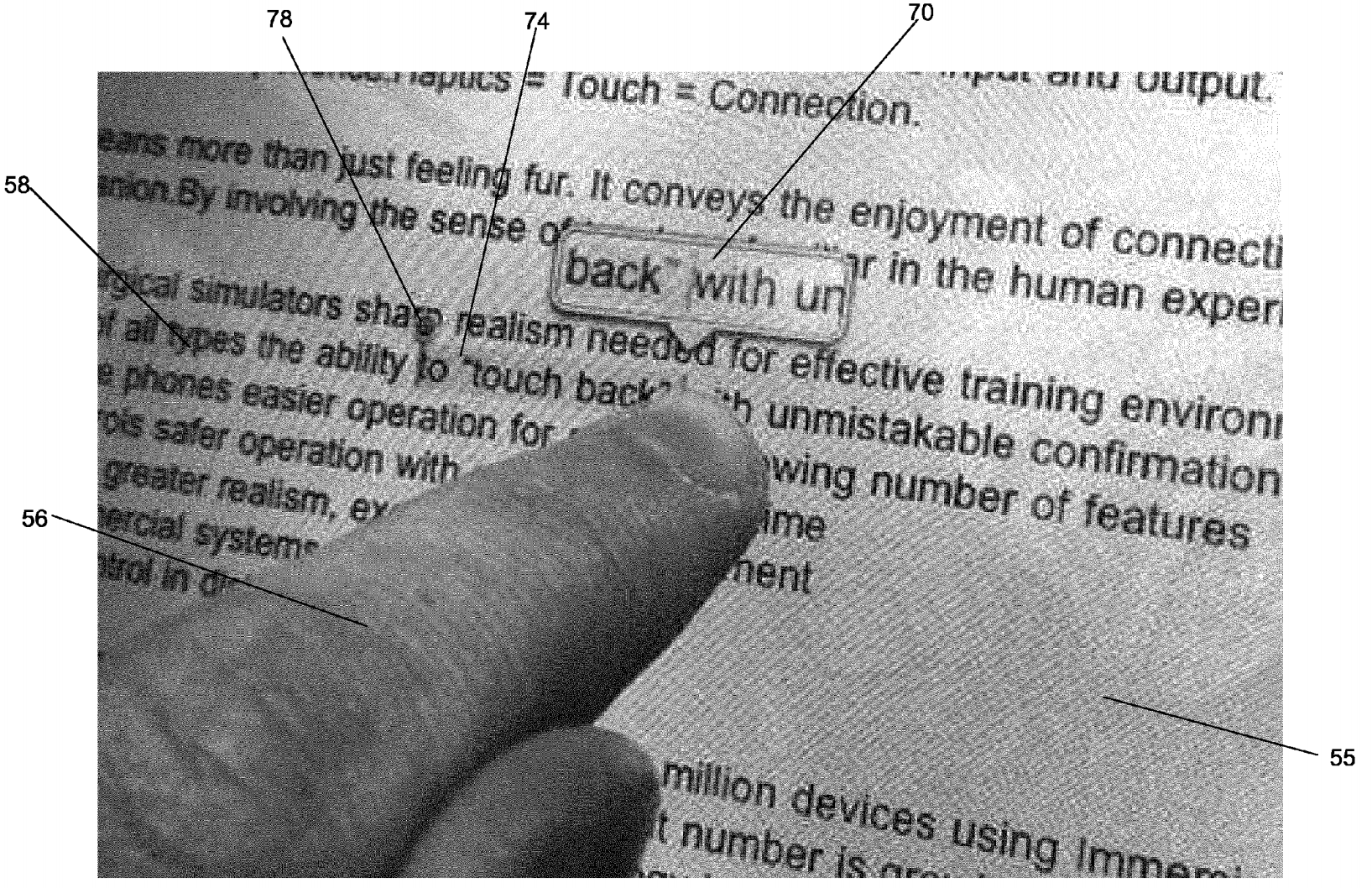
This European patent application generally relates to user interface techniques, and particularliy to a device with a touch screen that provides tactile feedback when it senses a touch by a user’s finger. The addressed problem is to support the user as he or she manipulates text.

The solution as claimed provides for adapting the type of tactile feedback to the type of manipulation and to specific touch gestures.

Fig 3 of EP 2 461 228

Here is how the invention is defined in claim 1:

  • Claim 1 (main request)

Is it technical?

The board of appeal used a document as closest prior art which discloses a device with a touch screen. The device is adapted to provide tactile feedback in different situations. The appellant had argued that this prior art did not anticipate the claimed feature of “as the finger slides across the dynamically generated text, different haptic events are generated”, and argued why this was non-obvious.

However, the board of appeal did not agree to the appellant’s analysis and took the view that the alleged difference was already disclosed in the prior art. As the only difference, the board identified the feature that “the user’s finger is being slid across the dynamically generated text and the corresponding portion of the text is highlighted”.

But this difference was found to be obvious by the board:

The technical effect of distinguishing feature (m1) is that the user is enabled to efficiently select a text portion.

The objective technical problem is considered to be how to enable the user to efficiently select a text portion.

Faced with this problem, the person skilled in the art would consider, based on his or her common general knowledge, that by dragging a selection cursor on a touch screen text can be selected and highlighted.

Similarly, document D1, which falls within the same technical field and discloses techniques for selecting information on a touch screen, discloses selecting and highlighting a region of text by a proximity-drag touch operation (Figures 45 and 46, paragraph 201). In this regard, the appellant confirmed (page 4, last paragraph of the statement of grounds) that document D1 discloses that “text may also (be) directly selected by sliding the finger over the text”.

Consequently, to solve the problem posed, the person skilled in the art would modify the teaching of document D2 by providing a possibility for the user to slide his or her finger across the text and thereby highlight the corresponding text’s portion. Moreover, the different haptic events of document D2 would clearly result as the finger slide across the text. In this way, the skilled person would arrive at the subject-matter of claim 1 in an obvious manner.

What is interesting about this decision is that enabling the user to efficiently select a text portion was accepted as a technical problem without any discussion. Accordingly, innovative user interface control mechanisms can indeed be patented, if they are non-obvious.

More information

You can read the whole decision here: T 2741/16 (Haptic feedback assisted text manipulation / Immersion)

Stay in the loop

Never miss a beat by subscribing to the email newsletter. Please see our Privacy Policy.

Privacy policy
* = Required field

Scoring the competence of an organisation: non-technical

In this decision, the European Patent Office refused to grant a software patent on the concept of assessing the competence of an organisation by processing score data. Here are the practical takeaways of the decision T 1902/13 (Assessing competence levels/SWISS RE) of 4.7.2019 of Technical Board of Appeal 3.5.01:

Key takeaways

Designing questions for determining competence levels and method steps and decisions leading thereto as well as mathematical/statistical operations of weighting, scaling and norming are all in the non-technical domain of an economist or a business person and do not make an inventive technical contribution.

The invention

This European patent application relates to a computer-based method for assessing competence levels of an organisation with multiple organisational units, as conventionally assessed by business consultants.

A computer stores scores related to answers given by a human representative of organisational units in response to defined questions. The computer assigns each score to one of the organisational units. For the organisational units, total scores are calculated in the computer by adding up the scores assigned to the respective organisational unit. Moreover, the computer calculates weighted total scores for the organisational units by adding up weighted maximum scores assigned to the questions. The weighted maximum scores each depend on the respective organisational unit and the respective question. Finally, the computer calculates competence levels of the organisational units. The results are provided by generating a graphical representation.

The applicant also filed an auxiliary request during the appeal stage, which adds the use of a rules-based expert-system.

Fig. 5 of EP 1 649 420

Here is how the invention is defined in claim 1:

  • Claim 1 (main request)

Is it technical?

First of all, the board briefly assessed whether the invention as defined in claim 1 was patent-eligible. As the avid reader will know, patent-eligibility is a very low hurdle at the EPO and thus there was no problem in this regard:

The claims are directed to a mix of technical and non-technical features. The Board does not dispute that the methods according to claims 1 and 8 appear in a technical context. The methods can be considered to be performed by technical means, because they involve a computer with means for storing data, means for processing data and means for transmitting and receiving data, and, therefore, have technical character. Accordingly, the claimed subject-matter is an invention in the sense of Article 52(1) EPC (see T 258/03 “Auction method/HITACHI“).

But the challenging question with mixed-type inventions is regularly that of inventive step, which requires an assessment of whether the invention makes a technical contribution over the prior art. Readers of this website will know that features which do not make such a contribution cannot support the presence of an inventive step (see T 641/00 “Two identities/COMVIK“, Headnote I).

Here the board sided with the first-instance examining division and found that most of the features of claim 1 were non-technical:

The Board agrees with the contested decision that except for the features relating to the technical infrastructure of a general purpose computer system, the features pertain to an administrative method, i.e. to the non-technical part of claim 1 and claim 8. Thus, the assessment of inventive step in the decision under appeal correctly considered a notoriously known general purpose computer system to be the closest prior art (see points 2 and 10 of the decision). Such a general purpose computer system was capable of storing, assigning, weighting, calculating and presenting all kinds of data. The claims as well as the description of the application lack technical detail with regard to the claimed computer system. Consequently, the Board does not find a specific disclosure of any technical aspect that could distinguish the computer system, on which the claimed method is based, from such a general purpose computer system.

Regarding the part of the invention which concerned the selection of questions and evaluating the answers, the board came to the following conclusion:

Designing questions for determining competence levels and method steps and decisions leading thereto as well as mathematical/statistical operations of weighting, scaling and norming are all in the non-technical domain of an economist or a business person (Article 52(2)(a) and (c) EPC) and do not make an inventive technical contribution. The parameters resulting from those questions are considered to be non-technical, i.e. cognitive data.

Also the computer implementation did not help, since the board found that the computer system would still follow the same principles as the business consultant:

A business consultant, who wants to assess the competence of an organisation would design a set of rules and questions, which can be reused for another organisation. In order to present meaningful results, e.g. on a flip-chart using graphical diagrams like well known spider diagrams, the business consultant would have to transform the answers into numerical values, scale and weight them. No computer would be needed for performing these tasks. The more dimensions the quantities require, the more cumbersome and time consuming these tasks would be. According to the invention, parts of the process are therefore automated using a computer system. However, the computer system would still follow the same principles as the business consultant following the underlying administrative concept according to the set of rules and questions. The Board does not agree with the appellant’s argument put forward during oral proceedings, that the business person and the skilled programmer would have to sit together in order to elaborate a workable solution. Rather the underlying administrative concept following the traditional business consultant approach would be provided to the programmer as a requirements specification.

The appellant had also argued that the invention automatically initiated certain decisions, but without success:

The Board does not see how the claimed invention can automatically initiate decisions (“automatische Initiierung von Verfahrensentscheidungen”) as argued by the appellant (see page 5, last paragraph of the grounds). Every decision concerning what to do in order to improve competence has to be taken by a human interpreting the diagrams or the data in general. There is no automation in this regard and this goes beyond what is covered by the independent claims.

Furthermore, also the appellant’s arguments regarding the technical character of th rule-based expert system (pursued in the auxiliary request) did not prevail:

The application discloses “Generally, questions with assigned low scores will determine the steps and areas of possible improvements. For example, computer 1 retrieves the steps and areas of possible improvements from a table stored in memory 12. Preferably, the steps and areas of possible improvements are determined by means of an expert system” (see the paragraph bridging pages 15 and 16).

However, no detailed technical disclosure of an expert system is found in the application, in particular how it has to be implemented. The knowledge and rules on which such an expert system is based, are considered to be part of the non-technical business related concept, which are part of the requirement specification (see point 3.3 above). The computer follows the same rules and questions that were designed by the business consultant. There is no added value in the decision making process caused by the computer means except for automation of calculations for scaling and weighting the values corresponding to the answers.

One further argument by the appellant was that the invention provided an improved man-machine interface, which is regularly accepted as technical by the boards of appeal. However, not in this case:

The contribution of the invention also does not lie in an improved man-machine interface as argued by the appellant with regard to a graphical representation. The man-machine interface used according to claim 1 is that of a general purpose computer which was notorious knowledge before the priority date. The contribution lies rather in the way of associating information with collected competence related data. Such data, however, in the Board’s view, is not technical, since it is cognitive data, not functional data (see T 1194/97 Data structure product/PHILIPS, OJ EPO 2000, 525). Storage, selection and processing of such data is an administrative measure, such as would be performed by a human when designing questions and assessing competence levels, implemented in a straight-forward manner making use of general purpose computer functions (e.g. storing and retrieving information and displaying content in electronic form) without creating a further technical effect.

Also with regard to the specific selection of a spider diagram for the graphical representation, the board had doubts regarding its technical contribution:

The appellant further argued that generating a graphical representation constituted a technical contribution. The Board does not agree. The appellant specifically referred to spider diagrams. The application discloses “preferably in the form of a so-called spider diagram” (see the sentence bridging pages 14 and 15). This clearly shows that such diagrams were already known and widely used when graphically presenting multiple parameters in one diagram. The Board agrees with the contested decision that the effects are in the subjective and mental area of presentation of information. The Board doubts that the kind of a diagram like a spider diagram contributes to the technical character. However, it would be an obvious choice for graphically presenting multiple parameters in one diagram for human interpretation and decision making. This feature therefore does not provide an inventive technical contribution.

Therefore, the board’s point of view did not differ from the first instance examining division and the board thus dismissed the appeal.

More information

You can read the whole decision here: T 1902/13 (Assessing competence levels/SWISS RE) of 4.7.2019

Stay in the loop

Never miss a beat by subscribing to the email newsletter. Please see our Privacy Policy.

Privacy policy
* = Required field

Predicting the formation of mould fungi: technical

In this decision, the European Patent Office considered predicting the formation of mould fungi based on experiments technical. Here are the practical takeaways of the decision in German language) T 0547/14 (Verfahren zur Vorhersage von Schimmelpilzbildung/FRAUNHOFER) of 29.1.2020 of Technical Board of Appeal 3.5.01:

Key takeaways

Method steps for determining physical quantities are likely considered technical since technical devices have to be used to carry them out.

The invention

This European patent application relates to a method for predicting the formation of mould fungi. Biological germination conditions or growth conditions for at least one mould fungus, which are determined experimentally or by a computer, are compared with the hygrothermic conditions on an object to be examined. Based on the obtained data, it is determined whether the germination or the the growth conditions are present on the examined object (cf. WO 03/014986 A2, Abstract).

Fig. 3 of WO 03/014986 A2

Here is how the invention is defined in claim 1 (translated by by the author of this post):

  • Claim 1 (main request)

Is it technical?

According to first instance examining division independent claim 1 would only comprise features that refer to a mental act and/or to an abstract concept. The only technical feature would be the computer that is presented as an option to compare determined biological germination conditions and/or growth conditions. However, according to claim 1, this comparison could also be done experimentally, i.e. without requiring any technical means:

3. The Examining Division found the subject-matter of claim 1 of the main request without the feature “with a computer” to be method that falls under the exclusion conditions of Article 52(2) and (3) EPC.

3.1 The Examining Division submitted that the features of claim 1, which related to an experimental determination of biological germination conditions for moulds, did not differ from a purely intellectual activity, since the “experimental” determination was not technically specified and could be carried out by pure cognitive observation.

As a result, the Examining Division rejected the present application, without considering prior art. In order to counter this argument, applicant submitted that the claimed determination steps would refer to physical quantities. Hence, they would have to be considered as technical.

The Board in charge agreed to applicant’s argumentation and explained that the claimed determination steps are of technical character, even when no computer is used to carry them out. The reason is that an “experimental” determination would require the use of technical means:

3.6 If these are determined ‘experimentally’, it is necessary to carry out experiments and thus to use technical means. In this respect, the Board agrees with the appellant that the subject matter claimed is thus technical. If a computer is used, the subject matter is also technical with the use of this technical means.

The Board in charge concluded that the features relating to the determination steps as claimed have to be considered for the assessment of inventive step. Hence, the Board in charge remitted the case back to the first instance Examining Division for further examination, including a consideration of the searched prior art documents.

More information

You can read the whole decision here: T 0547/14 (Verfahren zur Vorhersage von Schimmelpilzbildung/FRAUNHOFER) of 29.1.2020.

Stay in the loop

Never miss a beat by subscribing to the email newsletter. Please see our Privacy Policy.

Privacy policy
* = Required field

Generated metadata file for OLAP tools: non-technical

In this decision, the European Patent Office considered a generated metadata file as non-technical. Here are the practical takeaways of the decision T 2573/16 (OLAP-cube specification/ACCENTURE GLOBAL SERVICES) of 6.11.2019 of Technical Board of Appeal 3.5.07:

Key takeaways

If non-technical features could not contribute to a technical effect because they are non-technical, there would be no need for analyzing whether these features produce a technical effect over a computer. Hence, it has always to be analysed whether, and to what extent, a non-technical scheme, when implemented on a computer, produces a technical effect over that computer.

While a file itself is likely non-technical, the generation thereof might be technical.

The invention

This European patent application relates to online analytical processing (OLAP) which is a category of tools used to provide access to data in a database. With OLAP, multidimensional analytical queries can be quickly answered. Databases configured for OLAP may use a  multidimensional data model that provides multidimensional views of data for quick access to strategic information for further analysis (cf. EP 2 312 465 A1, para. [0002]).

OLAP tools use OLAP cubes to achieve efficient data retrieval which is a data structure that organizes categories of data by dimensions and measures (cf. EP 2 312 465 A1, para. [0003]). If users want to change the OLAP cube, such as add or remove dimensions, a cumbersome process must be followed by the technical solution team to properly implement the changes. The back-and-forth communications and processes needed to implement changes to the OLAP cube are burdensome (cf. EP 2 312 465 A1, para. [0005]).

The present application seeks to to improve OLAP systems by means of a template metadata file including metadata defining the structure of the OLAP cube (cf. EP 2 312 465 A1, para. [0006]).

Fig. 1 of EP 2 312 465 A1

  • Claim 1 (main request)

Is it technical?

According to the first instance Examining Division, almost all features of claim 1 would refer to non-technical aspects:

4.1 (…) Point 10.1.1.5 of the decision essentially repeats point 10.1.1.3 by stating that the only technical aspects present in claim 1 were the feature specifying that the metadata receipt module was “configured to receive input via a user interface”, which implied the use of a general-purpose computer, and the features relating to “files”, which were to be interpreted as “electronic data files in a computer memory” of that general-purpose computer. All other aspects of claim 1 were non-technical in nature and therefore formed “part of a given framework within which the technical problem [was] posed, for example in the form of a requirements specification provided to the person skilled in a technical field”.

Hence, considering a common personal computer as closest prior art, the Examining Division rejected the present application due to lack of inventive step.

According to the present decision, however, the Board in charge considered the reasoning of the Examining Division not persuasive:

4.5  In sum, the contested decision’s inventive-step reasoning is incomplete as it stands, and the general approach to assessing inventive step taken in the decision is prone to overlook technical contributions made by non-technical features.

In more detail, the Board argues that the Examining Division failed to assess whether the claimed non-technical scheme produces a technical effect or not:

4.2 Although in many cases the implementation of a non-technical scheme on a general-purpose computer results in subject-matter that is obvious, this is not inevitably the case. As the Examining Division essentially stated in point 10.1.1.4 of its decision, non-technical features are to be taken into account in the assessment of inventive step to the extent that they interact with the technical subject-matter of the claim to solve a technical problem or bring about a technical effect (see G 1/04, OJ EPO 2006, 334, reasons 5.3; T 154/04, OJ EPO 2008, 46, reasons 5, under (F), and 13 to 15). It therefore still has to be analysed whether, and to what extent, the non-technical scheme, when implemented on a computer, produces a technical effect over that computer.

Therefore, the Board in charge re-examined inventive step in all detail. In this respect, the Board, however, came to the conclusion that the process of generating a metadata file may be technical, but not the metadata file as such:

5.4 The overall effect of the four modules is the generation of a metadata file which defines the structure of an OLAP cube and which is to be used by the claimed system’s conventional OLAP functionality.

This generated metadata file cannot be technically distinguished from the metadata file produced by the technical solution team of the prior art: the four claimed modules do not ensure any special property of the generated metadata file that translates into a technical effect, occurring when the file is used by the system’s conventional OLAP functionality, that is different from the technical effects that occur when a metadata file produced by a technical solution team is processed.

(…)

Hence, the generated metadata file does not represent a technical effect achieved over the prior-art OLAP system. Any technical effect is thus to be found in the generation process itself.

However, the Board considered the technical aspects of the generation to be trivial:

Indeed, the only technical features here relate to reading and writing data from and to files and the use of implicit input and output devices for receiving input from and presenting information to the user. Since these features are well known and are used for their normal purpose, they do not support an inventive step.

As a result, the Board dismissed the appeal.

More information

You can read the whole decision here: T 2573/16 (OLAP-cube specification/ACCENTURE GLOBAL SERVICES) of 6.11.2019.

Stay in the loop

Never miss a beat by subscribing to the email newsletter. Please see our Privacy Policy.

Privacy policy
* = Required field

Displaying medical information on a patient monitor: non-technical

In this decision, the European Patent Office refused to grant a patent on a specific way of displaying medical information on a patient monitor. Here are the practical takeaways of the decision T 1442/16 (Cabrera ECG/PHILIPS) of 30.8.2019 of Technical Board of Appeal 3.5.05:

Key takeaways

One criterion for assessing the credibility of an alleged technical effect in inventions involving presentations of information is the distinction between subjective psychological factors and objective physiological factors.

Intuitiveness of presentations of information is not an objective effect, but rather a subjective one which depends on the user’s individual needs and preferences (confirmation of T 584/10 and T 407/11).

The invention

This European patent application relates to medical monitoring, in particular in the context of patient monitors that are used for the observation of the condition of the patient.

As explained in the background section, known patient monitors can display more than hundred different parameters and trigger alarm signals in case one or some of them shows an undesired behavior. Because of the large amount of displayed parameters it is sometimes difficult for a physician to quickly recognize a critical or undesired situation of the patient. The human bounded perception capabilities, worsen by the stress resulted from extreme medical situations like in operation procedures for example, hinder the complete perception of all the information offered by such monitors.

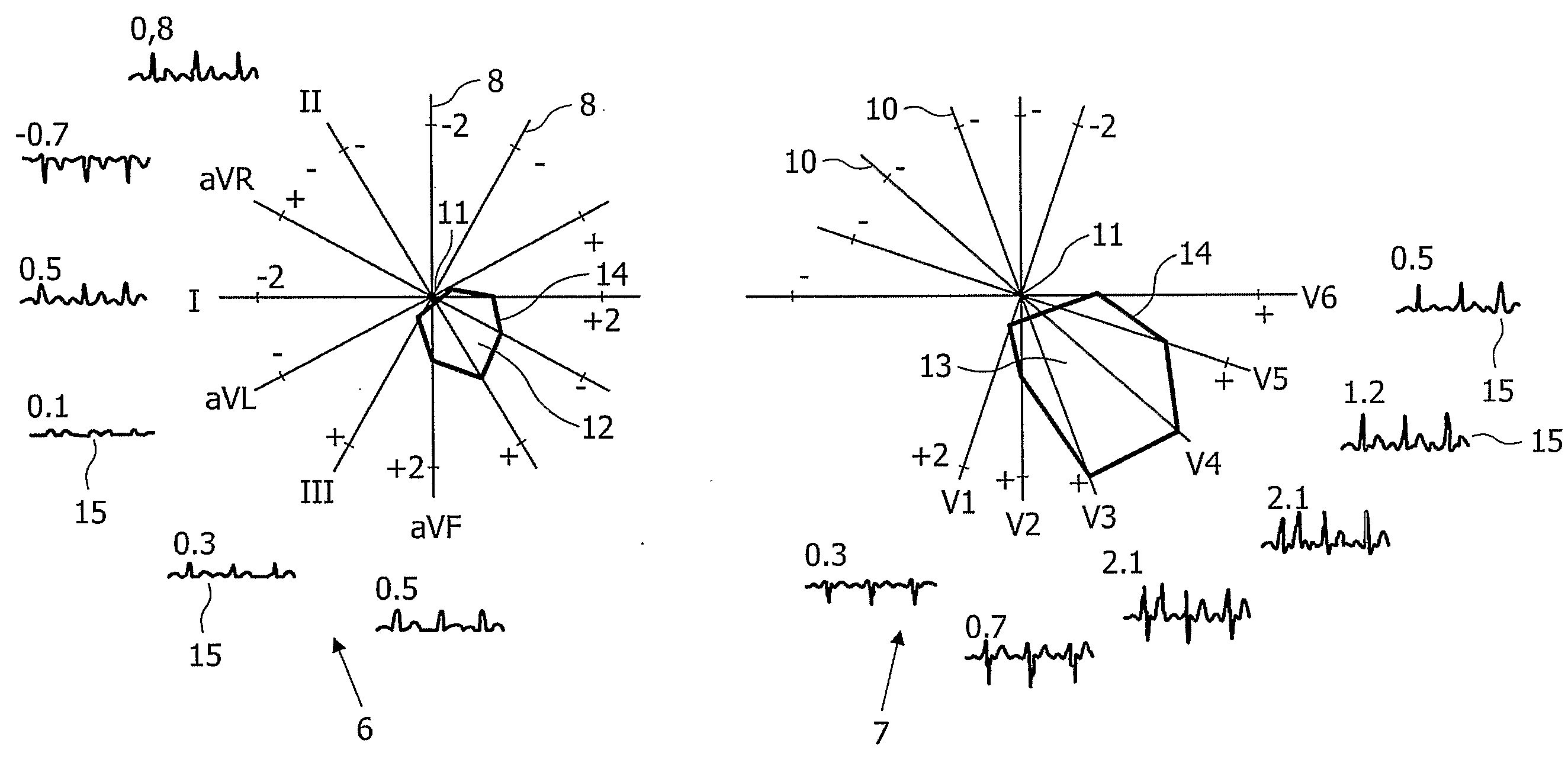
The patent application sets out to solve this problem essentially by displaying the data in a particular manner, namely using a number of multiaxis diagrams in which the position of the axes is related to the position of the sensors arranged on the patient. Fig. 2 shows an example of such multiaxis diagrams:

Fig. 2 of EP 1 794 694

Here is how the invention is defined in claim 1:

  • Claim 1 (main request)

Is it technical?

The board of appeal primarily dealt with claim 1 of auxiliary request III, since the findings applied equally to the more generic higher ranking requests. This claim version differed from the closest prior art in that each axis of the multiaxis diagrams displaying ECG data displays data from its respective ECG lead data, the position and the angle of each of the axes correspond to the location of the respective ECG lead in the arrangement according to which the respective ECG electrodes of the leads were positioned on the patient, and a 3D heart model is displayed together with the multiaxis diagrams, each of the axes in the multiaxis diagrams extending from the centre of the heart model.

According to the board, these features related to the presentation of information (which is one of the items on the exclusion list) and thus it had to be carefully assessed whether they produce a technical effect:

These features relate to presentations of information (Article 52(2)(d) EPC) and may only contribute to an inventive step if they produce a technical effect, i.e. if they contribute to the technical character of the claim by interacting with its technical features to solve a technical problem (see T 641/00, Headnote 1 and T 1143/06, point 3.4 of the reasons).

Interestingly, the appellants drew an analogy with the famous “Bildstrom” decision of the German Federal Court of Justice (BGH, X ZR 37/13, GRUR 2015, 660 – Bildstrom of 26 February 2015), and argued that in this decision the FCJ reviewed and explicitly confirmed the case law of the Boards of Appeal of the European Patent Office in relation to presentations of information. That decision was, however, noteworthy in that it identified a category of inventions related to presentations of information other than the “what” (“die Vermittlung bestimmter Inhalte” in the citation below) and “how” (“deren Vermittlung in besonderer Aufmachung” in the citation below) categories  regularly used by the EPO, namely those which exploit physiological characteristics of human perception so as to enable or improve the perception of presented information by a human.

The appellants were not aware of any such distinction having been made in the case law of the Boards of Appeal and asked the board to also recognise such inventions as contributing to the solution of a technical problem.

The board, however, held that also this alleged third category of technical inventions was already recognized by the EPO, but did not apply in the present case:

However, the distinction between subjective psychological factors and objective physiological factors when assessing the presence of a credible technical effect in inventions involving presentations of information has already been made in several decisions of the Boards of Appeal of the European Patent Office (see e.g. T 862/10, point 4.2 of the reasons; T 1375/11, point 4.6 of the reasons). This is not a further category of inventions involving presentations of information, but rather one criterion for assessing the credibility of an alleged technical effect. In the present case, although the Cabrera system evidently reflects the anatomy of the patient, an arrangement of the axes of the diagrams according to the Cabrera system clearly has nothing to do with the physiological characteristics of the physician’s eye or visual system.

The appellants were not able to demonstrate credibly that the distinguishing features of claim 1 of auxiliary request III produced a technical effect. Accordingly, they relate to presentations of information as such and are non-technical features which have to be disregarded in the assessment of inventive step according to the established case law (see T 641/00, Headnote 1).

Therefore, claim 1 of the main request and auxiliary requests I to III was found not to involve an inventive step.

The appellants also tried an auxiliary request IVa which essentially defined that two polygonal patterns are formed by connecting the values of ECG data on each of two multiaxis diagrams representing the horizontal and vertical planes in which the cardiac electrical field is projected.

The argument was that these polygons created new patterns which did not exist in raw ECG data and which provided additional information to the physician for locating a condition in a patient’s heart. Polygonal patterns were a more intuitive representation than mere points plotted on axes and could convey further information through their shape.

The board, however, did not follow these arguments:

The board is not convinced by these arguments since intuitiveness of presentations of information is not an objective effect, but rather a subjective one which depends on the user’s individual needs and preferences (see T 584/10, point 1.1.4 of the reasons; T 407/11, point 2.1.4 of the reasons).

Thus, also this request was found to lack an inventive step.

Finally, the appellants succeeded in filing another auxiliary request with numerous features related to polygonal patterns and parameters calculated on the basis of these patterns, which had not have been searched yet. The board decided to remit the case to the examining division for further prosecution on the basis of these claims.

More information

You can read the whole decision here: T 1442/16 (Cabrera ECG/PHILIPS) of 30.8.2019

Stay in the loop

Never miss a beat by subscribing to the email newsletter. Please see our Privacy Policy.

Privacy policy
* = Required field