Author Archive

Programming a currency tester: technical

The European Patent Office considered a method of programming a currency tester to have at least some technical features. Here are the practical takeaways from the decision T 0494/07 of May 13, 2011 of Technical Board of Appeal 3.4.03:

Key takeaways

A method may provide technical character if it does not only relate to a sequence of computer-executable instructions, i.e. a computer program, which merely have the potential of achieving an effect when loaded into and executed by a computer.

The invention

This patent application relates to a method of classifying an item of currency using a currcncy tester. It comprises the steps of sensing variable characteristics of a currency item and deriving a data vector using values of the sensed characteristics.

Fig. 4 of EP 1 367 546 A1
  • Claims 20 and 21 (main request)

Is it patentable?

The examining divsion reasoned its rejection essentially as follows:

Both the subject-matter of claims 20 and 21, which related to a method of programming a currency tester, and the final product being protected under Article 64(2) EPC 1973 were excluded from patentability under Article 52(2)(c) EPC 1973 with reference to programs for computers.

In contrast, the appelant argued as follows:

Claims 20 and 21 related to a method of programming a currency tester rather than to a program for computers and were therefore not excluded from patentability.

According to the Board in charge, however, the subject-matter of claims 20 and 21 provide technical character because the claimed method relates to storing data in a physical means rather than to a sequence of computer-executable instructions, i.e. a computer program, which merely have the potential of achieving an effect when loaded into and executed by a computer:

Claim 20 relates to a method of programming a currency tester. The claimed method therefore involves technical means, namely a currency tester, and is therefore regarded to have technical character (see the decision T 258/03 of the Boards of Appeal, reasons 4). In particular, the claimed method involves the step of storing data in a currency tester, with the effect that the data are in fact stored in the currency tester once the step has been carried out. This is to be contrasted to a sequence of computer-executable instructions, i.e. a computer program, which merely have the potential of achieving an effect when loaded into and executed by a computer. Thus, the claim category of the claimed method is distinguished from that of a computer program.

Claim 21 is dependent on claim 20 and as such includes all features of claim 20, so that the comments above also apply to that claim. The method defined in claim 21 is therefore also considered as an invention within the meaning of Article 52(1) EPC.

Thus, the Board remitted the case back to the department of first instance for further prosecution, as requested by the appellant.

More information

You can read the whole decision here: T 0494/07 of May 13, 2011.

Data transfer in a clipboard format: technical

The European Patent Office considered a method of performing data transfer of data in a clipboard format to have at least some technical features. Here are the practical takeaways from the decision T 0424/03 (Clipboard formats I/MICROSOFT) of February 23, 2006 of Technical Board of Appeal 3.5.01:

Key takeaways

Facilitating a data exchange across different data formats by means of a clipboard function may provide technical character, in particular when transferring non-file data.

A method implemented in a computer system represents a sequence of steps actually performed and achieving an effect. Thus, the claim category of a computer-implemented method is distinguished from that of a computer program.

The invention

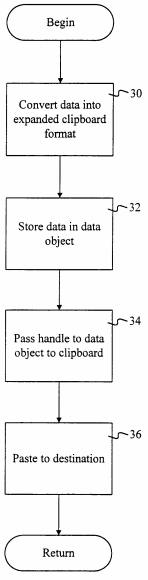
This patent application relates to providing expanded clipboard formats that embellish the number of formats that may be used with a clipboard. These expanded clipboard formats enable users in applications to broaden their use of the clipboard and other data transfer mechanisms.

Fig. 2 of EP 0 717 354 A1
  • Claim 1 (main request)

Is it patentable?

According to the appelant, the claimed method provides technical character:

The claimed method modifies the internal operation of a computer system and is therefore technical. Moreover, the method achieves a non-obvious improvement over the appellant’s prior operating system Windows 3.1 because the available prior art does not suggest a clipboard format which enables non-file data to be transferred for encapsulation into a file at a receiving application program (data sink) which expects to handle a file format (rather than a text format, for example).

The Board in charge generally agrees to appelant’s arguments:

Claim 1 relates to a method implemented in a computer system. T 258/03 – Auction method/Hitachi (OJ EPO 2004, 575) states that a method using technical means is an invention within the meaning of Article 52(1) EPC. A computer system including a memory (clipboard) is a technical means, and consequently the claimed method has technical character in accordance with established case law.

Moreover, the Board would like to emphasise that a method implemented in a computer system represents a sequence of steps actually performed and achieving an effect, and not a sequence of computer-executable instructions (i.e. a computer program) which just have the potential of achieving such an effect when loaded into, and run on, a computer. Thus, the Board holds that the claim category of a computer-implemented method is distinguished from that of a computer program. Even though a method, in particular a method of operating a computer, may be put into practice with the help of a computer program, a claim relating to such a method does not claim a computer program in the category of a computer program. Hence, present claim 1 cannot relate to a computer program as such.

The Board also considers the claimed method steps to contribute to the technical character of the invention:

These steps solve a technical problem by technical means in that functional data structures (clipboard formats) are used independently of any cognitive content (see T 1194/97 – Data structure product/Philips; OJ EPO 2000, 525) in order to enhance the internal operation of a computer system with a view to facilitating the exchange of data among various application programs. The claimed steps thus provide a general purpose computer with a further functionality: the computer assists the user in transferring non-file data into files.

Moreover, the Board considers that the claimed subject-matter solves a technical problem with technical means:

7.1 With respect to the closest prior art (Windows 3.1), the method of claim 1 solves the problem of how to facilitate a data exchange across different data formats, in particular when transferring non-file data.

7.2 The solution provides for a file contents clipboard format and a file group descriptor format which interact to allow data to be sent in a first format (non-file data) and processed in a second format (file encapsulation) at the receiving data sink.

As a result, the Board considered the claimed subject-matter to be non-obvious and finally granted a patent.

More information

You can read the whole decision here: T 0424/03 (Clipboard formats I/MICROSOFT) of February 23.

Method steps carried out by building management system: technical

The European Patent Office considered several method steps carried out by a building management system to be technical. Here are the practical takeaways from the decision T 0265/10 of July 5, 2011 of Technical Board of Appeal 3.4.03:

Key takeaways

Assigning a fixed internet address to a terminal of a building management system which is securely attached to a building provides the technical contribution that the system is capable of determining that a user actually was in said building when a specific interaction with the terminal was conducted.

The invention

The application underlying the present decision relates to a system for monitoring site events at a plurality of buildings. Each building comprises a terminal to which a unique internet address is assigned. Furthermore, the terminals are securely attached to the buildings. This allows transmitting status information to a terminal in a building in response to a user interaction conducted at the terminal.

Due to the unique internet address of the terminals and since the terminals are attached to the buildings, it is ensured that the status information is transmitted to the correct terminal actually located in the intended building. In other words, the system prevents that status information is transmitted to an unintended terminal, e.g. due to a wrongly identified terminal.

Fig. 1 of EP 1 266 361 B1
  • Claim 1 (main request)

Is it patentable?

The first instance examining division argued that the claimed subject-matter would involve a plurality of features that merely refer to administrative tasks and thus would lack technical character. Hence, these features were omitted when it came to the assessment of inventive step and the application was rejected, without even considering prior art documents:

4.1 According to the decision under appeal, the subject-matter of claim 1 then on file lacked an inventive step, Article 56 EPC 1973. In substance it was argued that claim 1 involved a number of non-technical features being administrative steps (decision under appeal, reasons 2.2.c)). These administrative steps were taken as starting point for the technically qualified professional to undertake the technical implementation by way of technical means.

The technical character of the claim was considered to reside in that software was running on terminals, data was held in a database, web browser software was running on terminals, and the terminals and database were connected over the internet.

A general purpose networked computer system with these functionalities was so well known before the priority date of the application as considered not to require documentary evidence (cf reasons 2.2.e) and g)).

However, the Board of Appeal in charge took a different view on this point:

Arguably, it would be obvious to a person skilled in the art to implement technically the underlying administrative procedure of monitoring site events reported by a user, by providing site terminals connected via the internet to a central database. As argued by the appellant, however, a particular problem relating to user reported events, as opposed to events reported by automated control systems located in the building, is the credibility of the data provided. In particular, it is perceived to be a problem that eg contractors may pretend to have been present at a particular building at a particular time. The mere technical implementation by providing an internet-based system would in fact open up a number of possibilities of entering data into the system from locations other than those intended, as the true geographical location of the input terminal of the user is generally not considered a relevant factor in the internet.

The application sets out to solve this specific problem and provides a technical solution to it. In particular, by giving each site terminal a pre-loaded unique internet address and physically securing it at a respective building, a time/date stamp of the interaction between the user reporting an event and the database, and a site stamp of the user’s location is provided. This permits identifying the building at which the interaction took place, via said unique internet address, and determining the time/date of the interaction. These measures are not considered part of the straightforward technical implementation of the above non-technical administrative procedure. Accordingly, considered from this perspective, the subject-matter of claim 1 is not obvious to a person skilled in the art.

As a result, the Board considered the claimed subject-matter to be non-obvious and finally granted a patent.

More information

You can read the whole decision here: T 0265/10 of July 5, 2011.

Group identifier for serverless group e-mails: technical

The European Patent Office refused to grant a software patent for serverless group e-mail, although the particular way of generating a group identifier was considered to be technical. Here are the practical takeaways from the decision T 1408/09 (Group identifier / SQUARE ENIX) of 7.9.2017 of Technical Board of Appeal 3.5.01:

Key takeaways

Providing a unique identifier for identifying user groups without using a server: technical

Catchwords: “According to the problem solution approach, the objective technical problem is formulated based on the technical effect of the difference between the claimed subject-matter and the starting point in the prior art. It is not a requirement for obviousness that the starting point address this problem. If it does, that could make the solution all the more obvious. If, on the other hand, there is a pointer away from the invention, that might be an indication in favour of inventive step.”

The invention

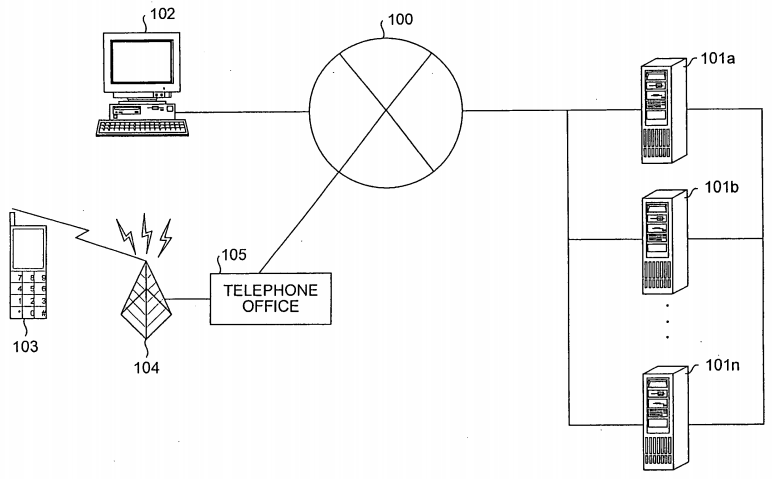
This patent application generally concerns serverless group e-mail, where the groups are managed by the members’ terminals without involving a server.

To this end, the terminals use a group identifier for identifying the groups. The group identifier is generated by combining user information of the terminal of the member forming the group and the time of forming the group. Since the same user cannot create more than one group at exactly the same time, the group identifier is unique throughout the system.

Fig. 1 of EP 1 469 409
  • Claim 1

Is it patentable?

The independent claims differed from the closest prior art in that a group identifier (“group information”) is generated by combining user information of the user generating the group and the time of forming the group. Concerning the effect of this distinguishing feature, the Board noted:

It is also common ground that the group identifier solves the problem of providing a unique identifier for identifying the groups, without using a server.

The Board did not dispute that this was a technical effect. Accordingly, the question to be decided was whether combining user information and the time of forming the group to generate the group identifier was obvious. Here, the Board pointed to another prior art document and concluded that the combination of both teachings renders the claimed subject-matter obvious:

Document D7, cited by the Board, describes a unique identifier called “universal unique identifier” (UUID), which is generated without involving a server. The UUID is based on user information (a node ID, or a POSIX user ID) and a timestamp.

The skilled person, faced with the problem of providing a unique identifier for mobile communication groups, would have looked for solutions in the wider field of networked systems. D7 is a general disclosure of a unique identifier that can be used for multiple purposes to reliably identify objects across a network. Although it has not been established that the particular format described in D7 was part of the skilled person’s general knowledge at the priority date, the Board considers that the concept of UUIDs as such was widely known at the date of the invention. Thus, the skilled person would have looked in the direction of UUIDs, and he would have considered the teachings in D7.

Therefore, the Board ultimately decided that the patent application does not involve an inventive step.

More information

You can read the whole decision here: T 1408/09 (Group identifier / SQUARE ENIX) of 7.9.2017

Viewing two video clips simultaneously: technical

The European Patent Office granted a European software patent for a method for quickly and easily viewing two different video clips simultaneously. Here are the practical takeaways from the decision T 1648/13 (Video editing/CORE WIRELESS) of 12.11.2018 of Technical Board of Appeal 3.5.07:

Key takeaways

The implementation of a graphical user interface (GUI) includes non-technical aspects of the GUI layout but also technical aspects regarding user-computer interaction.

Influencing the way a user interacts with a computer to perform specific operations may be considered a technical means solving a technical problem.

The invention

This patent application is about video editing and concerns a method for a user to quickly and easily view two different video clips simultaneously, and in particular for selecting a particular video frame for use in clipping and/or combining two video clips e.g. by cross-fading or wiping. According to the patent application, the invention is particularly advantageous when used in devices with small screens. To match two video clips (“video streams” in the claims), the frames of one video clip are arranged along a vertical timeline and the frames of the other video clip along a horizontal timeline. Either video clip can be moved along its timeline by moving an input device to the left and right, for the video arranged horizontally, and up and down, for that arranged vertically.

Fig. 2 of WO 2006/064358 A1
  • Claim 1 (auxiliary request)

Is it patentable?

According to the Board, the implementation of a graphical user interface (GUI) includes non-technical aspects of the GUI layout but also technical aspects regarding user-computer interaction. In the present case, displaying frames of video streams may provide a technical contribution, particularly in light of the features (c) “in response to user input, the frames displayed in the overlapping image area are changed by moving the first video stream left/right and the second video stream up/down”; and (d) “the frames displayed in the overlapping image area are selected for creating a single video stream by transitioning between the first and the second video streams”:

6.3 In the present case, amendments (c) and (d) introduced specific features of a user-interface for video editing in a computer which are technical features going beyond a non-technical method for presentation of information. Unlike claim 1 of the main request, the method of claim 1 of the first auxiliary request can no longer be seen as concerning mere presentation of information. The consideration of which features of the claimed invention make a technical contribution has hence to be reviewed.

6.4 In the Board’s opinion, the display of the frames of the video streams vertically and horizontally makes a technical contribution in combination with the other features of the claimed invention, since it influences the way the user interacts with the computer to perform a video-editing operation for combining two video streams by selecting a frame from each video stream.

In conclusion, the Board ruled that particularly features (c) and (d) have to be taken into account when it comes to the assessment of inventive step. Then, in light of the cited prior art documents, the Board further ruled that the subject-matter of claim 1 according to the auxiliary request involves an inventive step.

More information

You can read the whole decision here: T 1648/13 (Video editing/CORE WIRELESS) of 12.11.2018

Checking consistency and completeness of selection conditions: technical

The European Patent Office considered a method for checking consistency and completeness of selection conditions to have at least some technical features. Here are the practical takeaways from the decision T 2330/13 (Checking selection conditions/SAP) of 9.5.2018 of Technical Board of Appeal 3.5.07:

Key takeaways

Even though a claimed task is of a non-technical nature, the specific claimed calculation steps when performed by parallel processing, may contribute to the technical character of an invention.

The invention

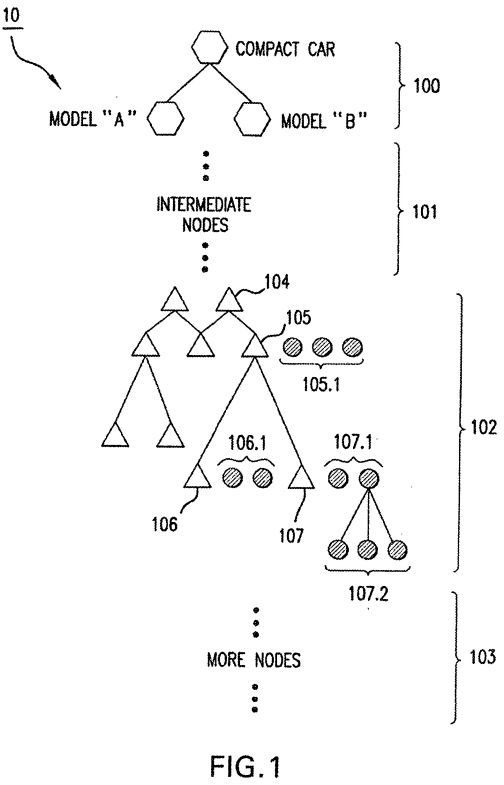
This patent application relates to a method for efficiently checking the consistency and completeness of selection conditions for components of a configurable product. It can be used, for instance, for the purpose of assembling an automobile model from a catalogue of parts according to a particular set of design specifications, in order to ensure that the combinations of parts are correct. According to the description, the method is significantly faster than prior-art methods because it uses bit operations to evaluate the selection conditions.

Fig. 1 of EP 1 519 284 A1
  • Claim 1 (auxiliary request)

Is it patentable?

According to the Board, the claimed invention unquestionably contains elements of a mathematical / logical nature. In particular, claim 1 of the (amended) main request specifies that the received selection and restriction conditions comprise defined logical operations which are applied to bit sub-matrices in order to form bit strings and that bit strings are combined using logical AND, OR and NOT operations.

5.3 According to established case law, it is legitimate to have a mix of technical and non-technical features (i.e. features relating to non-inventions within the meaning of Article 52(2) EPC) in a claim, even if the non-technical features form a dominating part (T 641/00, OJ EPO 2003, 352, reasons 4). Inventive step in so-called mixed-type inventions is to be assessed by taking account of all those elements of the claimed subject-matter which contribute to its technical character (see T 641/00, supra, reasons 6 and 7). Features which would, taken in isolation, belong to the matters excluded from patentability under Article 52(2) EPC may nonetheless contribute to the technical character of the claimed invention (G 3/08, OJ EPO 2011, 10, reasons 12.2.2). However, purely non-technical elements which do not interact with the technical subject-matter of the claim for solving a technical problem are ignored (see T 154/04, OJ EPO 2008, 46, reasons 5(F)).

5.8 In summary, even though the task performed by claim 1 is of a non-technical nature (see point 5.6 above), the specific claimed bit (sub-)matrices, bit strings and steps of the method, especially those of splitting the bit matrix, forming bit strings representing the selection and restriction conditions and determining inconsistent pairs of selection conditions when performed by parallel processing, do contribute to the technical character of the invention and should be taken into account when assessing inventive step. Similar conclusions apply to the other claims of the main request.

Thus, the Board disagrees with the assessment of the examining division with respect to the technical charachter of a plurality of the claimed method steps. Moreover, said features were also found not to be notorious, and thereore have to be considered in the assessment of inventive step:

7. In the Board’s view, the features of claim 1 of the main request contributing to the technical character of the claimed subject-matter which were listed above are not notorious. Furthermore, it follows from the technical-character assessment above that the claimed method cannot be seen as corresponding to an obvious “human approach”, as argued in decision T 1954/08. Unlike the binary map in that case, the bit (sub-)matrices and bit strings of the present invention are not merely used to store “flagged information”, but instead play an important role in the processing steps which are specifically adapted to use those data structures for the efficient parallel evaluation of selection conditions in a computer.

Thus, the Board remitted the case back to the first instance examining division for re-examination of inventive step.

More information

You can read the whole decision here: T 2330/13 (Checking selection conditions/SAP) of 9.5.2018

Server load balancing based on mathematical calculations: technical

The European Patent Office granted a software patent for a server load balancing technique based on mathematical calculations. Here are the practical takeaways from the decision T 0318/10 (Load Distribution/CLUB IT) of 2.9.2014 of Technical Board of Appeal 3.5.06: 

Key takeaways

Improving the resource consumption in a server is a technical effect

A basic difference between a mathematical method and a technical process can be seen in the fact that a mathematical method is carried out on numbers and provides a result also in numerical form, the mathematical method being only an abstract concept prescribing how to operate on the numbers and producing no direct technical result as such. In contrast thereto, if a mathematical method (in the present case the optimisation function) is used in a technical process (in the present case assigning a server from among a plurality of servers to process a client request), that process is carried out on a physical entity by some technical means implementing the method and provides as its result a certain change in that entity.

The invention

This patent application generally relates to server load balancing, i.e. to a method of load distribution to assign a server from multiple network-connected servers for the execution of a client’s processing request. The load distribution function can be installed on any server in the network.

Fig. 1 of EP 1 696 324
  • Claim 1 (main request)

Is it patentable?

In this case, the load distribution function was defined by mathematical formulae and thus the question to be decided was essentially whether such a mathematical optimization was technical:

The board does not agree with the appealed decision that the mathematical formulation of the optimisation function used in a load distribution method in a computer network is non-technical, or, put another way, without technical effects. As stated in T 208/84 (Reasons, point 5) (“Computer-related invention/VICOM”; see OJ EPO 1987, 14), a basic difference between a mathematical method and a technical process can be seen in the fact that a mathematical method is carried out on numbers and provides a result also in numerical form, the mathematical method being only an abstract concept prescribing how to operate on the numbers and producing no direct technical result as such. In contrast thereto, if a mathematical method (in the present case the optimisation function) is used in a technical process (in the present case assigning a server from among a plurality of servers to process a client request), that process is carried out on a physical entity by some technical means implementing the method and provides as its result a certain change in that entity. In the present case the optimisation function as defined by claim 1 results in a change in the resource consumption of the server system which is a technical effect.

Since none of the prior art on record provided a hint towards the claimed distance calculation and process request allocation techniques, the first instance rejection was lifted by the Board and a patent was granted.

More information

You can read the whole decision here: T 0318/10 (Load Distribution/CLUB IT) of 2.9.2014

EUROPEAN SOFTWARE PATENTS March 2019 updates

March came with seven new decisions in the EUROPEAN SOFTWARE PATENTS knowledge base relating to artificial intelligence, computer simulations, information modelling and Internet search engines:

Software patents for artificial intelligence?

Artificial intelligence is undoubtedly one of the hottest topics in tech these days. So far, there are only few decisions of the EPO Boards of Appeal dealing specifically with AI.

But some questions have been decided already: According to one Board, the question whether two text documents belong to the same class of documents in respect of their textual content is non-technical. Similarly, classifying data records for a non-technical purpose (e.g. for billing) was considered to be a non-technical issue.

(more…)

Simulating pedestrian crowd movement: to be decided by the Enlarged Board of Appeal

The Technical Board of Appeal 3.5.07 is uncertain whether a method of modelling pedestrian crowd movement in an environment and using the results for designing a building structure is technical or not. Here are the practical takeaways from the decision T 0489/14 (Pedestrian simulation/CONNOR) of 22.2.2019:

Key takeaways

According to earlier case law referring to the simulation of an electronic circuit, a computer-implemented method has technical character if the method is functionally limited to a technical purpose. However, in the present decision, the Technical Board of Appeal is uncertain whether the earlier reasoning is correct since the claimed subject-matter allegedly lacks a link to the physical reality.

Hence, the Board formulated three referral questions to the Enlarged Board of Appeal (the highest judicial entity in the European patent system) asking it to decide essentially whether the simulation of a technical system has to be excluded from patent protection or not.

The invention

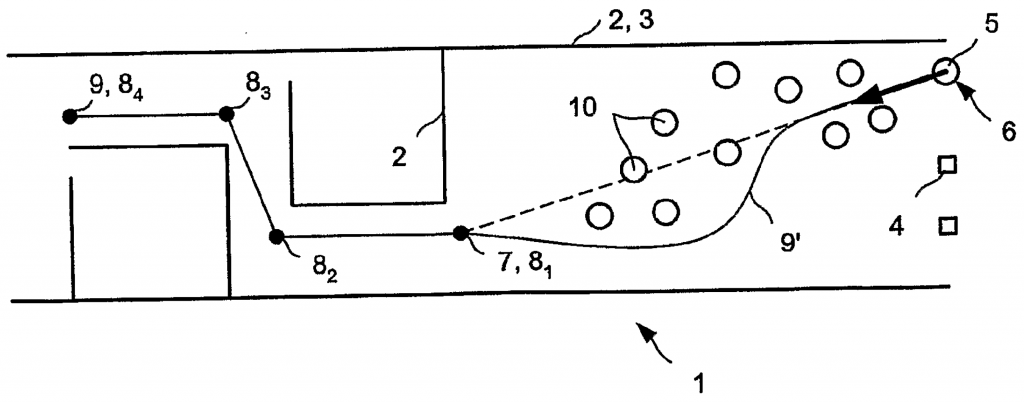
The patent application underlying this case concerns the modelling of pedestrian movement, which could be used to help design or modify a venue (building structures like houses or train stations). According to the applicant, this provides a more accurate and realistic simulation of pedestrian crowds in real-world situations, which could not be adequately modelled by conventional simulators. The invention is said to be based on the insight that human interaction could be expressed and modelled in the same way as physical interactions.

Fig. 2 of WO 22004/023347 A2

  • Claim 1 (main request)

  • Claim 1 (auxiliary request IV)

Is it patentable?

The EPO’s first instance examining division rejected the patent application by arguing that a simulation model is non-technical and that its implementation on a computer is obvious. In the appeal, the applicant argued in a nutshell that the method steps referring to the simulation algorithm are indeed technical because they relate to physical parameters (“humans cannot walk through a wall”). Moreover, the simulation according to the invention would have multiple similarities to the simulation of an electronic circuit which was considered technical in T 1227/05:

The application concerned modelling pedestrian movement, which could be used to help design or modify a venue. It sought a more accurate and realistic simulation of pedestrian crowds in real-world situations, which could not be adequately modelled by conventional simulators. The application was based, at least in part, on the insight that human interaction could be expressed and modelled in the same way as physical interactions.

In claim 1 of the main request, which was now directed to a method of modelling pedestrian crowd movement in an environment by means of simulation, the method steps contributed to the technical character of the invention in two ways. First, the method steps were themselves technical features, as they related to physical parameters which could be expressed in terms of physical quantities and involved applying physical laws of motion and considerations of cost or work. Second, they contributed to the technical character of the invention by virtue of their interaction with the computer. The method of claim 1 produced a technical effect in the form of a more accurate simulation of crowd movement. Following decision T 1227/05, modelling pedestrian crowd movement in an environment constituted an adequately defined technical purpose for a computer-implemented method. The claimed method yielded accurate and repeatable results no different from those produced by a method of modelling an electron using a similar numerical method. Moreover, the claimed simulation method was no more suited to being carried out mentally than the simulation method considered in decision T 1227/05.

According to the applicant, particularly claim 1 of auxiliary request IV would help clarify that a technical effect outside the computer is produced:

The third, fourth and fifth auxiliary requests helped clarify the effect outside the computer and emphasised that the process was one which could not be performed simply with the help of pencil and paper.

The board in case T 1227/05 had adopted a correct approach. It had recognised the importance of simulations and had understood the practical issues in claiming them. This approach had been followed in decision T 625/11 of 19 January 2017.

How the EPO examines software patentsBy the way, if you are interested in a deeper look into how the European Patent Office examines software-related inventions, this 30-minute video gives a concise overview of the “two hurdle” approach with lots of examples.

However, the Board in charge of this appeal expresses concerns about the correctness of T 1227/05 and raises doubts whether the invention underlying T 1227/05 produces a technical effect sufficient to constitute patent-eligibility:

11. In the Board’s view, a technical effect requires, at a minimum, a direct link with physical reality, such as a change in or a measurement of a physical entity. Such a link is not present where, for example, the parabolic trajectory followed by a hypothetical object under the influence of gravity is calculated. Nor can the Board detect such a direct link in the process of calculating the trajectories of hypothetical pedestrians as they move through a modelled environment, which is what is claimed here. In fact, the environment being modelled may not exist and may never exist. And the simulation could be run to support purely theoretical scientific investigations, or it could be used to simulate the movement of pedestrians through the virtual world of a video game.

15. In sum, the Board agrees with the appellant that decision T 1227/05 supports his case. However, the Board is not fully convinced by the decision’s reasoning. Its doubts are twofold.

First, although a computer-implemented simulation of a circuit or environment is a tool that can perform a function “typical of modern engineering work”, it assists the engineer only in the cognitive process of verifying the design of the circuit or environment, i.e. of studying the behaviour of the virtual circuit or environment designed. The circuit or environment, when realised, may be a technical object, but the cognitive process of theoretically verifying its design appears to be fundamentally non-technical.

Second, the decision [editor’s note: T 1227/05] appears to rely on the greater speed of the computer-implemented method as an argument for finding technicality. But any algorithmically specified procedure that can be carried out mentally can be carried out more quickly if implemented on a computer, and it is not the case that the implementation of a non-technical method on a computer necessarily results in a process providing a technical contribution going beyond its computer implementation (see e.g. decision T 1670/07 of 11 July 2013, reasons 9).

The Board applies the same line of argumentation with respect to claim 1 of the fourth auxiliary request, which explicitly relates to a process for designing a building structure:

This amendment limits the claimed computer-implemented simulation to its use in a method of design. Since decision T 1227/05 essentially derives the technicality of a computer-implemented simulation from its significance for modern product development processes, this limitation arguably strengthens the appellant’s case. The amendment does not, however, change the Board’s present position that the claimed computer-implemented simulation does not contribute to a technical effect, as a direct link with physical reality is still absent.

Further, the Board recognizes the (economic) importance of computer-implemented numerical simulations, but is hesitant to base its decision on such considerations:

There is no doubt that the significance of numerical development tools has increased even more since case T 1227/05 was decided, yet the Board is hesitant to base its decision on policy considerations relating to the appropriate scope of patent protection that have not been expressed by the legislator and have in fact arisen only since the relevant provisions of the EPC were enacted (the Diplomatic Conference for the revision of the EPC in 2000 not having materially changed them). The Board is aware that the legislator deliberately refrained from defining the terms “technical” and “technology” in order not to preclude adequate protection being available for the results of future developments in fields of research which the legislator could not foresee (cf. decision G 2/07, reasons 6.4.2.1), but it sees a difference between the emergence of a new field of innovation and a change in the perceived significance of an existing field.

As a result, the Technical Board of Appeal formulated three questions to be referred to the Enlarged Board of Appeal and consequently postponed the decision:

“In the assessment of inventive step, can the computer-implemented simulation of a technical system or process solve a technical problem by producing a technical effect which goes beyond the simulation’s implementation on a computer, if the computer-implemented simulation is claimed as such?”

“If the answer to the first question is yes, what are the relevant criteria for assessing whether a computer-implemented simulation claimed as such solves a technical problem? In particular, is it a sufficient condition that the simulation is based, at least in part, on technical principles underlying the simulated system or process?”

“What are the answers to the first and second questions if the computer-implemented simulation is claimed as part of a design process, in particular for verifying a design?”

More information

You can read the whole decision here: T 0489/14 (Pedestrian simulation/CONNOR) of 22.2.2019.

This case has also been discussed on The IPKat, the Kluwer Patent Blog and Lexology.