Author Archive

Improving information display on a display device of an aircraft: technical

The European Patent Office granted a software patent on a method of representing missed approach information in perspective view on a cockpit display. Here are the practical takeaways of the decision T 0013/18 of 12.4.2019 of Technical Board of Appeal 3.2.01:

Key takeaways

Enabling a pilot to abort a landing in due time if necessary, thereby improving safety: technical

The invention

This European patent application relates to a method for displaying information on a display device of an aircraft. The method comprises determining graphics data for visual aids that represent
missed approach data, incorporating the graphics data into a user interface that is in perspective view, and generating the user interface for display on the display device of the aircraft.

Fig. 3A of EP 2 664 549

Here is how the invention is defined in claim 1 of the main request:

  • Claim 1 (main request)

Is it technical?

The Board found that claim 1 differs from the closest prior art by the step of “determining, by a distance determination module (24), using the approach data (30) based on real-time flight data or prescribed flight data at least one of a time and a distance from the touchdown point where the decision height or the minimum descent altitude would be achieved” (feature c).

According to the Board, this difference solves the following technical problem:

Determining at least the time or distance from the touchdown point where the decision height or the minimum descent altitude would be achieved will enable the pilot to abort the landing in due time if necessary.

The problem to be solved may be regarded as to increase safety landing.

In view of the prior art at hand, there was no hint for the skilled person to come up with the claimed solution:

D1 (col.8, l.33-45, figure 4) discloses the following: “If the aircraft drops below a predetermined altitude, a shadow 63 of the predictor 31 becomes visible on the screen. The shadow 63 gives the pilot information as to the altitude and the predicted altitude without it being necessary to concentrate on another instrument. In connection with the change in the color of the symbols of the predictor 31 in the region of the lower permissible speed, the pilot can at a glance gather all necessary information shortly prior to touchdown”. The information displayed in D1 enables the pilot to correct the landing.

Thus D1 deals with another problem than the one in the present application. It does not enable the pilot to visualise the decision height or the minimum descent altitude to enable him to take a decision on aborting the landing of the plane. Furthermore there is no incentive for the skilled person to change the information displayed in D1 and to determine the time or distance from touchdown where the decision height or the minimum descent altitude would be achieved.

Therefore, the subject-matter of claim 1 was found to involve an inventive step.

More information

You can read the whole decision here: T 0013/18 of 12.4.2019

Stay in the loop

Never miss a beat by subscribing to the email newsletter. Please see our Privacy Policy.

Privacy policy
* = Required field

Displaying user interfaces more quickly by precomputing information: technical

In this decision, the European Patent Office acknowledged that precomputing user habit information for a graphical user interface of a mobile device is technical. However, this difference over the prior art was found to be obvious. Here are the practical takeaways of the decision T 1718/17 (User habit list/HUAWEI) of 29.4.2019 of Technical Board of Appeal 3.5.06:

Key takeaways

Maintaining information as sub-tables rather than generating the tabular information as needed has the advantage that the display interface can be generated more quickly when actually needed, but the disadvantage that the sub-tables must be precomputed and kept in memory.

In the art of computing, “precomputation” is a well known method of speeding up program execution.

The invention

This European patent application relates to the problem of simplifying the use of complex user interfaces, e.g. in smartphones.

The invention proposes to track users’ interactions with their devices to determine their “habits” and thus to predict what they might want to do next. A number of likely user preferences (“user habit options”) are compiled from actual user operations and displayed as a “user habit list” from which the user can select. The list is ordered according to priorities that aim to express user preferences well. The parameters being tracked (and taken into account to arrange the user habit list) relate to applications and their options, the frequency of calls, the time of day, and the like.

Fig. 4 of the application illustrates an example of a user habit list:

Fig. 4 of EP 2 888 664

Here is how the invention is defined in claim 1 of the main request:

  • Claim 1 (main request)

Is it technical?

The Board of Appeal identified the following difference between claim 1 and the closest prior art: Instead of maintaining a single user habit list as in the prior art, claim 1 referred to at least two “user habit statistical sub-tables” which reflect the user habits for “different time span[s] of a day”.

On the one hand, the Board took the view that the multiple statistical sub-tables indeed provide a technical effect. Doing so, however, was found to be obvious:

In the application to hand, the “sub-tables” are disclosed in embodiments 4 and 6 (see the original description, page 17, line 9, to page 19, line 7, and page 20, line 9, to page 22, line 16). Apart from no­ting that different sub-tables can model time-dependent user habits (see page 17, lines 16 to 29) – which is known from documents D3, D5 and D7 – the description does not disclose any specific technical effect of using the claimed subtables for the implementation of that model.

The board can only speculate that maintaining the pertinent information as “sub-tables” rather than (re-)generating the tabular information as needed has the advantage that the display interface can be generated more quickly when actually needed, but the disadvantage that the sub-tables must be precomputed and kept in memory. From this perspective, precomputing sub-tables would have been obvious to the skilled person to achieve the effect known from document D3 as a matter of the well-known trade-off of “precomputing”, namely between time and space requirements on the one hand and system responsiveness on the other.

The board takes the view that, in the art of computing, “precomputation” is a well known method of speeding up program execution. The basic idea is to avoid the time-consuming computation of certain data when it may be needed urgently, by computing it – or part of it – earlier. This speeds-up access to the data when needed and may, thereby, increase system responsiveness. This advantage comes at a cost, in that the precomputed data has to be stored until needed and thus increases the program’s memory consumption.

Therefore, the Board decided that claim 1 does not involve an inventive step and dismissed the appeal.

More information

You can read the whole decision here: T 1718/17 (User habit list/HUAWEI) of 29.4.2019

Stay in the loop

Never miss a beat by subscribing to the email newsletter. Please see our Privacy Policy.

Privacy policy
* = Required field

EUROPEAN SOFTWARE PATENTS May 2019 updates

May came with seven new decisions in the EUROPEAN SOFTWARE PATENTS knowledge base relating to graphical user interfaces, navigation systems, computer games, business methods, video processing, programming and cryptography:

Patents for graphical user interfaces

Improvements in graphical user interfaces are sometimes difficult to protect with patents when they are closely related to the presentation of information (which is as such excluded from patentability).

In one case, however, the Board of Appeal decided that displaying a 3D bird’s eye view map, e.g. in a car navigation system, and the associated calculation steps are technical and thus enter into the inventive step assessment. An important finding was that displaying information in an ergonomically improved manner is indeed a technical purpose.

In another decision relating to GUIs in video games, the European Patent Office granted a software patent on graphical layout aspects of a video game which improved its functional quality. One of the aspects of the invention related to making a possibly concealed indicator clearly visible on a display screen to the user of an interactive video game.

As a negative example in the realm of navigation systems, the European Patent Office refused to grant a patent for a navigation system that can be tailored to a user’s particular wishes.

Business method patents

In one recent decision, the Board of Appeal considered a method for determining a reference reading from a load cell of a cash till as technical and remitted the case back to the examining division. The Board emphasized the basic principle that a computer-implemented method may have a technical character provided that the method is functionally limited to a technical purpose.

By the way, if you are interested in a deeper look into how the European Patent Office examines software-related inventions, this 30-minute video gives a concise overview of the “two hurdle” approach with lots of examples.

Patents for audio / video / image processing

Just recently, the European Patent Office granted a software patent on improving the recognition of songs or background music in a video by using closed-captioning data for determining an audio segment that is relatively free of interference. The Board held that improving the recognition of songs or background music is a technical problem.

Programming

The act of programming in itself is regularly regarded to be a mental activity devoid of technical character. In this decision, several method steps for generating a parallel computation graph were found to be non-technical, since the mere potential for a speed-up by parallelization of a computer program is not sufficient for arguing a “further” technical effect.

Cryptography

Although normally based on mathematical concepts, inventions in the field of applied cryptography are regularly allowed by the European Patent Office. For example, in this case the Board of Appeal considered a mathematical method of masking a private key technical. More precisely, the Board decided that protecting a cryptographic computation against power attacks is a technical problem if, and only if, the computation is actually carried out on hardware and thus open to such attacks.

Fear of missing out?

Stay in the loop

Never miss a beat by subscribing to the email newsletter. Please see our Privacy Policy.

Privacy policy
* = Required field

Generating a parallel computation graph: not technical

The European Patent Office considered several method steps for generating a parallel computation graph as not technical. Here are the practical takeaways from the decision T 1125/17 (Parallelizing computation graphs/AB INITIO) of April 2, 2019 of Technical Board of Appeal 3.5.06:

Key takeaways

The mere potential for a speed-up by parallelization of a computer program is not sufficient for arguing a “further” technical effect as a requirement for patentability of a computer program.

The invention

This patent application relates to computation graphs in which the vertices and the links define, respectively, “data processing elements” and the data flow between them. More specifically, the application relates to the transformation of “serial computation graphs” into “parallel computation graphs”. The application explains that it may be desirable to implement a computation graph using multiple instances of individual components. For example, each instance of a component may be hosted an a different processor, thereby achieving a coarse-grain parallelism that provides an overall increase in computation capacity.

Fig. 2B of WO 2005/001687 A2

  • Claim 1 (auxiliary request 5)

Is it patentable?

According to the applicant, it would be easier to parallelize a parallel computation graph as generated by the claimed method:

6. During the oral proceedings, in the context of auxiliary request 4, it was discussed whether the transformation of one computation graph into another, without an explicit mention of the deployment of parallel hardware or the execution on parallel hardware, would have to be accepted as a technical effect on the assumption that the generated computation graph was established as lending itself more easily to parallelization than the given one. Although this question turned out not to be decisive for the case at hand, the appellant encouraged the board to comment on this question in its decision.

In response, the Board in charge explained that it is of the opinion that the generated parallel computation graph is actually not easier to parallelize than a given user-specified graph. Moreover, the Board argued that an accelerated execution of a parallel program would not only dependent on the program itself, but also on the computer platform on which it is executed. In other words, when a program is executed on a single-core architecture, no speed-up may occur, whereas an acceleration may be achieved when the same program is executed on a multi-core platform:

6.3 Even a program written in a programming language with parallelization instructions or with some express potential for parallel execution such as array processing may be executed on parallel hardware or not. Such a program can also be executed on a single-core processor. In this case, a speed-up by parallelization is not achieved. In many cases, a parallel program could be expected to execute more slowly on the single core than an equivalent serial program since any parallelization overhead is not compensated by the speed-up of parallel computation. This is to say that the speed-up of parallelization is not achieved by the form of the parallel program alone and not before the program is actually deployed and executed on parallel hardware.

Since the effect of an accelerated execution is only achieved on a specific execution platform, the effect of a speed-up could not be attributed to the program alone. Hence, to argue the technical effect of an accelerated execution, the execution platform would have to be included in the claim, which is not the case here:

6.5 This board takes the view that T 1173/97 meant to make this statement only if the mentioned further technical effect was produced whenever the program was run, i.e. on any suitable hardware or runtime environment. For if that effect was produced on a particular execution platform but not on another, the effect could not be attributed to the program itself – unless maybe there was an argument to the effect that the required execution platform was implicit in the program claim. In all other situations, it would seem that the execution platform required to achieve the effect would have to be claimed as an essential feature.

6.6 This would appear to mean that if, as in the present case, an inventive-step argument is to rely upon a speed-up by parallelization, a parallel execution platform must be claimed. Consequently, the mere potential for a speed-up by parallelization would not seem to be sufficient as a “further” technical effect because this effect is not achieved irrespective of how the program is executed.

As a result, the Board dismissed the appeal.

More information

You can read the whole decision here: T 1125/17 (Parallelizing computation graphs/AB INITIO) of April 2, 2019.

Determining a reference reading from a load cell of a cash till: technical

The European Patent Office considered a method for determining a reference reading from a load cell of a cash till as technical and remitted the case back to the examining division. Here are the practical takeaways from the decision T 1823/15 of 19.2.2019 of Technical Board of Appeal 3.5.03:

Key takeaways

In light of T 1227/05, a computer-implemented method may have a technical character provided that the method is functionally limited to a technical purpose

The invention

This patent application relates to reading data from a load cell of a cash till and monitoring cash till transactions. According to the applicant, it is advantageous in that it stores a reading as a verified value if that reading is within a predetermined amount of the subsequent reading, e.g. when the amount of jitter in the output of the load cell between readings is below a predetermined amount. The verified “good” reading can then be used to determine the weight on the load cell. However, a “bad” reading that is different from the subsequent reading by more than a predetermined amount, for example due to excessive jitter in the output of the load cell, will not be stored and consequently will not be used to determine the weight on the load cell.

Fig. 2 of WO 2012/045993 A1

  • Claim 1 (original main request)

Is it patentable?

According to the Board, a difference over the cited prior art resides in the algorithm or mathematical method used to arrive at the final result (or “reference value”) as claimed. However, the examining division considered this feature to be non-technical:

2.7 The Examining Division decided that this mathematical algorithm was a non-technical feature (Reasons, point 2.3.1.3), hence it based its analysis on Guidelines G-VII, 5.4, which concerns claims comprising technical and non-technical features (the reference in the contested decision to “G-VII §5.2” appears to be an error; the relevant section is G-VII, 5.4, both in the version of the Guidelines in force at the time of the decision and currently).

Applying the approach set out in this section of the Guidelines, the Examining Division decided that the claim referred to an aim to be achieved in a non-technical field, which might legitimately appear in the formulation of the problem as part of the framework of the technical problem that is to be solved, in particular as a constraint that has to be met. The Examining Division therefore formulated the problem as “adapting the predetermined rule of the reading method of D9 to another predefined rule”. The problem was therefore seen as merely implementing the claimed algorithm, and it was considered that this would be easily achievable by the skilled person (Reasons, points 2.3.1.4 and 2.3.1.5).

In contrast to the assessment of the examining division, particularly by referring to the principles established in T 1227/05, the Board came to the conclusion that the method defined by claim 1 of the main request relates to the technical purpose of weighing (and thereby counting) physical objects (notes and coins). The Board judges that this technical purpose is adequately defined:

2.12 In T 1227/05, by contrast, the claim related to a computer-implemented method for the numerical simulation of an electrical circuit which is subject to 1/f noise. In this case, the Board found that:

“simulation of a circuit subject to 1/f noise constitutes an adequately defined technical purpose for a computer-implemented method, provided that the method is functionally limited to that technical purpose.” (Reasons, point 3.1; all quotations are from the English translation of T 1227/05 appearing in OJ, 2007, 574.)

Since the claims were found to be adequately functionally limited in this sense, the Board concluded as follows:

“all steps relevant to circuit simulation – and that includes the mathematically expressed claim features – contribute to the technical character of the simulation method according to claim 1 or 2.” (Reasons, point 3.2.4.)

Hence, in assessing whether the claimed simulation methods involved an inventive step, all features which contributed to the technical character of the method were to be taken into account, including the mathematically defined steps (Reasons, point 4).

2.13 The method defined by claim 1 relates to the technical purpose of weighing (and thereby counting) physical objects (notes and coins), and Board judges that this technical purpose is adequately defined (in the sense referred to in T 1227/05) in claim 1 as “determining a reference reading from a load cell (6) of a cash till”, the “reference reading” being the value derived by the defined method from a successive series of readings from the load cell.

2.14 Since the claimed algorithm serves a technical purpose, it must be regarded as a technical feature, and the claimed subject-matter therefore comprises technical features only, and not a mixture of technical and non-technical features. The approach adopted by the Examining Division is therefore inapplicable.

Since the question whether the claimed subject-matter including the features expressed algorithmically is obvious to the skilled person in light of the cited prior has not been addressed by the Examining Division, and to allow the appellant the possibility – if necessary – to have this matter examined before two instances, the Board considers it appropriate to exercise its discretion under Article 111(1) EPC to remit the case to the department of first instance for further prosecution.

More information

You can read the whole decision here: T 1823/15 of February 19, 2019

Stay in the loop

Never miss a beat by subscribing to the email newsletter. Please see our Privacy Policy.

Privacy policy
* = Required field

Improving functional quality of the graphical layout of a video game: technical

This decision is a classic one concerning two items on the list of excluded subject-matter: gaming rules and the presentation of information. The European Patent Office granted a software patent on graphical layout aspects of a video game which improved its functional quality. Here are the practical takeaways of the decision T 0928/03 (Video game/KONAMI) of 2.6.2006 of Technical Board of Appeal 3.5.01:

https://www.youtube.com/watch?v=smG1ejC_QzE

Key takeaways

Making a possibly concealed indicator clearly visible on a display screen to the user of an interactive video game does not exclusively address a human mental process (i.e. it is not exclusively determined by the cognitive meaning of the information presented) but contributes an objective technical function to the display.

Highlighting of a second point of interest, in addition to the active player character, on the display screen in order to draw the user’s attention to the second point on the screen is a technical contribution to be considered in the inventive step discussion.

The invention

This European patent application relates to an interactive video game (e.g. a virtual soccer game) in which a user controls at least one player character displayed on a screen.

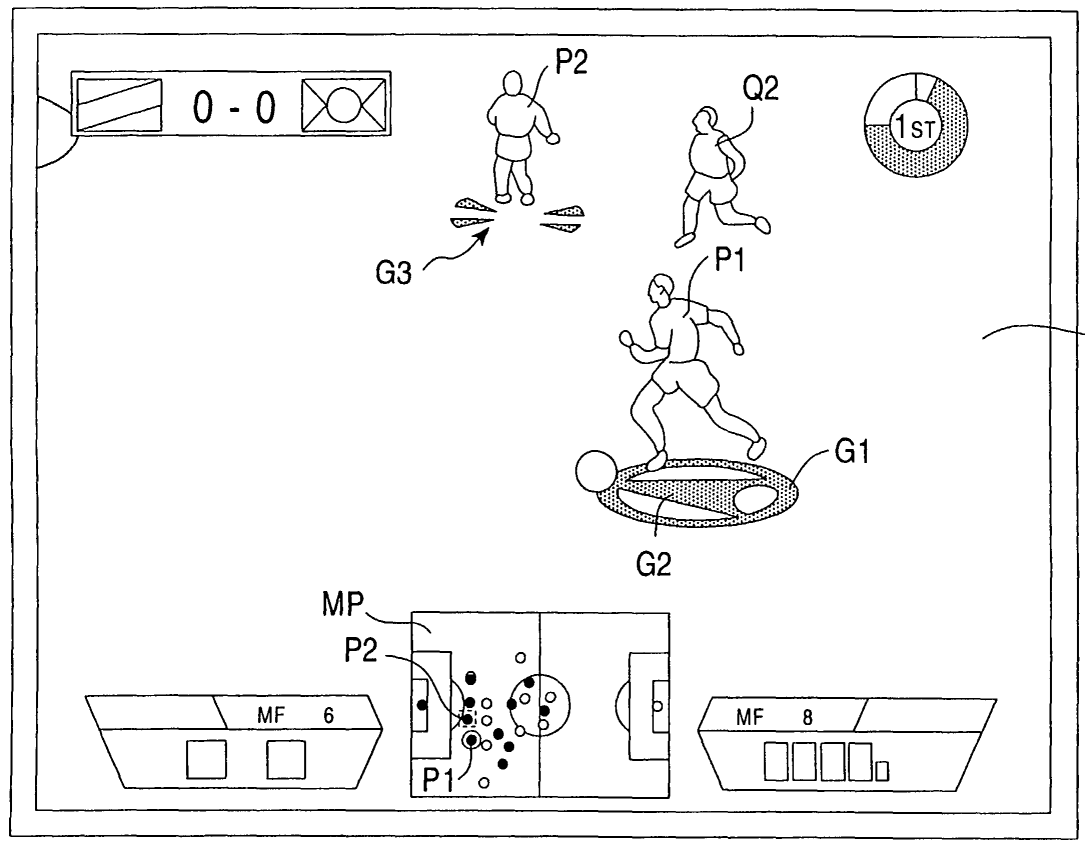
One aspect of the invention is to display a ring-shaped guide mark (see G1 in the image below) around the foot of the active player character. Further, a team mate of the active player is accompanied by a pass guide mark (G3) so that the active player character can easily pass the ball to the team mate. A central aspect was that the pass guide mark is displayed on the end of the display area even when the other player character and the pass guide mark come out of the display area of the monitor screen so as to properly indicate the direction in which the ball is to be passed by the player character.

Fig. 6 of EP 0 844 580

Here is how the invention is defined in claim 1:

  • Claim 1

Is it technical?

First of all, patent-eligibility was not an issue in the present case in accordance with the established case law:

Eligibility for patent protection has not been called into question by the Examining Division. The guide display device according to claim 1 indeed represents a physical entity in particular comprising displaying means which have a technical character by their nature.

The displaying steps of the independent method claim imply the use of displaying means which provides a technical character to the method (T 258/03-Auction method/HITACHI, OJ EPO 2004, 575).

Concerning inventive step, one difference over the closest prior, which indicates the active player character by displaying a small triangle above its head, was that the guide mark is ring-shaped and displayed around a foot of the active player character. The Board assessed the technical character of this difference as follows:

The aforementioned difference implies an enlarged size of the guide mark which avoids any risk of the mark being concealed by a neighbouring player character. Making a possibly concealed indicator clearly visible on a display screen to the user of an interactive video game does not exclusively address a human mental process (i.e. it is not exclusively determined by the cognitive meaning of the information presented) but contributes an objective technical function to the display. The functional quality is not cancelled by the fact that the visualised information will also enter into a decision of the user interacting with the video game displayed on the screen.

In conclusion, the enlarged size of the guide mark will enter into the appraisal of the display device and method with respect to inventive step (T 641/00-Two identities/COMVIK, Headnote I, OJ EPO 2003, 352).

However, the Board ruled differently with respect to the ring shape of the guide mark and its arrangement near the foot of the player character:

On the other hand, the Board is not convinced that the precise geometrical (ring-)shape of the guide mark achieves any effect other than an aesthetic impression. The shape of the guide mark relates to mere artwork in the menu design which the Board considers as non-technical (see T 244/00-Remote control/MATSUSHITA, point 12 of the Reasons).

Consequently, the ring-shape of the guide mark is merely an aesthetic creation and, thus, cannot constitute an inventive step within the meaning of Article 56 EPC.

The same goes for the precise (foot-related) location of the guide mark (G1) with respect to the player character to be marked. In view of the preferred embodiment of the video game (soccer), it may be added that – in accordance with the Examining Division’s finding – marking the foot zone of a player character may also be driven by the non-technical rules of the game, which confirms the non-technical character of that contribution.

By the way, if you are interested in a deeper look into how the European Patent Office examines software-related inventions, this 30-minute video gives a concise overview of the “two hurdle” approach with lots of examples:

Another difference over the closest prior art was that a team mate of the active player character is accompanied by a pass guide mark so that the active player character can easily pass the game medium (e.g. ball) to the team mate:

When the non-technical, game-rule-driven aspects of this feature are stripped off, the underlying technical contribution relates to the highlighting of a second point of interest, in addition to the active player character, on the display screen in order to draw the user’s attention to the second point on the screen. That is a technical contribution to be considered in the inventive step discussion.

A third difference over the closest prior art was that the pass guide mark is displayed on the end of the display area even when the other player character and the pass guide mark come out of the display area of the monitor screen so as to properly indicate the direction in which the game medium (e.g. ball) is to be passed by the player character:

The technical problem underlying this feature relates to conflicting technical requirements: On the one hand, a portion of an image is desired to be displayed on a relatively large scale (e.g. zoom in); on the other hand, the display area of the screen may then be too small to show a complete zone of interest. Resolving that conflict by technical means implies a technical contribution which has to be considered in the inventive step discussion.

The first two differences, albeit being technical contributions, were found to be obvious by the Board. The third difference – highlighting a second point of interest in addition to the active player character on the display screen to draw the user’s attention to the second point on the screen – was found to be non-obvious:

The technical contribution by feature [c] addresses the conflicting technical requirements of displaying an enlarged portion of an image (into which the user may have zoomed) and keeping an overview of a zone of interest which is larger than the display area. Conventional video game GUIs (as acknowledged by the appellant, see point V, last paragraph supra) compromise by superimposing a down-scaled map of the zone of interest on the enlarged portion of the image (covering a considerable part of that portion), or by zooming out (losing detail), or by shifting the viewing perspective (losing focus).

Feature [c] allows an enlarged portion of the image to be displayed and overview information to be provided to the user without sacrificing surface, detail or focus of the enlarged image portion.

In the Board’s judgment, the first and second instance discussions have not revealed any obvious pointer to a display device displaying a guide mark on the end of the display area in order to indicate a second point of interest which is being outside the display area of the monitor screen.

Therefore, the Board decided that claim 1 involves an inventive step.

More information

You can read the whole decision here: T 0928/03 (Video game/KONAMI) of 2.6.2006

Stay in the loop

Never miss a beat by subscribing to the email newsletter. Please see our Privacy Policy.

Privacy policy
* = Required field

Background music recognition in videos: technical

The European Patent Office granted a software patent on improving the recognition of songs or background music in a video by using closed-captioning data for determining an audio segment that is relatively free of interference. Here are the practical takeaways of the decision T 2123/16 (Audio-content identification/ROVI GUIDES) of 5.2.2019 of Technical Board of Appeal 3.5.07:

https://www.youtube.com/watch?v=3qip8g1U3ng

Key takeaways

Improving the recognition of songs or background music is a technical problem.

The invention

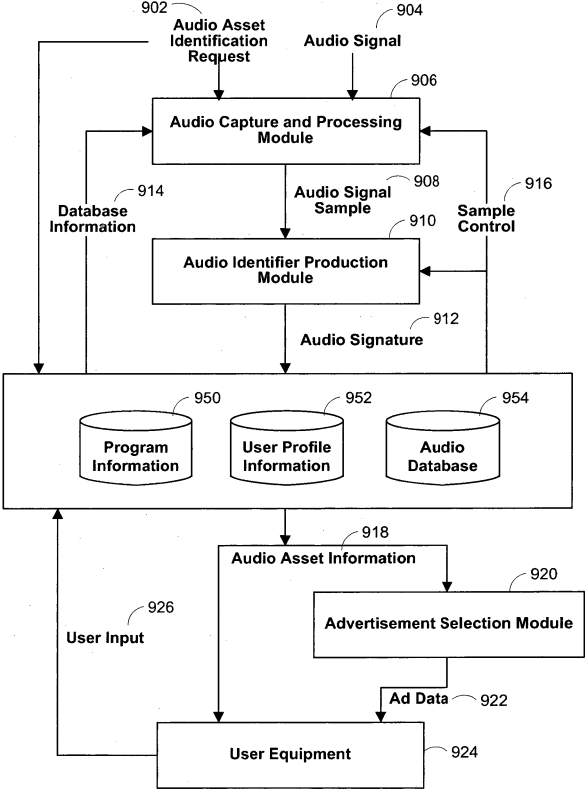
This European patent application relates to identifying audio content (a so-called “audio asset”) included in a video program, in particular a song or background music. This is done by generating an “audio signature” from a segment of the embedded audio asset and looking up the audio signature in a database of audio signatures of known audio assets.

A central aspect of the invention is how to improve the identification process. To this end, the invention proposes generating the audio signature from a segment of the audio asset “where interference from audio data not related to the audio asset is minimized”. This segment is determined by analyzing closed-captioning data included in the video program. Typically, using the closed-captioning data will ensure that the segment is chosen to be one where dialogue is not present.

Fig. 9 of EP 2 483 889

Here is how the invention is defined in claim 1 of the sole request:

  • Claim 1

Is it technical?

Claim 1 differed from the closest prior art in that, with the help of closed-captioning data included in the video program, a segment of the audio asset, i.e. of a song or background music, is determined “where interference from audio data not related to the audio asset is minimized”.

Concerning the effect achieved by this difference, the Board noted:

By generating the audio signature from a segment of the audio data that is (relatively) free from interference from unrelated audio signals, the chances that the song or background music is correctly identified are improved. The distinguishing features therefore solve the problem of improving the recognition of songs or background music.

The Board implicitly accepted that this is a technical problem, since the decision contains no discussion of this question.

By the way, if you are interested in a deeper look into how the European Patent Office examines software-related inventions, this 30-minute video gives a concise overview of the “two hurdle” approach with lots of examples:

Starting from the closest prior art and taking only the skilled person’s common general knowledge into account, the Board took the view that claim 1 was non-obvious. On the one hand, closed-captioning data included in a video was well-known, but only for a different purpose:

However, the Board is not convinced that the skilled person, on the basis of only his common general knowledge, would consider analysing closed-captioning data included in the video program for the purpose of identifying a segment of audio data free from interference of unrelated audio signals such as actor voices or voice-overs. Closed-captioning data included in video programs was well known at the priority date, but the data served the purpose of informing hearing-impaired or foreign-language viewers of the content of spoken text, not of automatically selecting a segment of audio data free from voices or other types of unrelated audio signal.

Also none of the further prior art was found to hint at the use of closed-captioning data for determining a segment of audio data that is relatively free of interference. Therefore, the Board decided that claim 1 involves an inventive step.

More information

You can read the whole decision here: T 2123/16 (Audio-content identification/ROVI GUIDES) of 5.2.2019

Stay in the loop

Never miss a beat by subscribing to the email newsletter. Please see our Privacy Policy.

Privacy policy
* = Required field

EUROPEAN SOFTWARE PATENTS April 2019 updates

April came with nine new decisions in the EUROPEAN SOFTWARE PATENTS knowledge base relating to cloud computing, distributed systems, business methods, graphical user interfaces and search engines:

Patentable cloud computing innovations

Improvements in cloud computing and distributed computing techniques are regularly considered technical by the European Patent Office. For example, the EPO granted a software patent for a server load balancing technique based on mathematical calculations, since they were found to improve the server’s resource consumption.

A method of providing a unique identifier for identifying user groups without using a server was also found to be technical, although obvious in view of the prior art.

In another decision, assigning a fixed internet address to a terminal of a building management system which is securely attached to a building was found to provide a technical contribution, because the system was capable of determining that a user actually was in the building when a specific interaction with the terminal was conducted.

"The implementation of a user interface includes non-technical aspects of the GUI layout, e.g. the graphical design of menus or the positioning of a control button according to user preferences, but also technical aspects regarding the user-computer interaction"
Showing browsing options depending on number of search results: non-technical

More challenging: business methods

One decision related to a method for efficiently checking the consistency and completeness of selection conditions for components of a configurable product. On the one hand, the Board held that the task performed by claim 1 was of a non-technical nature. However, the specific claimed bit (sub-)matrices, bit strings and steps of the method, especially those of splitting the bit matrix, forming bit strings representing the selection and restriction conditions and determining inconsistent pairs of selection conditions when performed by parallel processing, were indeed found to contribute to the technical character. The case was remitted back to the first instance for reexamination of inventive step.

The same applied to a method of programming a currency tester, which was also remitted back to the first instance for further prosecution.

GUI software patents

In the field of graphical user interfaces, a method for video editing, more precisely for quickly and easily viewing two different video clips simultaneously, involved technical aspects regarding the user-computer interaction which went beyond a non-technical method for presentation of information. The invention was also found to be non-obvious and a European software patent was granted.

In an older decision, facilitating data exchange across different data formats with a clipboard function was considered to provide technical character, in particular when transferring non-file data, and a patent was granted.

By the way, if you are interested in a deeper look into how the European Patent Office examines software-related inventions, this 30-minute video gives a concise overview of the “two hurdle” approach with lots of examples.

Patents for search engine techniques

In the field of data retrieval, a method of scoring search engine results based on history data was found to be non-technical, since assigning a score to a document based on the frequency and the amount of changes to the document was considered not to be a technical task.

Finally, one decision dealt with the graphical user interface of a search engine. Here, the basic idea was to check how many search results there are, and in case of only a few, to maximize the display area for those search results while minimizing another display area that normally shows browsing options. In this case, the Board ruled that the layout of the areas in the display and the emphasizing of specific areas are non-technical aspects of the invention.

Fear of missing out?

Stay in the loop

Never miss a beat by subscribing to the email newsletter. Please see our Privacy Policy.

Privacy policy
* = Required field

Showing browsing options depending on number of search results: non-technical

The European Patent Office refused to grant a software patent for a user interface to facilitate client-side user searching. Here are the practical takeaways from the decision T 1559/14 (Processing search information/EBAY) of 11.1.2019 of Technical Board of Appeal 3.5.07:

Key takeaways

The implementation of a user interface includes non-technical aspects of the GUI layout, e.g. the graphical design of menus or the positioning of a control button according to user preferences, but also technical aspects regarding the user-computer interaction (confirmation of T 505/13)

In the present case, the layout of the areas in the display and the emphasising of specific areas are non-technical aspects of the invention.

The invention

This European patent application is about the graphical presentation of search engine results. The general purpose of the invention is to facilitate client-side user searching for data items provided by a web server.

When a user enters a query in the client system, the query is communicated to the computer system, where it is processed by search applications, and a user interface is generated and sent to the client system. The user interface includes a first area for displaying data items and a second area for displaying other information such as browsing options. These two areas are complementary in size. The display area of the first area is increased and that of the second area is decreased if the number of data items to be displayed is less than the predetermined threshold. On the opposite, the size of the first area is decreased and that of the second area is increased if the number of data items is equal to or greater than the predetermined threshold.

Fig. 1 of EP 1 877 933

  • Claim 1 (main request)

Is it patentable?

As a starting point for inventive step, the Board of Appeal considered web-based systems implementing online shops, which were well known at the priority date according to the Board. Such systems typically included a server machine running server applications, e.g. a search application for searching data items corresponding to a query, and a client machine running a browser. In such a well known e-commerce system, the server obtained queries from the client, determined a set of data items corresponding to the query and communicated the results to the client for display. The results sent to the client for display were typically transmitted in the form of one or more web pages for displaying the set of items. Such a network commerce system was also acknowledged in the patent application itself.

One difference to this prior art was that the display of the first area (the data items) and of the second area (the browsing options) depends on whether the number of found data items exceeds a predetermined threshold.

By the way, if you are interested in a deeper look into how the European Patent Office examines software-related inventions, this 30-minute video gives a concise overview of the “two hurdle” approach with lots of examples.

The patent applicant (appellant) argued that the threshold had a technical function and allowed switching between two types of interfaces depending on the amount of data being displayed. For example, if a user received fifty results, there was no need to further narrow the search because fifty results was small enough to be processed by the user. In such a case, the second area would be de-emphasised so that the user could concentrate on the displayed items. The distinguishing features solved the problem of improving the user interface to allow refinement of search results in an efficient manner based on the response of the user to the data. It would not have been obvious to refine the query result because the skilled person would rather have paginated the list of data items if too many items had to be displayed in the limited display area.

But the Board did not agree:

The Board does not agree with the appellant’s formulation of the technical problem. The method of claim 1 is not related to the refinement of search results by the system. The browsing options could take the form of “previous” and “next” buttons that allow the user to browse through sub-sets of results of a single search.

In general, the implementation of a user interface includes non-technical aspects of the GUI layout, e.g. the graphical design of menus or the positioning of a control button according to user preferences, but also technical aspects regarding the user-computer interaction (see T 505/13 of 6 June 2018, reasons 8.3). In the present case, the layout of the areas in the display and the emphasising of specific areas are non-technical aspects of the invention. However, since the technical and non-technical features are tightly intermingled in claim 1, which makes it difficult to initially separate them, the following deals with the distinguishing technical and non-technical features in combination.

The combined distinguishing features solve over the acknowledged prior art the problem of presenting an arbitrary number of data items to the user in a limited area of the client’s display.

At the priority date of the present application, it was well known to display the results of a query in more than one web page and to display user-selectable browsing options (e.g. next, previous) on each web page to let the user browse through the result pages to identify data items.

It would therefore have been obvious for the skilled person facing the above mentioned problem to have added the steps of counting the number of data items, comparing this count with a threshold representing the maximum number of data items to be displayed on a page and adding a second display area for the browsing options according to features (a) to (c1).

The remaining features relate to presentation of information as such and are, in any case, obvious options. If the results fit on one page, the browsing options for changing to the other pages of results are not necessary. In this case, it is obvious to reduce the size of the area occupied by the browsing options and leave more space for the area displaying the data items, thereby emphasising the data items found rather than the browsing options. Since the display area is limited, the second area for displaying browsing options should then be complementary in size to the first area.

Therefore, the Board ultimately decided that the patent application does not provide any technical contribution which could be the basis for an inventive step.

More information

Scoring search engine results based on history data: non-technical

The European Patent Office refused to grant a software patent for scoring search engine results based on history data. Here are the practical takeaways from the decision T 0817/16 (Document scoring/GOOGLE) of 10.1.2019 of Technical Board of Appeal 3.5.07:

Key takeaways

Assigning a score to a document based on the frequency and the amount of changes to the document is not a technical task.

A reduction in the number of search queries and the corresponding saving of resources does not qualify as a technical effect of (improved) recommendations, as they depended on subjective choices made by the user (confirmation of T 306/10)

A chain of effects cannot be used as evidence of a technical effect if one of the links between the effects is not of a technical nature (but, for example, of a psychological nature) (confirmation of T 1741/08)

The invention

This European patent application relates to search engines. Its background section explains that, ideally, a search engine provides the user with the results most relevant to the user’s query. Relevant documents are typically identified by comparing the search-query terms to the words contained in the documents, as well as other factors like the existence of links to or from the documents (see Google’s famous PageRank algorithm).

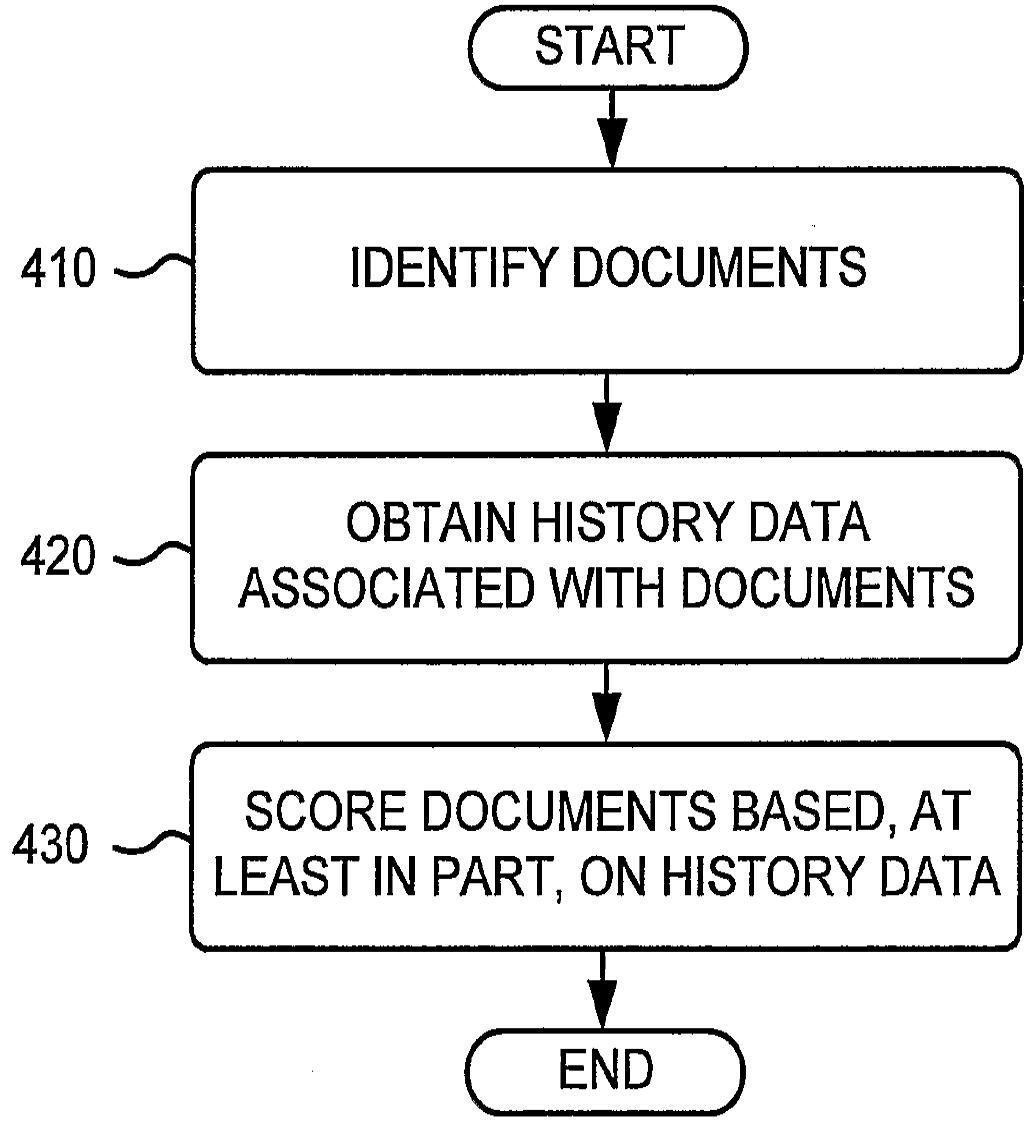
The invention as claimed proposes scoring a document on the basis of “history data” that reflects (a) the frequency at and (b) the amount by which the content of the document changes over time. This history data is obtained by “monitoring signatures of the document”.

Fig. 4 of EP 1 668 551

  • Claim 1 (main request)

Is it patentable?

This is one of the rare cases where the claim would almost have failed the patent-eligibility hurdle since it did not necessarily require any technical means:

Unlike claim 1 of the first and second auxiliary requests, claim 1 of the main request is not worded as a “computer-implemented” method and therefore arguably encompasses mental acts as such, which are excluded from patentability under Article 52(2) and (3) EPC. But since the appellant at the oral proceedings expressed its willingness to limit the claim to a “computer-implemented” method, the Board will, for the purpose of assessing inventive step, interpret claim 1 accordingly.

The Board considered a general-purpose computer to be the closest prior art. The question was then whether the algorithmic features of the claim contribute to the solution of a technical problem, so that they would need to be taken into account in the inventive step assessment:

These steps define the algorithm underlying the computer-implemented method in abstract, functional terms that do not imply any interaction with specific technical means. In particular, the step “monitoring signatures of the document” calculates and compares signatures for different versions of the document without specifying a technical mechanism by which different versions are detected or retrieved. And “generating a score for the document” and “scoring the document” merely associate the document with a calculated score value. The steps of claim 1 are thus non-technical, apart from their implementation on a computer.

As the avid reader will know, non-technical features in a patent claim may nevertheless “become technical” if they interact with the technical features of the claim (here: the “computer” which the Board read into the claim for the sake of argument) to produce a technical effect over a general-purpose computer. But not in this case:

The Board concurs with the Examining Division that assigning a score to a document based on the frequency and the amount of changes to the document is not a technical task, even if performed by a computer. The appellant originally did not dispute this, but at the oral proceedings it suggested that providing good scores improved the search results returned by the search engine and that improved search results resulted in a reduction in the number of search queries, which amounted to a saving of resources.

A similar argument was dealt with in decision T 306/10 of 4 February 2015 in the context of recommendation engines. The board there considered that a reduction in the number of search queries and the corresponding saving of resources did not qualify as a technical effect of the (improved) recommendations, as they depended on subjective choices made by the user (see reasons 5.2). It referred to decision T 1741/08 of 2 August 2012, reasons 2.1.6, where the argument was made that a chain of effects cannot be used as evidence of a technical effect if one of the links between the effects is not of a technical nature (but, for example, of a psychological nature).

In the present case, the appellant’s argument fails for the reason alone that claim 1 is silent on what the generated score is used for. Merely assigning a score to a document is not a technical effect. This is not different if the score is somehow based on the frequency and the amount of changes made to the document.

Therefore, the Board ultimately decided that the patent application does not provide any technical contribution which could be the basis for an inventive step.

More information