Author Archive

Performing pre-operating assessment more efficiently and intuitively: non-technical

This decision concerns conducting pre-operating assessments more efficiently and intuitively. However, the EPO considered this non-technical. Here are the practical takeaways from the decision T 2520/16 () of 23.3.2021 of Technical Board of Appeal 3.4.03:

Key takeaways

Features aimed exclusively at improvements regarding the way information is perceived or processed by the human mind are generally regarded as non-technical.

Features defining presentation of information may be considered to produce a technical effect if they credibly assist the user in performing a technical task by means of a continued and/or guided human-machine interaction process.

The invention

The subject-matter of the European patent application underlying the present decision was summarized by the Board in charge as follows:

2. The claimed invention

The claimed invention relates to a procedure and a system for performing pre-operating assessment of one or more anatomical structures.

Anatomical structures (e. g. a tumour) within organs (e. g. a liver) are rendered as 3D images in a 3D space and displayed at an output interface (e. g. a screen). One or more closed 3D volumes having a size and shape that are deformable represent(s) (a) safety margin indicator(s). These volumes are adjustable in order to conform to the shape and size of anatomical structures.

The user manipulates on the screen a safety margin indicator deforming it with respect to the anatomical structure it surrounds/encloses. The system provides immediate feedback to the user by re-rendering and displaying the deformed safety margin indicator immediately after the user’s manipulation.

For example, the user (a surgeon) deforms the safety margin indicator displayed around a tumour within an organ so that they can visualise the part of the organ that has to be removed in the operation. The pre-operating assessment is carried out by visualising several possible deformations of the safety margin indicator and assessing which approach would be best for the subsequent operation.

Fig. 1 of WO 2010/132606 A1

Here is how the invention was defined in claim 1:

  • Claim 1 (main request)

Is it patentable?

According to the Technical Board of Appeal 3.4.03, the subject-matter as claimed would only differ in a minor aspect from the closest prior art document D1:

3.1.2 Summarising, D1 discloses a method and a system for rendering 3D and 2D images containing multiple volumes. The system allows a user to manipulate the volumes in the displayed images and provides real-time updating of the modified images (see for example paragraphs [0032] and [0038]). The description of the related art can be considered a hint that the system may be used in medical applications without any further details.

3.2 The claimed invention differs from D1 only in that the displayed volumes represent anatomical structures, organs and safety margin indicators. In other words, in the information the images convey to the user, i. e. their cognitive content (“what” is displayed).

The appellant did not agree to this assessment and argued as follows:

3.3.1 According to the appellant, the claimed invention comprised the displaying of 3D volumes representing anatomical structures. Making reference to paragraphs [0038] and [0039] as well as Figures 2a to 2c of the application, the appellant explained that the safety margin indicator was a closed 3D volume having shape and size that were adjustable to conform to the shape and size of anatomical structures. Based on input from the user, the safety margin indicator was deformed in its shape and/or size with respect to the anatomical structure (see also appellant’s letter of 23 February 2021, pages 2 and 3).

3.3.2 In contrast thereto, the system of D1 displayed 3D volumes as stacks of cross sectional 2D images. The user’s manipulation of those volumes consisted in moving section planes through the 3D volumes and displaying the corresponding cross sections (see appellant’s letter of 23 February 2021, page 4).

3.3.3 These differences provided a technical effect in that they enabled the user to perform pre-operating assessment more efficiently and intuitively.

However, the Board in charge was not persuaded by these arguments. According to the Board, pre-operating assessment would be a cognitive process and therefore not a technical activity:

3.4.1 First of all, the board does not consider the pre-operating assessment in the context of the present application to be a technical activity, but rather a cognitive process that takes place in the mind of the user (a surgeon in this case).

Furthermore, the Board outlined that features that only aim at improving the way how information is perceived has to be regarded as non-technical. Only in specific cases can such features contribute to the technical character of an invention:

3.4.2 Second, according to established case law and practice, features aimed exclusively at improvements regarding the way information is perceived or processed by the human mind are generally regarded as non-technical.

Such features defining presentation of information may be considered to produce a technical effect if they credibly assist the user in performing a technical task by means of a continued and/or guided human-machine interaction process. Such a technical effect is considered credibly achieved if the assistance to the user in performing the technical task is objectively, reliably and causally linked to the features (see Case Law of the Boards of Appeal of the EPO, 9th Edition, July 2019, I.D.9.1.6 a)).

In the present case, however, the task performed by the user would be non-technical:

… the task performed by the user (pre-operating assessment) is not technical. Moreover, there is no indication of a continued and/or guided human-machine interaction process that might guide the user in performing this task. The user (surgeon) is provided with information to which they may react by, for example, changing their mind about the subsequent operation.

Since the distinguishing feature over D1 could not provide any technical contribution, the claimed subject-matter does not involve any inventive step within the meaning of Article 56 EPC. Hence, the appeal was dismissed.

More information

You can read the whole decision here: T 2520/16 () of 23.3.2021

Stay in the loop

Never miss a beat by subscribing to the email newsletter. Please see our Privacy Policy.

Privacy policy
* = Required field

Translation of a natural language into an abstract language: non-technical

This decision concerns a European patent application relating to the translation of a human language into an abstract formal language which was considered non-technical by the EPO’s Board of Appeal in charge. Here are the practical takeaways from the decision T 2825/19 (Natural language to machine language translator/RAVENFLOW) of 19.3.2021 of the Technical Board of Appeal 3.5.07:

Key takeaways

All computer programs have technical effects, since when different programs are executed they cause different electrical currents to circulate in the computer they run on. However such technical effects are not sufficient to confer “technical character” on the programs; they must cause further technical effects.

The invention

The application underlying the present decision relates to a system and method for translating a natural (human) language into a formal language. The purpose of the formal language is to serve as a template for further translations into a variety of machine languages which are executable in specific operational environments (WO 02/103555 A2, page 1, first paragraph).

More specifically, the invention translates natural language input into internal formal language expressions and then further translates these expressions into executable formal expressions in a formal language such as SQL (structured query language) or SMTPL (the language of the mail protocol SMTP) (WO 02/103555 A2, page 34, last paragraph).

Fig. 2 of WO 02/103555 A2

Here is how the invention was defined in claim 1:

  • Claim 1 (main request)

Is it patentable?

In the first instance, the application underlying the present decision was refused due to lack of inventive step. According to the Examining Division, claim 1 comprises technical and non-technical features. However, in view of the cited prior art, the only identifiable technical contribution consisted in the claimed implementation of the non-technical features in the system disclosed in in cited prior art. More specifically, the Examining Division argued that the translation of linguistic considerations by means of a computer involves technical considerations, but no “further technical considerations” as required by the EPO’s case law:

3. (…) According to the examining division (see communication of 13 November 2018, point 4), referring to decisions T 598/14 and T 1177/97, the translation of linguistic considerations into a mathematical model with the aim of enabling the linguistic analysis to be done automatically by a computer could be seen as involving, at least implicitly, technical considerations. However, according to opinion G 3/08 (OJ EPO 2011, 10), point 13.5 of the Reasons, this was not enough as the technical character would have to be established on the basis that those considerations constituted “further technical considerations”. Moreover, machine-executable instructions per se were not technical as computer programs as such were explicitly excluded from patentability (Article 52(2)(c) EPC).

Against this assessment, the Appellant inter alia argued as follows:

4. (…) Furthermore, the appellant argued that linguistics was not concerned with translating expressions in an internal formal language into equivalent formal expressions executable in an external operational environment. Rather, steps b) to r) of the claimed method defined a technically advantageous method of translating natural language to executable formal expressions via an abstract formal language. This abstract formal language was explicitly designed to serve as a universal template for further translations into a comprehensive variety of machine languages which were executable in specific operational environments. This was evidence that the steps involved further technical considerations. The method of claim 5 did not use the computer merely as a tool for implementation but focused on improving the computer functionality itself.

However, the Board in charge did not follow the Appellant’s arguments:

5.3.6 (…) By contrast, the board sees no support for the appellant’s view that the concept “further technical considerations” should be interpreted with a broader meaning that would also cover considerations aiming to solve problems “merely” relating to programming such as maintainability, re-usability and understandability of program code, or, in this case, the use of a universal template for translating natural language into executable expressions in external operational environments. Such a broader view of the concept “further technical considerations” appears to be problematic with regard to the imperative to ensure legal certainty and judicial predictability requiring a uniform application of the law (see opinion G 3/08, Reasons 7.2.3) since no criteria are apparent which could then be used to establish a clear border between “technical” and “non-technical” aspects of computer programs.

5.3.7 In view of the above, the board agrees with the examining division that steps b) to p) do not contribute to the technical character of the claimed invention as these steps do not involve technical considerations going beyond “merely” finding an abstract computer algorithm to carry out the translation from natural language text into an internal formal language.

As a result, the appeal was dismissed.

More information

You can read the whole decision here: T 2825/19 (Natural language to machine language translator/RAVENFLOW) of 19.3.2021

Stay in the loop

Never miss a beat by subscribing to the email newsletter. Please see our Privacy Policy.

Privacy policy
* = Required field

Method of providing a user interface for controlling a system: Technical

This decision concerns a European patent application for providing a user interface for controlling a system based to the body movement of the user. This application is one of the few applications relating to user interface that have been granted. Here is the practical takeaways from the decision T 3131/19 (Body movement dependent user interface/PHILIPS) of 7.4.2021 of the Technical Board of Appeal 3.5.05:

Key takeaways

Providing an improved and more flexible user input interface for controlling a system is a technical problem.

The invention

The European patent application concerns a method and a system for providing a user interface for controlling the system relative to the responsiveness of the user action. In particular, the invention provides a sensor for observing a body and a perceptible user interface. Based on the rate of displacement of the body, the underlying system is controlled.

In a simple example, a coffee maker has a mechanical switch and a sensor capable of determining the displacement rate of the user’s hand approaching the switch. Based on the rate of approach, the functionality of the switch changes. For instance, on the one hand, if the rate is higher (rapid action to the switch), the controller changes the switch functionality to a first action (stop pouring coffee). On the other hand, if the rate is slower (hand slowly brought to the switch), the switch functionality is converted to an ON/OFF function of the coffee maker.

Therefore, the rate of displacement determines the user interface of the functionality of the system.

Fig. 2 of WO 2009/069050 A1

Here is how the invention was defined in claim 1:

  • Claim 1 (main request)

Is it patentable?

The first-instance Examining division had refused the application for lack of novelty. The cited prior art document disclosed a video game where the user could control the character by moving the body.

On appeal, the Board agreed with the appellant that the cited document only disclosed using the displacement of the body to interact with the user interface (i.e., the character on-screen) and not to provide a part of the user interface associated with the functionality of controlling the system. Therefore, the claim was considered novel.

When deciding whether the distinguishing feature was technical, the Board provided the following reasoning:

The technical effect of the essential differences detailed above between the subject-matter of claim 1 and the disclosure of D1 is that a part of the user interface provides different functionalities for controlling the system depending on the rate of displacement of a user’s body part towards the user interface.

The objective technical problem can thus be formulated, as proposed by the appellant, as how to provide an improved and more flexible user input interface for controlling a system.

The Board then concluded that the subject-matter of the claim is inventive: None of the cited documents aim at improving a user interface. Moreover, none of the cited documents discloses the distinguishing feature.

More information

You can read the whole decision here: T 3131/19 (Body movement dependent user interface/PHILIPS) of 7.4.2021

Stay in the loop

Never miss a beat by subscribing to the email newsletter. Please see our Privacy Policy.

Privacy policy
* = Required field

Auto-correction of text input: non-technical

This decision concerns the field of user interface design and the question, to which extent text-correction is a technical task. Here are the practical takeaways from the decision T 2372/17 (Multi-word autocorrection/APPLE) of 25.2.2021 of Technical Board of Appeal 3.5.07:

Key takeaways

Text correction as such is not technical. Text auto-correction could contribute to a technical effect if it were used in combination with other user-computer interaction techniques for facilitating the user’s entering of text in a computer.

The invention

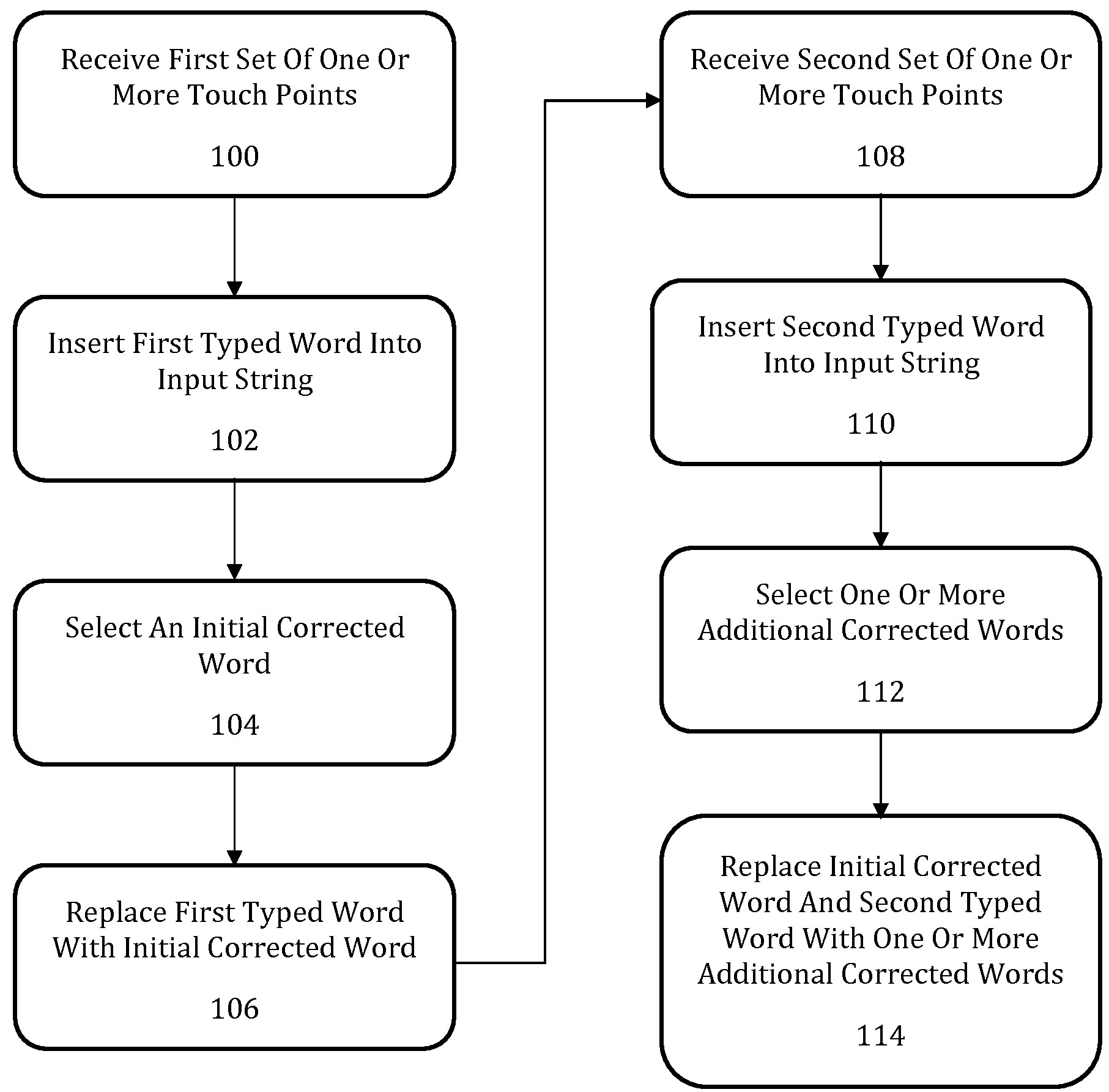
This European patent application concerns multi-word auto-correction which occurs when a user enters text with a touch-sensitive keyboard. The core idea was basically that a selection of an initial corrected word is revisited if a subsequently typed word indicates that it would be more appropriate to select a different correction for the initial word instead.

For example, the system may select an initial corrected word “new” based on a user’s input of “nes”. However, if the subsequently typed word is “york”, then the system can revisit the selection of “new” and instead correct the initial word to “New” and select a corrected word “York” to replace the typed word “york”.

Fig. 1 of EP 2 859 470

Here is how the invention was defined in claim 1:

  • Claim 1 (main request)

Is it patentable?

The first-instance examining division had refused the application based on lack of inventive step over the prior art on record, wherein some features were considered to relate to non-technical user requirements.

On the appeal stage, the board of appeal assessed whether teh auto-correction as claimed contributed to the technical character of the invention:

[…], linguistic aspects and presentation of information as such are not patentable pursuant to Article 52(2) and (3) EPC. Such features of a graphical user interface can be considered to contribute to a technical effect if they credibly assist the user in performing a technical task by means of a continued and/or guided human-machine interaction process (see decisions T 336/14 of 2 September 2015, Reasons 1.2.4, and T 1802/13 of 10 November 2016, Reasons 2.1.5 to 2.1.7).

However, the claim does not detail any interaction between the user and the computer in relation to the auto-correction that is taking place, and there is nothing to suggest that the user is taking into account what is being displayed. It is therefore doubtful that there is any continued and/or guided such interaction.

With regard to the use of touch points in the claimed method, the board notes that the first touch points are transformed into characters in advance of the correction and that claim 1 does not define any specific way of transforming any of the touch points to input characters or using the touch points to influence the text auto-correction.

In view of this, the board doubts that the text auto-correction in the context of the claimed method contributes to a technical effect.

Therefore, the board held that no technical effect can be established by the distinguishing features, which concern presentation of information. As a result, the main request was found to lack an inventive step. Since none of the auxiliary requests was found to be allowable either, the appeal was dismissed in the end.

More information

You can read the whole decision here: T 2372/17 (Multi-word autocorrection/APPLE) of 25.2.2021

Stay in the loop

Never miss a beat by subscribing to the email newsletter. Please see our Privacy Policy.

Privacy policy
* = Required field

Improving billing code accuracy with machine learning: non-technical

There are few decision yet which specifically address the question to what extent machine-learning aspects make a technical contribution. This decision explores whether using machine learning for improving the accuracy of medical billing codes makes a technical contribution.

Here are the practical takeaways from the decision T 0755/18 (Semi-automatic answering/3M INNOVATIVE PROPERTIES) of 11.12.2020 of Technical Board of Appeal 3.5.07:

Key takeaways

If neither the output of a machine-learning computer program nor the output’s accuracy contribute to a technical effect, an improvement of the machine achieved automatically through supervised learning to generate a more accurate output is not in itself a technical effect (Catchword)

A billing code is non-technical administrative data. Generating a billing code is a cognitive task. The process of generating a billing code on the basis of documents is thus a non-technical administrative task, which, as such, is not patentable.

The invention

This European patent application concerns billing codes for medical billing. Such billing codes may relate to a hospital stay of a patient based on a collection of the documents containing information about the medical procedures that were performed on the patient during the stay and other billable activities performed by hospital staff. This set of documents may be viewed as a corpus of evidence for the billing codes that need to be generated and provided to an insurer for reimbursement.

The patent application starts from known computer-based support systems that guide human coders through the process of generating billing codes. Such systems typically include “concept extraction components” (e.g. to extract concepts like “allergy” or “prescription” from a medical report) and an “inference engine” that generates appropriate billing codes.

The invention sets out to improve the accuracy of such automatically generated billing codes.

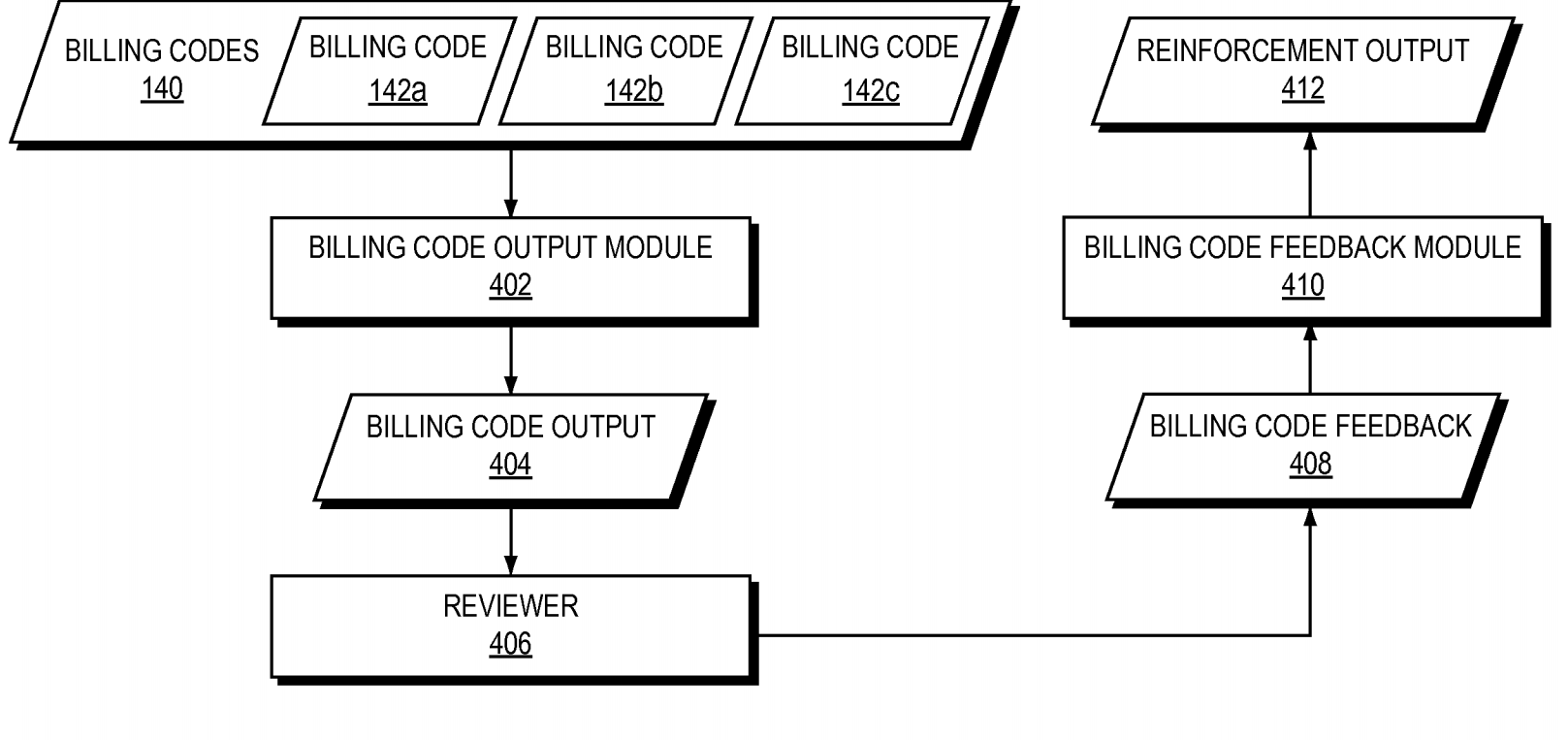
To this end, the invention allows a human operator to provide input as to whether the generated billing codes are accurate (e.g. a verification status). The system may automatically interpret the feedback, and the reasoning process may be inverted in a probabilistic way to assign blame and/or praise for an incorrectly/correctly generated billing code to the constituent logic clauses which led to the generation of the billing code.

Fig. 4 of EP2619661
Fig. 4 of EP2619661

Here is how the invention was defined in claim 1:

  • Claim 1 (main request)

Is it patentable?

The first-instance examining division had refused the application based on lack of inventive step over a standard general purpose computer.

On the appeal stage, the board of appeal assessed which of the features of the invention actually makes a technical contribution, and took the view:

A billing code is non-technical administrative data which may take the form of a textual representation, for instance “Unspecified diabetes” (see paragraph [0050] of the international publication). Generating a billing code (see also point 1. above) is a cognitive task (paragraphs [0002] and [0015]). The process of generating a billing code on the basis of documents is thus a non-technical administrative task, which, as such, is not patentable pursuant to Article 52(2) and (3) EPC.

The appellant had argued that simply because a certain feature offers a solution to an administrative, economic or business problem, it did not in and of itself prohibit the same feature from simultaneously solving a technical problem for which an applicant was entitled to seek protection. The board agreed that the presence of non-technical features in the claim does not mean that the claimed subject-matter is not patentable and that features which are non-technical when taken in isolation but which interact with technical features of the invention to solve a technical problem should be taken into account in assessing inventive step.

Moreover, the appellant argued that the invention used machine-learning techniques to improve the accuracy of the machine output. According to the appellant, the invention was technical because it improved the system so that it would generate more accurate billing codes in the future.

The board did not follow this argument:

In the board’s opinion, if neither the output of a learning-machine computer program nor the machine output’s accuracy contributes to a technical effect, an improvement of the machine achieved automatically through supervised learning for producing a more accurate output is not in itself a technical effect. In this case, the learning machine’s output is a billing code, which is non-technical administrative data. The accuracy of the billing code refers to “administrative accuracy” regarding, for example, whether the billing code is consistent with information represented by a spoken audio stream or a draft transcript (paragraph [0051]) or is “justified by the given corpus of documents, considering applicable rules and regulations” (paragraph [0002]). Therefore, improving the learning machine to generate more accurate billing codes or, equivalently, improving the accuracy of the billing codes generated by the system, is as such not a technical effect.

Also the further arguments made by the appellant were not successful, and the main request was found to lack an inventive step. In addition, since none of the auxiliary requests was found to be allowable either, the appeal was dismissed in the end.

More information

You can read the whole decision here: T 0755/18 (Semi-automatic answering/3M INNOVATIVE PROPERTIES) of 11.12.2020

Stay in the loop

Never miss a beat by subscribing to the email newsletter. Please see our Privacy Policy.

Privacy policy
* = Required field

Server-based fonts to solve licensing issues: non-technical

This decision is interesting in that the distinguishing feature was found not to provide a technical contribution mainly because of the reasons for using the feature disclosed in the application. Here are the practical takeaways from the decision T 1865/17 (Generating two-dimensional visual objects/GMC SOFTWARE) of 4.12.2020 of Technical Board of Appeal 3.5.07:

Key takeaways

If the reasons for not supporting a font in a terminal are licensing issues, i.e. non-technical commercial reasons, the aim to overcome such licensing issues may be added as a constraint to the objective technical problem.

The invention

This European patent application concerns a method for generating two-dimensional visual objects, e.g. graphical objects or characters.

According to the background described in the application, many companies often design their own fonts to ensure their visual appearance is consistent and uniform. These fonts are typically protected under intellectual property laws and may only be used by a third party with explicit permission or licence from the proprietor. However, it is not practical to provide communication terminals or browsers with permissions, or licences to use the company’s proprietary fonts or other visual objects. Nor is it desirable to store all these fonts on mobile communication terminals.

The general idea of the invention is that, when a user types a character sequence, it is initially displayed with a locally available font. After a certain duration of time, the display is refreshed using a second, enhanced visual representation (e.g. based on a server font) and the cursor is positioned to allow the user to continue typing:

Fig. 6 of EP 2 367 118

Here is how the invention was defined in claim 1:

  • Claim 1 (main request)

Is it patentable?

The first-instance examining division had refused the application based on lack of inventive step.

On the appeal stage, the board of appeal  started its inventive-step assessment based on document D1. D1 discloses the handling of large character sets in devices with memories too small to store the complete character set. When a character not stored in the device is required, a placeholder character is displayed instead, and the missing character is requested from a server where the complete character set is stored. Upon receipt of the missing character from the server, the displayed placeholder character is replaced with the correct character.

The invention thus differed from the closest prior art in that:

  • F1: the first visual representation has a one-to-one correspondence to the data entry
  • F2: positioning a cursor, based on the character metrics data associated with the second visual representation of the characters, to a position that enables continuation of data entry by the user

The applicant essentially argued that features F1 and F2 synergistically yielded the technical effect of ensuring immediate readability during continuous, uninterrupted data entry and thus supported a continuous human-machine interaction within the meaning of T 336/14 of 2 September 2015. Features F1 and F2 ensured that the readability was immediate and uninterrupted, respectively.

However, the board did not see any synergistic effect:

The board does not recognise the alleged synergistic effect of distinguishing features F1 and F2. Rather, the board agrees with the examining division that, when compared to the unreadable placeholders used in the method of document D1, feature F1 has the effect of an immediate readability. The board also agrees with the examining division that the positioning of the cursor according to feature F2 has the effect of enabling continued data entry after overwriting the first visual representation with the second. The effect of feature F2 is independent of the effect of feature F1, as the need to position the cursor after overwriting the first visual representation with the second is not dependent on displaying, as first visual representation, characters (in a substitute font) or placeholders.

Concerning feature F1, the board concurred with the examining division. Since D1 disclosed that placeholders for unavailable characters is unsatisfactory, the skilled person would prefer to use characters of a locally available font over unreadable placeholders, even if this font is not the desired font.

Moreover, the board also took the motivation for using a local font into account, and found that the motivation was rather non-technical:

In this context, the board observes that according to the description, page 4, lines 3 to 5, the reasons for not supporting a font in the terminal may be licensing issues, i.e. non-technical commercial reasons. The aim to overcome such licensing issues may thus be added as a constraint to the objective technical problem (see decision T 641/00, Two identities/COMVIK, OJ EPO 2003, 352), and the appellant agreed. In view of this non-technical motivation to avoid licensing issues, the skilled person would have replaced the placeholders as disclosed in document D1 with characters in a substitute font available locally when a character could not be rendered in a desired font by the communication terminal. Hence, the board is not convinced by the appellant’s argument that the skilled person starting from document D1 had no motivation to search for a solution different from using unreadable placeholders.

Also the second distinguishing feature F2 did not rescue the appellant’s case:

Regarding feature F2, the board also agrees with the examining division that the skilled person carrying out the method of document D1 was directly confronted with the problem of how to move the cursor to an appropriate display position after replacing the placeholder characters, since users would find it inconvenient to manually position the cursor after the placeholder characters were replaced with the characters in the desired font. Since any cursor positioning in a displayed text needs to be based on character metrics, the skilled person would obviously have used the character metrics, which were received from the server when downloading font information, for determining the correct position.

Furthermore, a correct positioning of the cursor was standard practice and notoriously known at the priority date. In particular, in the context of continuous text data entry, a correct positioning of a cursor implied (and still does) that the cursor is positioned behind the visual representation of the character sequence already entered in a way supporting continued entry of a sequence of characters forming text. Consequently, the skilled person would have implemented a correct positioning of a cursor without exercising inventive skill.

Therefore, the main request was found to lack an inventive step. Also the other requests did not succeed, so that the appeal was dismissed in the end.

More information

You can read the whole decision here: T 1865/17 (Generating two-dimensional visual objects/GMC SOFTWARE) of 4.12.2020

Stay in the loop

Never miss a beat by subscribing to the email newsletter. Please see our Privacy Policy.

Privacy policy
* = Required field

Registering at an interface to receive relevant data for performing a task: non-technical

This case may be interesting for people involved in transportation and logistics business, specifically in the aviation sector. The European Patent Office considered registering (e.g. by a pilot) at an interface to receive relevant data for performing a task non-technical. Here are the practical takeaways from the decision T 2316/16 () of 12.2.2021 of Technical Board of Appeal 3.4.03:

Key takeaways

The commercial success of an invention does not allow any conclusions to be drawn about its technical character.

While non-technical features cannot contribute to inventive step, they may however legitimately form part of the problem to be solved by claimed subject-matter.

Procedural aspect: Declaring non-attendance at oral proceedings is considered as equivalent to a withdrawal of the request for oral proceedings.

The invention

The Board in charge summarized the subject-matter of the European patent application underlying the present decision as follows:

3. The invention

The invention relates to a method for selecting relevant information from a database for a user active in the transport sector. In particular, the invention finds its use in the aviation sector, more in particular, the invention relates to the selection of information which, for a pilot, where the latter is performing a task, is relevant at that moment, see the application, page 1, lines 4 to 8.

In the transport sector, in particular the aviation sector, obtaining accurate data such as weather information, vehicle information, or environmental information, is crucial for being able to correctly perform a task. This applies to, for example, “operators of the vehicle, who take a vehicle from point A to point B, as well as to the logisticians, who create plannings, as well as to maintenance personnel, who maintain vehicles”, see the application, page 1, lines 11 to 16.

According to the claimed method, transport activity related data is supplied to an interface of a predetermined user (e. g. a pilot) who is to perform a given task (e. g. a flight from A to B at a given time). The method and the system according to the invention are applicable by means of portable interfaces, such as for example those on mobile terminals, such as tablet computers, smart phones, laptops, etc., or by means of wired interfaces that are provided in the vehicle in a suitable position, such as for example a touch screen in the cockpit of an aircraft, see the application, page 2, lines 16 to 20.

The transport activity related data are stored in a database, wherein the plurality of data comprises different data types which are periodically loaded with different frequencies and which have a different validity period. Each of the data has at least four parameters attributed thereto: a first parameter contains one or more vehicle identifier means, a second parameter specifies at least one user-related qualification, a third parameter defines an area and a fourth parameter defines a time period.

After registering at the interface and identifying the vehicle (e. g. the aircraft to be used), a predetermined user (e. g. a pilot) is provided with the relevant data for performing the task (a flight from A to B at a given time). In case of a pilot, transport activity related data could relate to weather, flight planning, navigation charts, vehicle operation, vehicle load, etc.


Fig. 2A WO 2012/155218 A1

Here is how the invention was defined in claim 1 according to the main request:

  • Claim 1 (main request)

Is it patentable?

The first instance examining division rejected the present application due to lack of inventive step. The Board in charge arrives at the same conclusion and states that the subject-matter of claim 1 is a combination of technical and non-technical features. However, out of the plurality of features of claim 1, only three features of claim 1 would belong to the first group of technical features:

4.1 For the Board, the technical features according to claim 1 are the following:

– an interface (of a predetermined user) with means for running a program (e. g. a processor)

– a central information storage system having means for comprising a database (e. g. a memory device), means for storing a plurality of data

– a communication link for providing communication between the interface and the central information storage system.

To convince the Board in charge of the technical character of the remaining features of claim 1, the appellant filed three annexes and argued that (1) a similar case was considered technical by the German Federal Court of Justice (“Bundesgerichtshof”), that (2) a product that makes use of the claimed subject-matter is commercially successful, and that (3) that the claimed subject-matter provides a solution to minimize the risk of human errors by making sure that the user receives only the relevant and up to date information.

4.7.3 The appellant submitted Annex 1 related to the European patent EP 1 474 927 to provide evidence that, in that case, the German Bundesgerichtshof came to the conclusion that the enhanced perceptibility of information by a specific way of using an image stream and two subset image streams could be regarded as a technical effect. The appellant argued that, for the present invention as defined in claim 1, a user also could more quickly and efficiently grasp information to perform her/his task, see statement of grounds of appeal, points 4. to 7.

4.7.4 The appellant filed Annex 2 to show a commercial success of the present application and for supporting an inventive step. It cited slides 22 to 25, 14 to 21 and its client’s testimonials as evidence that the features shown in slides 14 to 25 contributed to the commercial success, see statement of grounds of appeal, points 9 to 11.

4.7.5 The appellant filed Annex 3 to show a long-felt need and cited the conclusions on pages 81 and 82. It argued that, whilst the invention did not provide a solution to completely solve the risk of human error, it minimized this risk by making sure that the user had only the relevant and up to date information. It added that the invention provided “a solution which can ensure that necessary data to be able to detect human errors or identity risks, for example for take-off performance parameters, is available on the user interface“, see statement of grounds of appeal, point 12.

However, the Board in charge did not follow the appellant’s arguments and commented on the filed annexes as follows:

Annex 1:

4.8.3 ad 4.7.3: the Board is of the opinion that the outcome of national proceedings related to European patent EP 1 474 927 are not relevant for the present case and that the determination of those features having a technical nature and those that do not contribute to any technical problem is to be made on the basis of how a skilled person understands the claim. The Board does not share the appellant’s view that the invention as defined in claim 1 necessarily provides a user (e. g. a pilot) more quickly and efficiently with the information which is needed to perform her/his task. For the Board, accumulating data, keeping it up do date and selecting a relevant subset to be supplied to a specific user is an administrative task of an aircraft operator employing pilots that are legally obliged to have specific data on board an aircraft.

Annex 2:

4.8.4 ad 4.7.4: The Board notes that Annex 2 was published in 2016 and does not see a link between the testimonials of slide 13 (for the Aviobook® EFB Platform shown from slides 14 to 25) and the invention defined by the present claims. In particular, the way of displaying information according to slides 14 to 21 and the system architecture of slides 22 to 25 are not present in the method of claim 1. Post-published Annex 2 cannot support an inventive step of claim 1. Even if Annex 2 were considered to establish the commercial success of the Aviobook® EFB Platform, it does not provide evidence that this commercial success derives from the technical features of claim 1.

Annex 3:

4.8.5 ad 4.7.5: The Board agrees that Annex 3 describes the wish to reduce the risk of human errors during the take-off phase of flight. The Board is of the opinion that the method according to claim 1 does not include technical features that necessarily reduce errors made by humans or avoid inappropriately designed or unavailable material, because the invention according to claim 1 only specifies the way the pilot obtains data, and does not improve the quality of the data itself.

For reasoning its decision, the Board focused on the specific embodiment in which a pilot is to perform a flight (indeed, claim 1 is formulated much broader):

4.3 Although claim 1 is not limited to the particular case of a pilot who is to perform a given flight with an aircraft, the Board focuses on this specific embodiment.

The Board is of the opinion that the above features relate to an administrative scheme for gathering, selecting and supplying information, which a pilot requires during a flight (manuals, handbooks for the aircraft, weather information, flight planning, navigation charts, aircraft operation, load, information about the destination airport, etc.). This administrative scheme merely corresponds to the typical steps which an aircraft operator would take (and may be legally obliged to take) to provide the pilots with the information they require during a flight.

In other words, in order to perform the administrative scheme as defined above, an aircraft operator will have to maintain an up-to-date collection of data (aircraft manuals, weather data, data about airports, etc.) organised in a way which enables data relevant for a particular flight (time, location, type of aircraft) or pilot (qualification) to be easily retrieved. In order to be provided with the relevant data, the pilot must necessarily “register” by identifying himself, the aircraft, the start and destination airports and the time of the flight. Once a pilot has “registered” himself and given the details about his flight (start and destination, type of aircraft, time of the flight, etc.), the aircraft operator would have to select the relevant data and supply the selected data to the pilot.

Against this background, the Board further argued as follows:

4.4 In view of the above identified technical features, the closest prior art is a notorious server/client system with a communicating link between server and client device.

Although the Board has no doubts that a server/client system was well known at the priority date of the present application, it wishes to point to D1, D8 and D9, which all disclose an interface (of a pilot) with means for running a program (D1: 2, 3 in figure 1; D8: 10 in figure 3; D9, 12 in figure 1), a central information storage system (D1: 5 in figure 1; D8: 38 on figure 3; D9: 14 in figure 1) having means for comprising a database and a communication link for providing communication between the interface and the central information storage system (D1: 4, figure 1, D8: figure 3; D9: figure 1).

4.5 It is established case law that non-technical features cannot contribute to inventive step, but may legitimately form part of the problem to be solved (T 641/00), for example in the form of a specification of requirements given to the skilled person to implement, see Case Law of the Boards of appeal, 9th edition, 2019, I.D.9.1.4.

Starting from the closest prior art, the objective technical problem to be solved by the skilled person, a computer engineer, is to implement the non-technical administrative schemeon the notorious server/client system.

Finally, the Board concludes that the subject-matter of claim 1 lacks an inventive step:

4.6 It is the view of the Board that it would be obvious for a skilled person having normal programming skills to arrive at the subject-matter of claim 1 …

Hence, the appeal was dismissed.

Some comments on procedural aspects

In the present case, the appellant informed the Board that he will not attend the oral hearing which was considered by the Board as a withdrawal of the request for oral proceedings:

2. Procedural issues

In preparation for the oral proceedings, the Board issued a preliminary opinion on the case, see section III. above.

The appellant’s declaration of non-attendance at the oral proceedings is considered by the Board as equivalent to a withdrawal of its request for oral proceedings (see Case Law of the Boards of Appeal of the European Patent Office, 9th Edition, 2019, III.C. 4.3.2).

Therefore, keep in mind, if non-attendance is declared, it is likely that no oral hearing will take place at all.

More information

You can read the whole decision here: T 2316/16 () of 12.2.2021

Stay in the loop

Never miss a beat by subscribing to the email newsletter. Please see our Privacy Policy.

Privacy policy
* = Required field

Network-controlled SIM OTA Enabler: non-technical

This decision concerns the way how applications can be installed on a mobile phone’s SIM. One might not expect big surprises concerning the technical character in this field, but the board took a stricter view in this case. Here are the practical takeaways from the decision T 1310/17 (Anwendungen auf SIM-Karten/TELEKOM) of 11.11.2020 of Technical Board of Appeal 3.5.03:

Key takeaways

Providing the SIM OTA Enabler as a server system in the network provider’s network relates to administrative processes or administrative considerations rather than technical considerations.

The invention

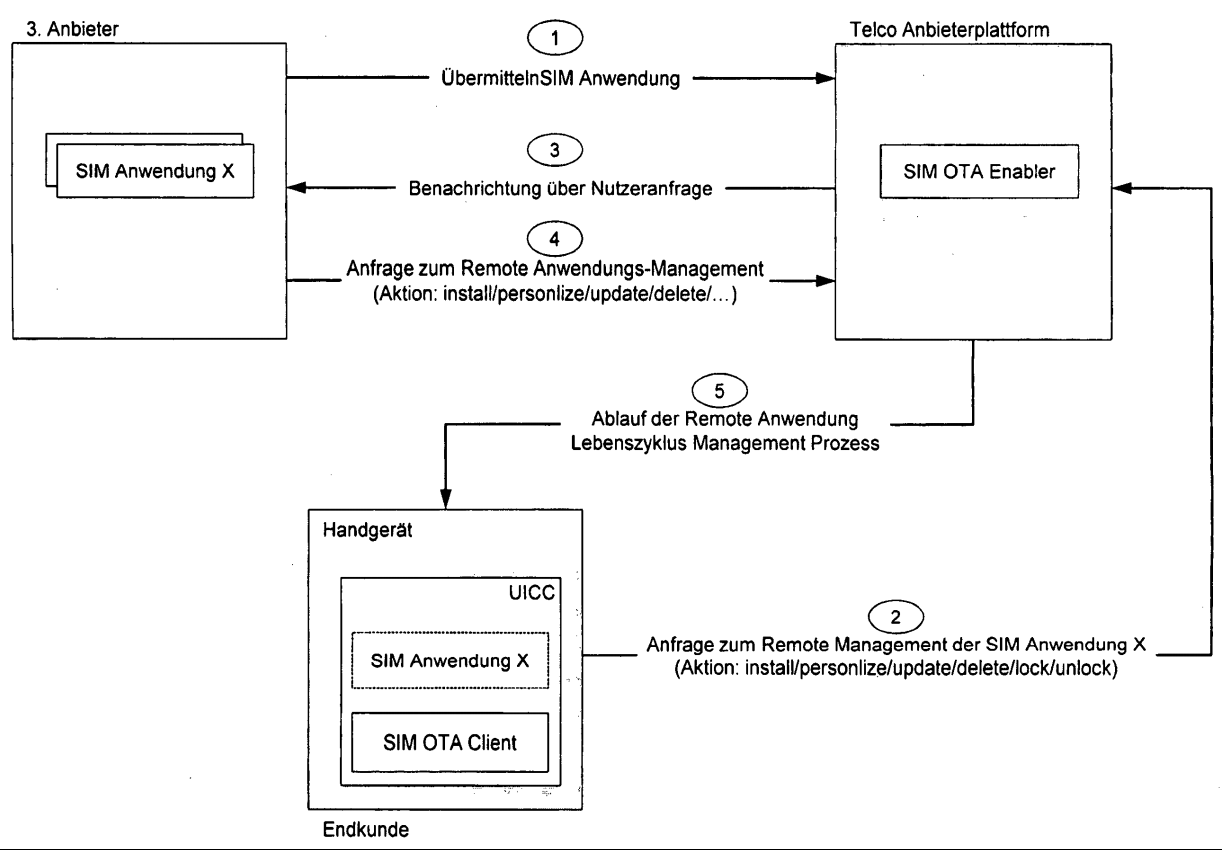
This is an opposition appeal. The European patent concerns the way how applications are loaded onto the SIM card in a mobile phone (so-called “provisioning”). In the prior art, the provisioning is done either locally via the SIM card’s contacts and a card reader, or remotely via GSM/UMTS or a similar wireless interface (so-called “over the air” or “OTA” provisioning).

According to the patent, a drawback of the prior art is that the (OTA) provisioning is controlled by the network operator, so that third parties have only limited capabilities of equipping a SIM card with application software. It is therefore the problem addressed by the patent to open up the internal process of the network provider such that third parties can install their apps on the SIM cards of the network provider’s customers.

Fig. 1 of EP 2 451 135

Here is how the invention was defined in claim 1:

  • Claim 1 in amended form (English translation by the author of this article)

Is it patentable?

In this opposition case, the opposition division had maintained the patent only in amended for according to auxiliary request 1. An appeal was filed by the opponent only.

On the opposition appeal stage, the board based its inventive-step analysis on a prior art document that already disclosed the concept of individualized application provision by a SIM OTA Enabler.

In its analysis of the differences of the claimed method over the prior art, the board first discussed whether the prior art anticipates the “forwarding” of messages to the SIM. Interestingly, the board took quite a broad interpretation of what it means to “forward” a message, which seems to rely of the board’s general understanding of the subject-matter without reference to the patent or the common general knowledge of the skilled person (all citations are translations of the German decision):

According to point 10.3 of the grounds of the appealed decision, the opposition division took the view that the “TSM” in D7 would not forward messages but would rather generate own “Perso commands” from the “Perso Data”. The forwarding of the messages would mean that the message “Ack (Perso Data)” of block 7 would have to be provided unchangedly to the SIM of the mobile terminal. Instead, the TSM of D7 unpacks the data “Perso Data” of the “Ack” message and generates different commands based on the data, which commands are then provided to the SIM of the mobile terminal. Thus, feature b4) was not disclosed in D7.

This cannot be followed. The expression “message” in claim 1 does not imply a specific limitation with regards to the underlying data packet formats or transport protocols. As explained by the appellant on page 9 of the grounds of appeal, Fig. 11 of D7 shows a forwarding by way of a bent arrow, which is the case despite a possible reformatting of the “Perso Data”.

As a result, according to the board the only difference over the closest prior art was that the SIM OTA Enabler is provided by the network provider as a server system in the network of the network provider (feature b), and that the application request is sent to the SIM OTA Enabler by a user of a SIM card (feature b2).

On the one hand, the board acknowledged that the effects of these features are expressly explained in par. [0021] of the patent. There, it is explained that the invention has “the following advantages over existing solutions”:

  1. The OTA provisioning of Javacard applications is opened to third-party providers – without having to rely on an intermediary in the sense of a Trusted Service Manager.
  2. The customer can trigger the provisioning of SIM-based Java applications him/herself.
  3. The solution can be integrated seamlessly in existing enabler platforms of the network provider.

However, the board took the view that these effects were not technical effects, but rather administrative ones:

These advantages, however, relate to administrative processes or administrative considerations rather than technical considerations. Since the distinguishing features thus do not affect technical aspects, they are taken as requirements to be fulfilled in the formulation of the objective technical problem (see T 641/00, OJ 2003, 352, Headnote II).

Therefore, the objective technical problem can be formulated … as the “implementation of a SIM/SE platform which is easier to employ on the market, i.e. the implementation of an “open ecosystem” within the network of D7, so that the network provider can provide and bill for additional services by means of the increased control over the customer. A motivation based on purely technical considerations cannot be seen.

In the end, the claimed solution was considered obvious. In the absence of additional requests on file, the patent was revoked in its entirety.

More information

You can read the whole decision here: T 1310/17 (Anwendungen auf SIM-Karten/TELEKOM) of 11.11.2020

Join us live on Clubhouse to discuss the case:

Stay in the loop

Never miss a beat by subscribing to the email newsletter. Please see our Privacy Policy.

Privacy policy
* = Required field

Checking whether a resource is likely to be available when a corresponding request is serviced: non-technical

This case is interesting for developers of online systems for selling, for example, event tickets. The basic question was whether providing a ticket sale system based on a specific queuing mechanism solves a technical problem. However, the decision also concerns whether non-technical features have to be considered regarding the assessment of novelty.

Here are the practical takeaways from the decision T 0552/14 (Queue message/TICKETMASTER) of 12.1.2021 of Technical Board of Appeal 3.5.01:

Key takeaways

Notifying a customer having requested a resource, such as an event ticket or tickets, whether the resource is likely to be available when the request is serviced is an organisational matter and thus not technical. Moreover, queuing per se is considered an administrative (or abstract mathematical) concept.

Whether non-technical features may be ignored for assessing novelty is left undecided.

The invention

The Board in charge summarized the subject-matter of underlying European patent application as follows:

1.1 The invention concerns a method of processing electronic queue data and providing queue messaging over a network. The idea is essentially to notify the customer having requested a resource, such as an event ticket or tickets, whether the resource is likely to be available when the request is serviced. The estimate is based on the number of requests in the queue and historical queue abandonment rates (and certainly also the available quantity of the resource in question). Based on the notification, the customer can decide to abandon or stay in the queue.

Figs. 1 and 1A of WO 2006/102354 A2

Here is how the invention was defined in claim 1:

  • Claim 1 (main request)

Is it patentable?

The first instance examining division rejected the present application because it would not solve a technical problem. The Board in charge generally agreed to this assessment:

2.1 The Board agrees with the examining division that a method of processing queue data comprising receiving a ticket request, estimating whether the requested ticket will be available when the request is serviced, and notifying the user if it is estimated that the ticket will not be available, does not on its own solve a technical problem. This subject-matter is, as the examining division said, an organisational matter.

2.3 (…)

Although queues may have technical applications, the act of queuing per se is an administrative (or abstract mathematical) concept. Thus, it follows that improving such a non-technical activity, by allowing it to be performed more efficiently, is not a technical problem.

Notably, the first instance examining division did not apply the well-established COMVIK approach (see T0641/00) but rejected the present application due to lack of novelty. In more detail, the examining division ignored the non-technical features of the claimed subject-matter and took only into account the technical features of claim 1 for assessing novelty:

3.1 The examining division argued that the lack of technical contribution over the prior art (a notorious computer system) resulted in a lack of novelty (Article 54(1) and (2) EPC). …

While the Board in charge agreed to the result of the examining division on the merits, it expressed some concerns whether the approach of the examining division to reject the application based on a lack of novelty was correct. Specifically, the examining division justified its reasoning by referring to three decisions, which appear to imply that only technical features may establish novelty:

3.1 … As support for this approach, the examining division referred to decisions G 2/88 (Friction reducing additive), T 172/03 (Order management/RICOH), and T 154/04 (Estimating sales activity/DUNS LICENSING ASSOCIATES).

3.2 The cited decisions indeed seem to suggest that only technical features can establish novelty. However, the individual statements made in these decisions have to be seen in the context of the decision as a whole and not just in isolation. None of the decisions applies the “approach” to a computer-implemented invention.

However, the Board came to the conclusion that from none of the three cited decisions it could be generally deduced that only technical features were to be considered for the assessment of novelty. G 2/88 only referred to the specific example of a use claim

3.3 G 2/88 includes the following statement:

“a claimed invention lacks novelty unless it includes at least one essential technical feature which distinguishes it from the state of the art”.

The statement was made in the specific context of use claims where the only novel feature lay in the purpose of the use. The Enlarged Board discussed the difference between a purpose having a technical effect, and a purpose that merely existed in the mind of the person carrying out the invention, and was therefore subjective rather than objective. While the former conferred novelty on the known use, the latter did not. The Enlarged Board of Appeal did not consider whether objectively distinguishing features involving non-technical aspects, for example computer-implemented method steps, could establish novelty over, say, a computer.

3.4 In T 172/03, the Board stated that the patentability of an invention, for which inventive step was a requirement, had to arise from features and aspects of the invention from which a technical solution to a technical problem could be inferred and which were thus of technical character (point 3).

This statement seems to suggest that novelty, which is also a patentability requirement, can be based only on technical features.

(…)

Nevertheless, the case in T 172/03 was decided on inventive step (Article 56 EPC). The Board did not elaborate further on the question of “technical novelty”.

3.5 In T 154/04, the Board summarized the case law on computer-implemented inventions. It was said that non-technical features “as such” did not provide a technical contribution to the prior art and were thus to be ignored in the assessment of novelty and inventive step (point 5(f)). However, also in T 154/04, the case was decided on other grounds than novelty.

Hence, the Board concluded that none of the three decisions could support the approach of the examining division with respect to disregarding non-technical features for the assessment of novelty. Unfortunately, the Board did not decide on this issue due to potential implications on other aspects of the EPC and, as outlined above, applied the well-established COMVIK approach to reject the application based on lack of inventive step:

3.6 The question of “technical novelty” is complex, and has potential implications on many areas of patent law, such as the assessment of the same invention in Article 87 EPC, as well as added matter under Articles 76 and 123(2) EPC.

In the present case, the Board does not need to decide on this issue, because the notorious computer system is clearly prior art under Article 54(2) EPC. Therefore, the case can be decided on inventive step.

More information

You can read the whole decision here: T 0552/14 (Queue message/TICKETMASTER) of 12.1.2021

Join Patrick Heckeler and Bastian Best on Clubhouse👋 to discuss this decision:

ESP talk

Stay in the loop

Never miss a beat by subscribing to the email newsletter. Please see our Privacy Policy.

Privacy policy
* = Required field

Zoom bounce-back effect on a touchscreen: technical

This case is interesting for UX designers. The basic question was whether a particular type of touch gesture to control the device is technical. The decision is one of the rarer cases where a “continued and/or guided human-machine interaction” was acknowledged. 

Here are the practical takeaways from the decision T 2004/17 (Zooming on touch screen/APPLE) of 10.12.2020 of Technical Board of Appeal 3.5.05:

Key takeaways

Providing continuous feedback to the user, in that there is an uninterrupted response to the user’s continued touch, and indicating an internal state of the device to the user, namely that it has reached the maximum zoom-in level for persistent display, is a technical effect.

The invention

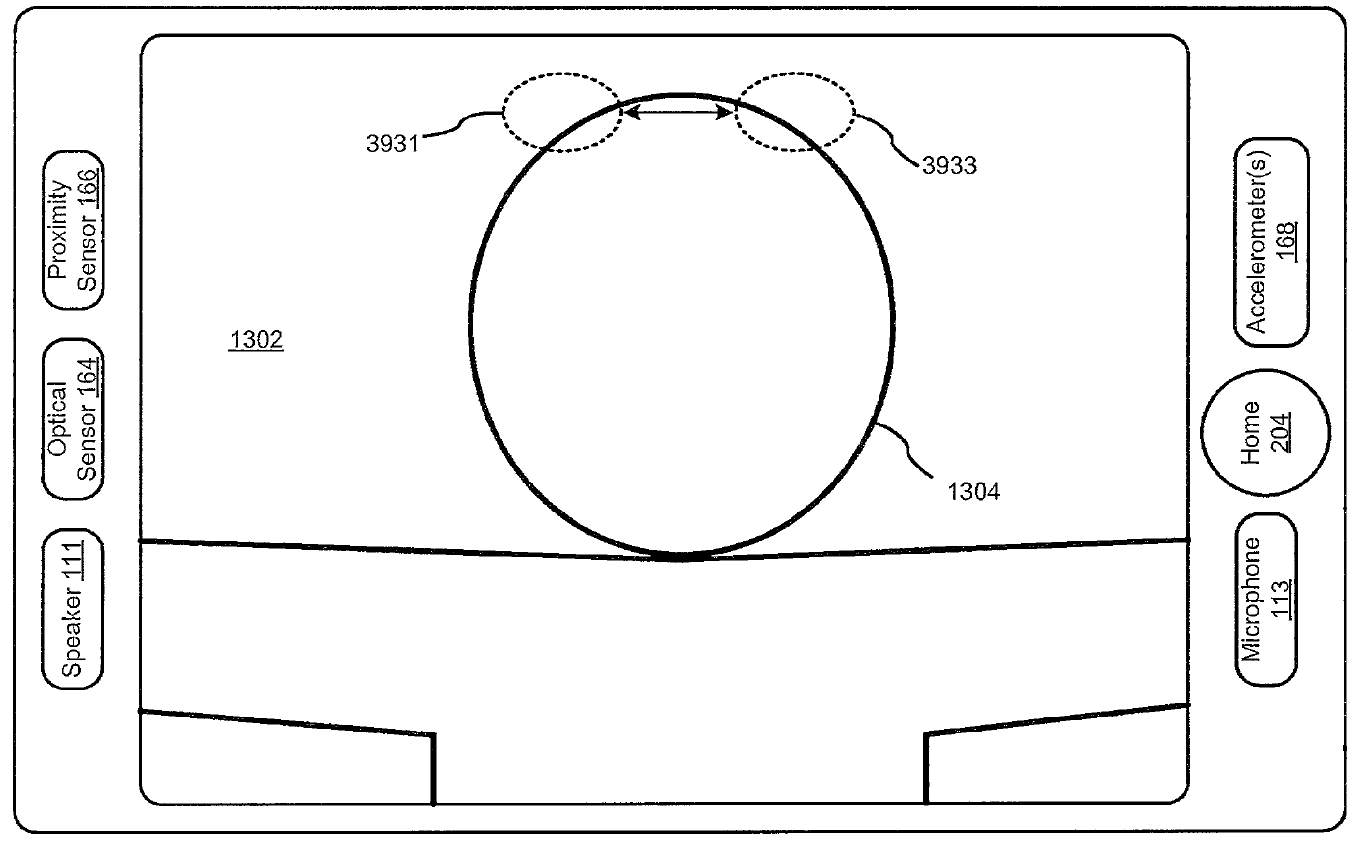
This European patent application concerns touch gestures for scaling documents on a touchscreen.

According to the description, as portable electronic devices become more compact it has become challenging to design a user interface that allows users to easily interact with a multifunction device, especially devices with smaller screens.

For example, frequently only a portion of an electronic document can be displayed on the screen at a given time, and users have to scale (i.e. magnify or de-magnify) the displayed document. But according to the application, the limitations of conventional user interfaces can cause these actions to be awkward to perform.

The aim of the claimed invention was hence to provide for easy and intuitive scaling of electronic documents on a device with a touchscreen display.

Fig. 13B of EP 2 402 851

Here is how the invention was defined in claim 1:

  • Claim 1 (main request)

Is it patentable?

The first-instance examining division had refused the patent application for lack of inventive step of the main request. The applicant pursued the same main request on the appeal.

On the appeal stage, the board considered the difference of claim 1 over the closest prior art to be that a respective portion of the electronic document is displayed at a predefined magnification if, upon detecting termination of the gesture, the magnification exceeds the predefined magnification.

The board interpreted this difference as follows:

In other words, the zoom-in level reached during the user’s gesture does not persist, upon termination of the user’s gesture, if this zoom-in level exceeds a threshold value; instead, the document is then displayed at a zoom-in level equal to this threshold value.

This was different from how this situation was handled in the prior art:

In contrast, D3 implements a hard stop, wherein if a maximum zoom-in level is reached during the gesture, the zooming-in action is stopped during the gesture and the document is persistently displayed at this maximum zoom-in level even if the user’s gesture is continued.

The question was then, of course, whether this difference was a technical one. The board took the position that it was:

The technical effect of this distinguishing feature is that feedback is provided continuously to the user, in that there is an uninterrupted response to the user’s continued touch, and that an internal state of the device, namely that it has reached the maximum zoom-in level for persistent display, is indicated to the user by providing the zoom bounce-back effect. In contrast, the device of D3 does not respond to the user’s gesture when the hard stop is reached, and the user does not know whether the fact that zooming has stopped is due to a malfunction of the device or not.

The objective technical problem can thus be formulated as how to indicate to the user that the maximum allowable persistent zoom-in level has been reached while providing continuous visual feedback to indicate that the device is responding to the user’s gesture.

Being a technical feature, the remaining question was then whether it would have been obvious for the skilled person to provide the claimed zoom bounce-back feature:

Nothing in D3 itself prompts the skilled person to provide an over-zooming feature and a zoom bounce-back feature as defined in claim 1.

Nor would the skilled person be prompted to look at D2, since this document does not disclose a touch-screen display wherein continuous zooming in a document is performed by a user’s continuous gesture. There is thus no disclosure in D2 of over-zooming and zoom bounce-back in response to a user’s gesture.

Moreover, the appellant argued persuasively that in D3 the absence of feedback when the hard stop is reached may confuse the user, who may then repeatedly attempt to perform the zoom-in gesture without receiving any response before understanding that the document cannot be viewed at a greater zoom level. In contrast, the zoom bounce-back in claim 1 definitely provides clear feedback that the maximum zoom level has been reached and that no additional input is required.

Therefore, the board held that claim 1 involved an inventive step.

The appealed decision was set aside and the case was remitted to the first instance with the order to grant a patent.

More information

You can read the whole decision here: T 2004/17 (Zooming on touch screen/APPLE) of 10.12.2020

Stay in the loop

Never miss a beat by subscribing to the email newsletter. Please see our Privacy Policy.

Privacy policy
* = Required field